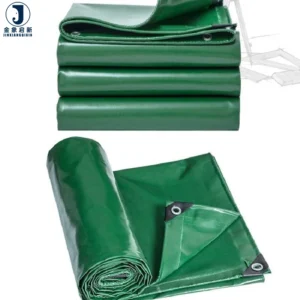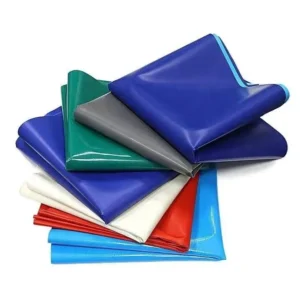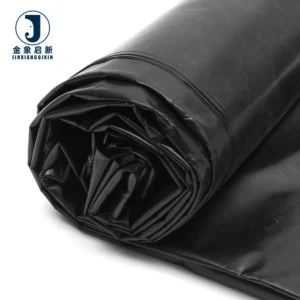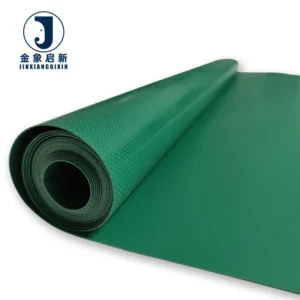
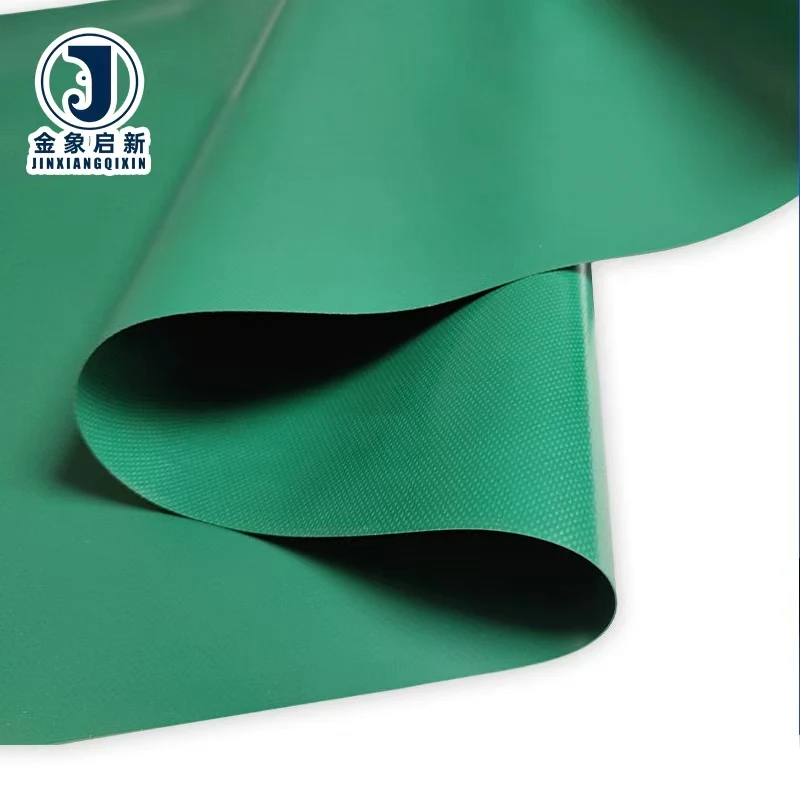
Deep Coating Process Control — Nearly 30 years of PVC coating expertise ensures precise GSM consistency and base fabric adhesion across every roll of PVC Coated Tarpaulin produced.
Technical Specifications
| Parameter | Value |
|---|---|
| Product Type | PVC Coated Tarpaulin Roll |
| Base Fabric Denier | 500D×840D / 500D×1000D / 1000D×1000D / 1000D×1300D / 1300D×1300D / 1000D×2000D |
| Mesh Density | 20×20 / 30×19 / 30×15 |
| Weight Range | 350 / 400 / 420 / 500 / 600 / 650 / 750 / 900 GSM |
| Thickness Range | 0.29 mm / 0.32 mm / 0.38 mm / 0.44 mm / 0.46 mm / 0.55 mm / 0.65 mm |
| Tensile Strength (Warp) | 1650 / 1800 / 1850 / 2050 / 2500 / 2550 / 2750 / 3900 N |
| Tensile Strength (Weft) | 1600 / 1700 / 1750 / 1900 / 2200 / 2250 / 2850 / 3500 N |
| Coating Material | PVC & Polyester |
| Flame Retardant | Available in flame retardant grades — confirm the grade required for your market |
| UV Treatment | Anti-UV treatment available (test basis not stated) |
| Waterproof Rating | Water Resistant / Waterproof |
| Brittle Temperature | ≤ -50 to -60 ℃ |
| Softening Temperature | ≥ 80 ℃ |
| Edge Treatment | High-temperature heat-sealed seamless edge wrapping, reinforced corners |
| Eyelet Specification | 3 cm enlarged aluminum alloy eyelets with 5 mm rope |
| Standards | ISO and CE certified facility |
Application Suitability
| Application | Exposure & Requirement |
|---|---|
| Truck Side Curtains | Constant flexing at fold lines, road debris abrasion, prolonged UV exposure, wind load tension |
| Trailer & Container Covers | Tie-down strap pressure, weather cycling, mechanical stress at corners and eyelet points |
| Awning & Tent Fabric | Tension frame loading, sun exposure, rain pooling, repeated assembly and disassembly |
| Construction Site Covers | Equipment impact, puncture risk from sharp materials, wind uplift, dust containment |
| Inflatable & Membrane Structures | Internal air pressure stress, welded seam integrity, fire compliance for enclosed spaces |
| Pond & Reservoir Liners | Permanent water immersion, soil chemistry contact, puncture from substrate |
Why Base Fabric Denier Matters More Than GSM Alone
Tensile strength is engineered at the yarn level before coating begins.
Technical buyers often specify PVC coated tarpaulin by weight alone, assuming higher GSM means stronger fabric. In practice, a 500 GSM roll woven from 1000D×1000D yarns can outperform a 650 GSM roll made from 500D base fabric in both tensile and tear resistance. The coating adds weight and waterproofing but contributes minimally to structural strength. [NEED_CITE: relationship between base fabric denier and tensile performance in coated textiles per ISO 1421]
When the base fabric denier is undersized for the application, the coating may hold together while the yarn structure fails internally — visible as stretching, deformation, or catastrophic tearing at stress points. Specifying by denier and mesh density alongside GSM gives a complete picture of how the PVC coated tarpaulin base fabric denier GSM tensile strength relationship performs under real load conditions.
How Yarn Count and Mesh Density Define Structural Performance
The base fabric construction — expressed as denier pairs like 500D×840D or 1000D×1000D — determines the load-bearing skeleton of the PVC coated tarpaulin roll. Higher denier yarns provide greater individual filament strength, while mesh density values such as 20×20 or 30×19 indicate how many yarns are packed per unit area in warp and weft directions. A fabric with 1000D×2000D yarns at 30×15 density delivers high warp strength with optimized weft coverage, suited to applications where directional loading is predictable.
Coating Weight, Thickness and Their Relationship to Tensile Behaviour
The PVC coating layer serves as the environmental shield — providing waterproofing, UV screening and surface durability — but its contribution to tensile performance is secondary to the base fabric. Thickness values from 0.29 mm to 0.65 mm across the available GSM range reflect the combined build of base fabric and coating. [NEED_CITE: coating adhesion and peel strength test methods for PVC coated polyester fabrics] Thicker coatings improve abrasion resistance and weld seam adhesion but add stiffness, which affects how the PVC Coated Tarpaulin behaves during fabrication and installation on curved or tensioned frames.
Reading the Specification Table: What the Numbers Mean for Your Application
Selecting the correct grade requires matching three parameters simultaneously: base fabric denier for structural strength, mesh density for dimensional stability, and GSM for overall weight and coating thickness. A 500 GSM grade at 0.44 mm thickness with 1000D×1000D construction suits medium-duty truck covers where flexibility and weight are balanced. Heavy-duty applications such as mining equipment wraps or container roofs demand the upper GSM tiers with 1300D×1300D or 1000D×2000D base fabrics, where tensile values reach 2750 N warp and above. The brittle temperature rating of ≤ -50 to -60 ℃ confirms the PVC compound remains flexible in cold climate deployment, while the softening threshold of ≥ 80 ℃ defines the upper service boundary before dimensional stability degrades.
What Happens When the Specification Does Not Match the Application
Underspecifying the base fabric denier for a high-tension application leads to progressive yarn failure that is not immediately visible — the coating surface appears intact while the internal structure weakens, eventually resulting in sudden tearing under wind load or tie-down stress. [NEED_CITE: coated fabric failure modes at stress concentrations and flex points] Conversely, overspecifying GSM for an application that requires frequent handling adds unnecessary weight and stiffness, increasing labour cost during installation and accelerating fatigue at fold lines. Colour inconsistency between rolls in the same order becomes visible once panels are installed side by side on a truck fleet or building facade, forcing costly replacement or acceptance of a non-uniform appearance.
Why Procurement Verification Starts Before the Roll Ships
Every roll of PVC coated tarpaulin roll produced at this facility passes through 100% pre-shipment inspection, with GSM, base fabric denier and coating weight verified against the material specification sheet before dispatch. Three full production lines and 36 sets of professional equipment support volume consistency across large orders. The 10-person R&D team handles grade selection, custom width development and sample preparation — samples are developed within days for custom requirements. Dedicated QA/QC at every production stage ensures the PVC Coated Tarpaulin base fabric denier GSM tensile strength data on the specification sheet matches the physical roll received.
Documentation & Verification
- Material specification sheet stating GSM, base fabric denier and coating composition per roll
- Weight verification measured per roll against the quoted GSM before dispatch
- Test report for UV and flame retardant grades supplied where applicable at inquiry
- ISO and CE certificates included with customs documentation and certificate of origin
- Pre-shipment inspection record confirming 100% check before container loading
Fabrication, Handling & Storage
- Heat sealing parameters must match the PVC coating thickness to achieve full seam adhesion without burning through the base fabric layer
- Eyelet placement at 3 cm enlarged aluminum alloy spacing distributes tie-down load across the reinforced hem area
- Store rolls horizontally on pallets to prevent edge compression marks that transfer to the coated surface
- Allow cold-stored rolls to reach ambient temperature before unrolling to prevent coating micro-cracking at low temperatures
- Cut panels with allowance for weld seam overlap — high-temperature heat-sealed edge wrapping requires clean, straight edges for consistent bonding
Inquiry Guidance for Technical Buyers
Provide the intended application and primary exposure conditions — mechanical stress type, environmental factors and any fire or safety compliance requirements for your market. Specify the target GSM range, preferred base fabric denier and required roll width to enable accurate grade recommendation. Indicate whether you need roll stock for in-house fabrication or finished panels with eyelets and hem treatment, and confirm if colour matching or flame retardant certification is required for your project.
Frequently Asked Questions
Q: How is GSM verified against the quoted specification before shipment?
A: Each roll is weighed and measured during the pre-shipment inspection process. The GSM is calculated from the measured weight and area, then recorded on the inspection report that accompanies the shipment. This allows incoming quality checks at your facility against the material specification sheet provided with the order.
Q: Which test standard applies to the tensile strength values listed in the specification?
A: The tensile strength values in newtons are measured under controlled conditions at the production facility. For projects requiring third-party certification or compliance with a specific international test standard, confirm the required standard at inquiry stage so testing can be arranged through an accredited laboratory before production.
Q: What flame retardant grades are available and how do I confirm compliance?
A: Flame retardant PVC coated tarpaulin is available in multiple grades. The applicable grade depends on the fire safety regulations in your target market and the end-use application. Specify the required standard at inquiry — such as building code classification or transport sector requirements — and the matching grade and test report will be confirmed before production.
Q: How does base fabric denier affect heat sealing and welding performance?
A: Higher denier base fabrics require adjusted heat sealing temperature and dwell time to ensure the PVC coating fuses fully without damaging the yarn structure. The 1000D and above grades may need wider weld overlap and controlled pressure settings. Request fabrication guidance for your specific denier selection to optimize weld seam strength.
Q: What roll width and length options are available for container loading?
A: Roll widths and lengths are configured based on the selected GSM grade and your fabrication requirements. Container loading plans are calculated by roll count and weight to maximize utilization. Provide your preferred dimensions and annual volume at inquiry stage for packing optimization and lead time confirmation.