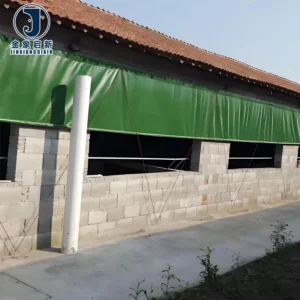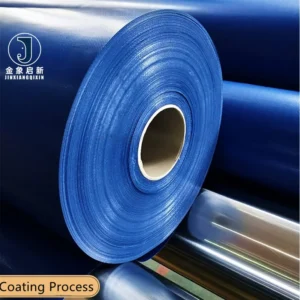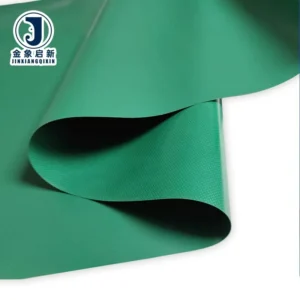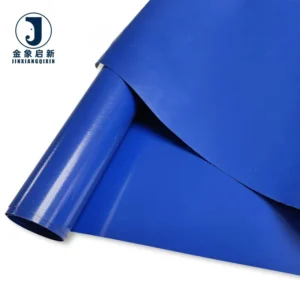
Deep Process Control Over Coating Weight — Every roll of this PVC Coated Tarpaulin 650 gsm knife coated fabric undergoes stage-by-stage QA to ensure the stated 650GSM is what arrives at your dock, not a lighter substitute.
Technical Specifications
| Parameter | Value |
|---|---|
| Product Type | PVC Coated Tarpaulin Roll |
| Specification | 650GSM 1000D1000D 2323 1.50*50M/R |
| Weight | 650GSM |
| Base Fabric Denier | 1000D*1000D |
| Mesh Count | 23*23 |
| Coating Material | PVC |
| Roll Width | 1.50M |
| Roll Length | 50M |
| Surface Finish | Glossy (matte available on request) |
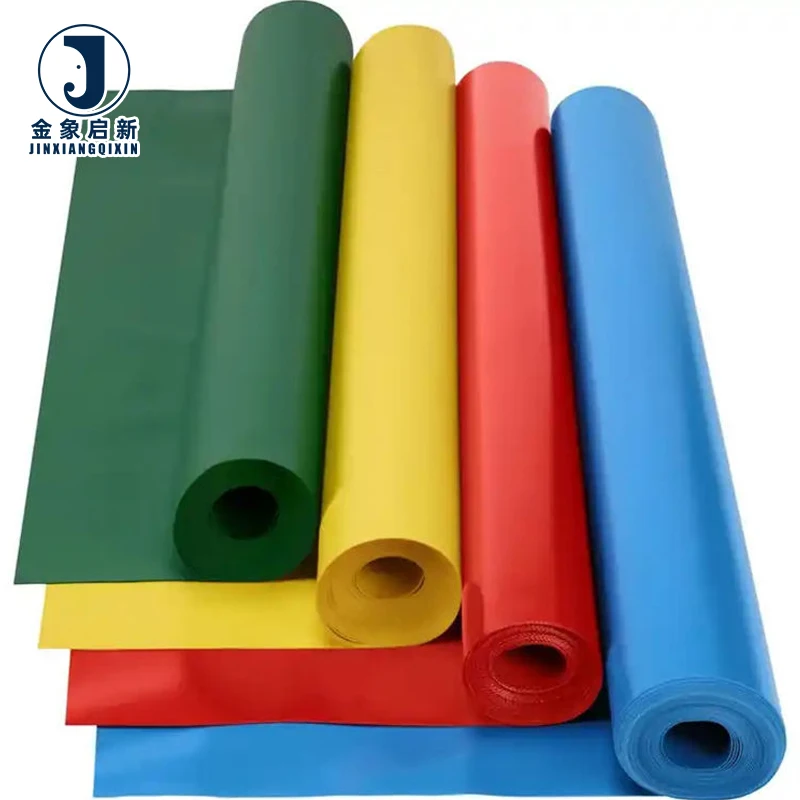
| Colour Options | Blue, yellow, black, green, white, etc. |
| Temperature Range | -15°C to 70°C |
| Key Features | Waterproof, UV treated (test basis not stated in source), FR treated (grade not stated in source), anti-fungal treated |
| Coating Method | Knife coated |
| Environmental Note | Eco-friendly formulation |
| Certifications | ISO 14001, ISO 45001, CE, RoHS |
Application Suitability
| Application | Exposure & Requirement |
|---|---|
| Truck side curtains and trailer covers | Constant flexing at fold lines, road debris abrasion, weather and UV exposure |
| Tent and awning structural panels | Tensile load under wind, water ingress resistance, weld seam integrity |
| Equipment and construction site covers | Puncture from sharp edges, prolonged outdoor weathering, dust and rain |
| Agricultural and aquaculture covers | Permanent moisture contact, fungal growth environment, chemical exposure from fertilizers |
| Tarpaulin converter stock for custom fabrication | Batch colour consistency, predictable weld behaviour, roll-to-roll GSM uniformity |
Why a Quoted GSM Does Not Guarantee the Fabric You Receive
The only way to confirm 650GSM is to weigh a measured sample from the roll you received, not trust the label on the bale.
Technical buyers who specify a PVC Coated Tarpaulin 650 gsm knife coated fabric often discover at incoming inspection that the material is lighter than agreed. The shortfall may be invisible to the eye — a few grams per square metre less coating on each side — but it changes how the fabric behaves at the weld line and under tensile load. [NEED_CITE: tensile and tear test methods for coated fabrics per ISO 1421] When coating weight drops, the PVC layer becomes thinner, reducing abrasion resistance at flex points and lowering the temperature threshold at which the coating stiffens in cold weather. This page lays out the exact construction so you can cross-check denier, mesh count and coating weight against what arrives in your warehouse.
How Coating Adhesion Affects Weld Seam Integrity
The bond between the PVC coating and the 1000D×1000D polyester base fabric determines whether a hot-air weld holds or peels under load. When adhesion is weak, heat applied during welding can separate the coating from the substrate before the two panels fuse together. This PVC coated tarpaulin 650 gsm knife coated material uses a knife-over-edge coating process that forces PVC paste into the interstices of the 23×23 mesh, creating a mechanical lock that supports consistent weld strength across the roll width.
Base Fabric Construction and Tear Propagation Resistance
A 1000D×1000D denier with 23×23 mesh count means each square inch of base fabric contains a dense grid of high-tenacity polyester yarns. When a puncture or cut occurs in the field, the dense weave limits how far the tear can propagate before it encounters a yarn intersection that arrests it. [NEED_CITE: coated fabric tear propagation behaviour per DIN 53354] This matters most in truck side curtains, where a small cut from a forklift tine can become a long rip if the base fabric lacks the density to stop it.
Reading the Specification Sheet: What Each Number Controls
The 650GSM total weight is the sum of base fabric and coating on both sides. A heavier coating improves water shedding and abrasion resistance but adds stiffness, which affects how the roll handles on a cutting table. The 1000D denier governs tensile strength — thicker yarns carry more load before breaking. The 23×23 mesh count controls how tightly those yarns are woven; a tighter mesh resists tear propagation but requires more coating paste to fill the gaps, which is why this PVC Coated Tarpaulin 650 gsm knife coated fabric balances weight and weave density for general-purpose cover applications. The -15°C to 70°C temperature range reflects the PVC formulation’s flexibility envelope — below the lower limit, the coating stiffens and may crack if folded sharply. Glossy finish sheds dirt more easily than matte and accepts heat-transfer printing, while matte reduces glare on large installed panels.
The Hidden Cost of Specifying on Price Alone
When a buyer selects a roll based on the lowest per-kilogram quote, the supplier may compensate by reducing coating thickness while keeping the base fabric denier the same. The roll still reads as 1000D on a burn test, but the thinner PVC layer wears through faster at tie-down contact points and fold lines. [NEED_CITE: PVC coating thickness and abrasion resistance correlation in coated polyester fabrics] In flame-retardant applications, specifying FR without naming a grade means the supplier may ship a treatment level that does not pass the fire test your local authority requires, resulting in rejected installation and full replacement cost. Colour variation between rolls in the same container is another consequence of cost-driven production — when pigment dosing is not controlled batch-to-batch, two panels welded side by side show a visible shade difference once installed on a truck or building.
Why Technical Buyers Source This Roll Stock Here
Nearly 30 years of focused production on coated fabric means the coating-to-substrate ratio on every roll of PVC Coated Tarpaulin 650 gsm knife coated material is controlled by operators who understand how paste viscosity and knife gap affect final weight. Three full production lines and 36 sets of professional equipment provide the capacity to fill a container order within standard lead times. A 10-person R&D team develops custom colour matches and surface finishes, producing samples within days rather than weeks. Dedicated QA/QC at every production stage — from base fabric inspection through coating, curing and rolling — ensures 100% inspection before any roll is packed for dispatch.
Documentation & Verification
- Material specification sheet stating 650GSM, 1000D×1000D denier, 23×23 mesh count and glossy finish per roll
- UV and flame-retardant test reports available — confirm the grade required for your market before ordering
- Pre-shipment inspection record with coating weight verification against stated GSM per batch
- Roll packing list with individual roll weight and measured length for receiving inspection
- ISO 14001, ISO 45001, CE and RoHS certificates available on request
- Certificate of origin and customs documentation for international shipment
Fabrication, Handling & Storage
- Hot-air weld temperature and speed should be calibrated to the 650GSM coating thickness before production runs begin
- Store rolls upright on end caps to prevent flat-spotting the 1.50M width across the 50M length
- Allow cold rolls to acclimate to workshop temperature before unrolling to avoid coating crack at -15°C stiffness
- Use a sharp blade for cutting to prevent fraying the 1000D×1000D base fabric at panel edges
- Glossy surface accepts solvent-based and heat-transfer inks — test adhesion before full print run
- Clean with mild detergent; avoid solvents that degrade the PVC coating layer
Before You Request a Quote
Provide your end-use application and the environmental conditions the fabric will face — outdoor exposure duration, temperature extremes, and whether the panels will be welded or sewn. Specify the flame-retardant grade or UV test standard your market requires so we can match the treatment to your compliance obligation. Confirm whether you need standard 1.50M × 50M rolls or custom widths and lengths, and whether colour matching against a Pantone or RAL reference is necessary for batch consistency.
Frequently Asked Questions
Q: How do I verify the 650GSM coating weight when the rolls arrive?
A: Cut a measured sample from the roll — a 100mm × 100mm square is standard — and weigh it on a calibrated scale. Compare the result to the specification sheet supplied with the shipment. Our pre-shipment inspection record documents the coating weight per batch, giving you a baseline to cross-check against incoming material.
Q: What flame-retardant grade is available for this PVC coated tarpaulin construction?
A: Flame-retardant treatment is available in multiple grades. The specific grade and test standard must be confirmed before production to match your local fire safety requirements. Request the test report for the grade you need — such as B1 per DIN 4102 or M2 — and we will supply documentation with the batch.
Q: What is the basis for the UV treatment claim on this roll stock?
A: UV stabilizers are incorporated into the PVC coating formulation. The specific test duration or standard is not stated in the base specification. If your application requires a documented UV test result — for example, a specified number of hours under xenon-arc exposure — confirm the standard before ordering so the correct treatment level is applied.
Q: How does the 650GSM / 1000D×1000D construction behave during hot-air welding?
A: The knife-coated PVC layer fuses predictably under standard hot-air weld parameters. The 23×23 mesh density provides a stable substrate that resists distortion under heat. We recommend running a test weld on a sample piece to set temperature and speed before beginning production, especially at seam intersections.
Q: Is colour consistent across all rolls in a single bulk order?
A: Rolls within one production batch are manufactured from the same pigment mix to maintain colour uniformity. For orders spanning multiple batches, we recommend requesting a colour swatch from each batch before dispatch. Specify your colour reference — Pantone, RAL or physical sample — at the inquiry stage to ensure a match.