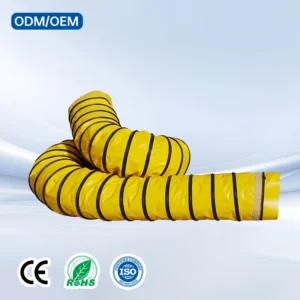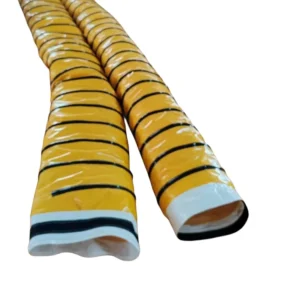
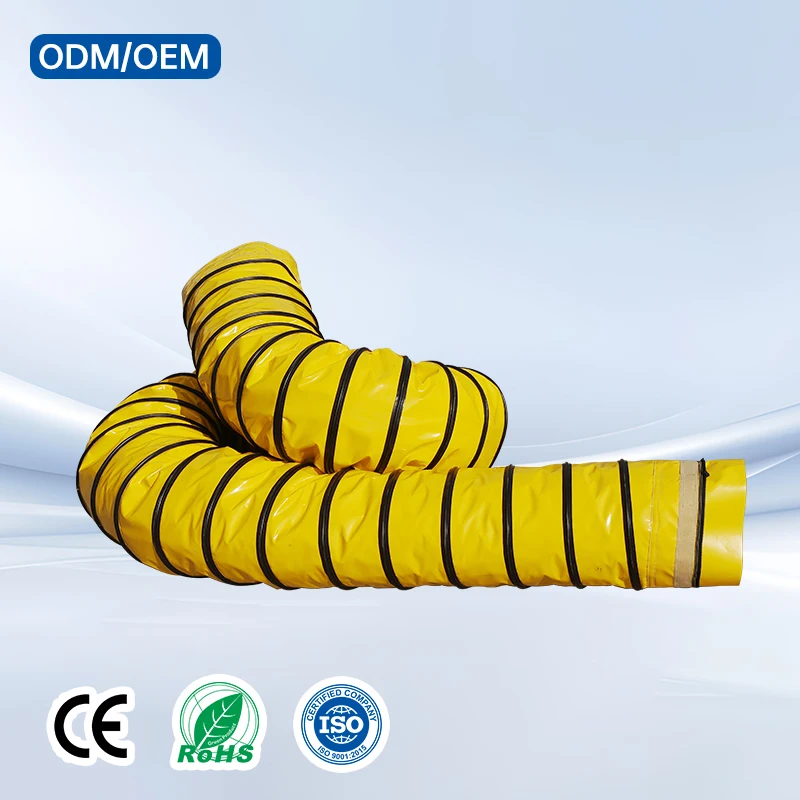
Precision Coating Control — Each Aviation PCA Air Duct Hose undergoes 100% pre-shipment inspection with verified insulation layer integrity and seam welding traceability, ensuring compliance with airfield operational mandates.
Technical Specifications
| Parameter | Value |
|---|---|
| Product Type | Aircraft PCA Air Duct |
| Coating Material | PVC |
| Base Fabric | Fabric-reinforced layer |
| Insulation Layer | Aluminum foil bubble film |
| Temperature Range | -30°C to 150°C |
| Connection Type | Zipper, Velcro |
| Outer Layer Color | Yellow-black alternating (high visibility) |
| Anti-Mildew | Stated (grade not stated in source) |
| Waterproof | Stated (rating not stated in source) |
| Flame Retardant | Available in flame retardant grades — confirm the grade required for your market |
| Standards | ISO, CE (specific standard numbers to be confirmed per order) |
Application Suitability
| Application | Exposure & Requirement |
|---|---|
| Airport apron ground handling | Constant UV exposure, fuel and de-icing fluid contact, high-visibility safety compliance, repeated folding and deployment |
| PCA unit to aircraft cabin interface | Thermal insulation across -30°C to 150°C, flexible routing under pressure, rapid connect-disconnect cycles between turns |
| Military and charter airfield operations | Rapid-deploy climate control, harsh weather storage, rough terrain transport and handling |
| Aviation GSE manufacturing integration | OEM fitment to mobile air conditioning units, custom diameter and length matching, branded outer layer options |
Why Certified Fire Performance Matters More Than Stated Compliance on the Apron
Every aviation duct we ship carries test documentation matching the compliance standard your airfield mandates — not a generic claim.
Ground support crews operate under strict airfield safety regulations. When a ventilation duct arrives without verifiable fire-retardant or anti-static certification, the entire PCA system can be rejected at commissioning. We have seen airfield operators face operational delays because the duct paperwork did not match the specified aviation standard [NEED_CITE: aviation ground equipment fire safety classification standards]. This Aviation PCA Air Duct fire retardant / anti-static / certified product line addresses that gap directly by tying each shipment to documented test results.
Thermal Insulation Engineered for Continuous Apron Operation
The aluminum foil bubble film insulation layer maintains thermal performance across the full -30°C to 150°C operating range. This means pre-conditioned air reaches the aircraft cabin at the required temperature regardless of ambient apron conditions. The insulation is bonded between the PVC coated outer shell and the inner liner, preventing delamination during repeated flex cycles.
Rapid-Deploy Connection System for Turnaround Efficiency
Zipper and Velcro connections allow ground crews to attach and detach the Aviation PCA Air Duct fire retardant / anti-static / certified hose without tools during aircraft turns. This connection method supports the high-frequency deployment rhythm of busy airport aprons where turnaround time directly impacts gate utilization. The system also enables sectional replacement if a single segment sustains damage [NEED_CITE: airport ground support equipment turnaround cycle requirements].
Reading the Material Specification Beyond the Surface Color
The PVC coated fabric-reinforced outer layer provides the structural backbone, while the base fabric denier and weave density determine how the duct handles internal pressure and external abrasion. Coating weight and adhesion strength govern whether the outer shell resists peeling at fold points after months of daily deployment. The aluminum foil bubble insulation thickness directly correlates to thermal retention efficiency over long duct runs from PCA unit to aircraft door. Temperature range ratings must account for both continuous operating exposure and peak transient conditions during hot-day ramp operations. Buyers specifying material should request the base fabric specification sheet alongside the coating weight data to evaluate the composite system as a whole.
What Happens When Duct Specifications Do Not Match the Airfield Mandate
A duct that lacks the fire-retardant grade required by local airfield regulations will fail safety inspection, grounding the PCA unit until replacement arrives. Anti-static performance below the threshold specified for fuel-adjacent operations creates an ignition risk that no amount of operational caution can fully mitigate. Insulation that degrades outside its rated temperature band leads to cabin air arriving above or below the required setpoint, triggering passenger comfort complaints and potential equipment strain. Welded seams that separate under high-pressure airflow create hotspots and pressure drops that reduce the entire system efficiency [NEED_CITE: flexible duct seam failure modes under positive pressure cycling].
Procurement Backed by Process Control, Not Promotional Claims
Three full production lines and 36 sets of professional equipment support batch consistency across repeat orders of Aviation PCA Air Duct fire retardant / anti-static / certified hose. A dedicated 10-person R&D team handles diameter customization, connection interface matching, and pattern printing for fleet identification. QA/QC checkpoints at every production stage verify coating adhesion, insulation bonding, and seam integrity before the duct moves to packing. Samples are developed within days for custom diameter or connection configuration, allowing buyers to validate fitment before committing to full production volume. Pre-shipment inspection covers 100% of finished ducts, not a statistical sample.
Documentation & Verification
- Material specification sheet stating base fabric denier, coating weight, and insulation layer composition
- Fire-retardant test report with grade and applicable aviation standard referenced on the document
- Anti-static surface resistance measurement report with test methodology and measured values
- Pre-shipment inspection record covering insulation integrity, seam welding, and connector functionality
- ISO and CE certificates with scope covering coated fabric and flexible duct manufacturing
Fabrication, Handling & Storage
- Heat welding parameters must match the PVC coating thickness to ensure seam strength equals fabric strength
- Zipper and Velcro connection zones require reinforced stitching to withstand repeated attach-detach cycles
- Store folded ducts in dry conditions to preserve anti-mildew treatment effectiveness on the PVC outer layer
- Avoid dragging the yellow-black outer layer across rough apron surfaces to prevent coating abrasion
- Inspect aluminum foil insulation layer for punctures before each deployment to maintain thermal performance
- Clean PVC surface with mild detergent only; solvents may degrade the coating adhesion over time
Specify Your Airfield Requirements Before Quoting
Provide your PCA unit model, aircraft types served, and the specific fire-retardant or anti-static standard mandated by your airfield authority. Confirm required duct diameter, section length, and whether you need zipper-Velcro connections or an alternative interface. State your annual volume estimate and whether logo or pattern printing is required for fleet identification across multiple stations.
Frequently Asked Questions
Q: What fire-retardant grade does the PCA duct meet, and which aviation standard does it comply with?
A: Our Aviation PCA Air Duct fire retardant / anti-static / certified range is available in multiple fire-retardant grades. The specific grade and corresponding aviation standard are confirmed during the inquiry stage based on your airfield regulatory requirements. We provide the test report with the grade and standard reference before order confirmation.
Q: How is anti-static performance verified, and what surface resistance value is guaranteed?
A: Anti-static performance is measured using standardized surface resistance testing methods. The measured value is documented in the test report supplied with each shipment. Confirm your airfield’s required surface resistance threshold during inquiry so we match the correct material formulation.
Q: Can the duct diameter and length be customized to fit specific PCA unit and aircraft interface dimensions?
A: Yes. Diameter, section length, and connection interface are fully customizable to match your PCA unit output and aircraft door connection geometry. Our R&D team develops samples within days for fitment validation before full production begins.
Q: How are welded seams tested to prevent delamination under high-pressure airflow and flexing?
A: Welded seams undergo peel strength testing during in-process quality checks. The 100% pre-shipment inspection verifies that seam integrity meets specification across the full duct length, particularly at connection zones and flex points where pressure cycling concentrates stress.