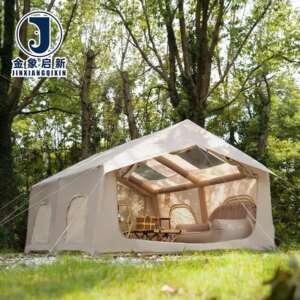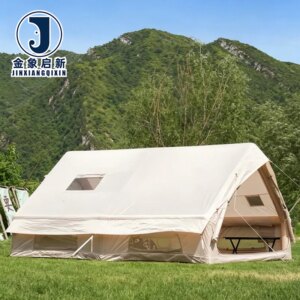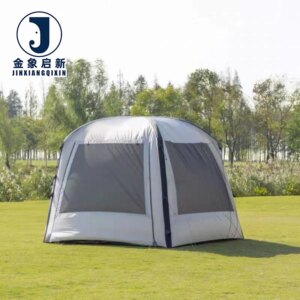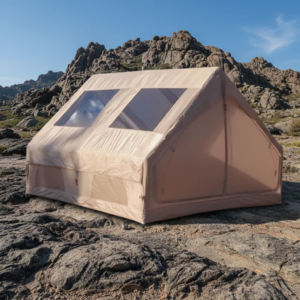
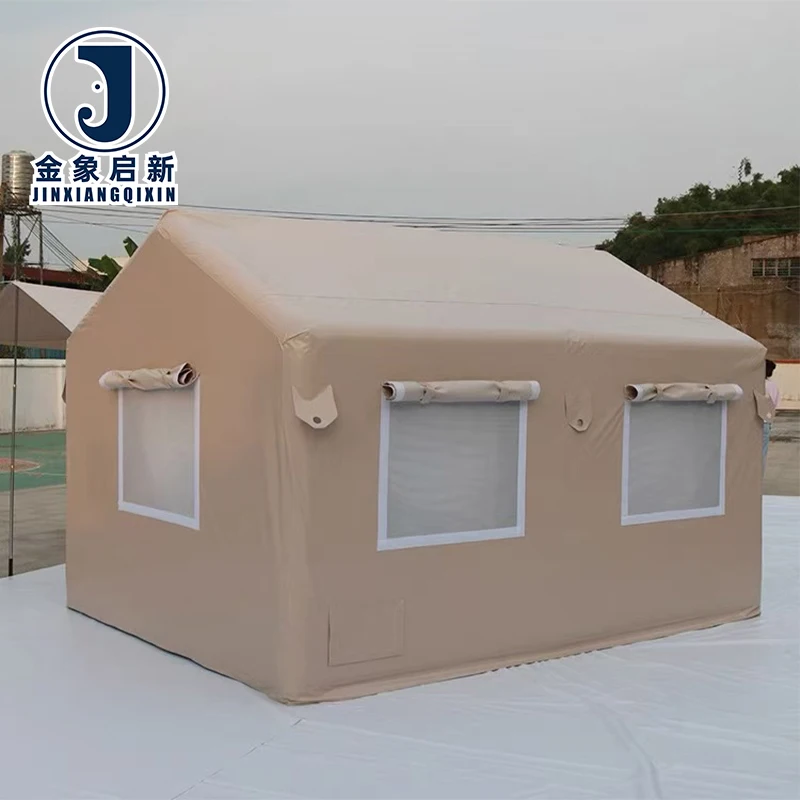
Deep coating control — three full production lines with dedicated QA&QC staff ensure PVC tarpaulin adhesion and weld integrity for inflatable membrane structures.
Technical Specifications
| Parameter | Value |
|---|---|
| Product Type | Inflatable Tent |
| Core Material | PVC Tarpaulin |
| Capacity | 6-8 Persons |
| Deployment Feature | Quick Automatic Opening |
| Design Configuration | Four-Season, Single Layer Construction, Extended Type |
| Key Features | Waterproof, UV-resistant (test basis not stated), Tear-resistant |
| Customization | OEM & ODM (material selection, design, pattern printing) |
| Standards | ISO9001, ISO14001, ISO45001, CE |
Application Suitability
| Application | Exposure & Requirement |
|---|---|
| Temporary site offices during infrastructure projects | Continuous inflation cycles, wind loading on membrane faces, abrasion at ground contact points |
| Emergency response command centers for disaster recovery | Rapid deployment under time pressure, exposure to rain and debris, need for airtight seam integrity |
| Equipment storage facilities in remote construction areas | UV exposure over extended weeks, dust ingress prevention, thermal fluctuation across seasons |
| Temporary warehousing for logistics hubs | Forklift proximity and puncture risk, large membrane spans requiring consistent inflation pressure |
Why Welded Seams Fail Before the PVC Inflatable Tent Fabric Does
The membrane is only as strong as the coating’s ability to fuse under heat and pressure at the joint.
When inflatable structures lose pressure, it is rarely the PVC tarpaulin body that ruptures first. The failure concentrates at the heat-welded seams where the inflation tubes bend and flex under cyclic stress. If the coating formulation does not match the welding temperature profile, the bond degrades long before the base fabric reaches its tensile limit. Technical buyers specifying PVC Inflatable Tent aftermarket supplier fabric need to verify that the coating chemistry supports reliable thermal fusion across the entire seam length, not just at the center of the joint [NEED_CITE: tensile and peel test methods for coated fabrics per ISO 1421].
Coating Adhesion and Cyclic Inflation Stress
Inflatable shelters experience repeated pressurization and deflation, placing the PVC coating under constant mechanical cycling. The bond between the coating layer and the polyester base fabric determines whether the membrane holds airtight through hundreds of setup and teardown sequences. Our PVC tarpaulin production controls coating weight and adhesion at each stage across three dedicated production lines, ensuring the material maintains bond integrity when the inflatable tubes flex at junction points. Specifying PVC Inflatable Tent aftermarket supplier material requires confirming that the coating formulation supports the welding parameters used by your fabrication team.
Waterproof and Tear-Resistant Membrane Behaviour
A single-layer inflatable structure depends entirely on the coated fabric to block water ingress while resisting puncture from ground contact and handling. The tear-resistant property of the PVC tarpaulin prevents small nicks from propagating into full membrane splits under inflation pressure. This is critical for emergency command centers deployed on uneven terrain where sharp aggregate contacts the base. Waterproof performance is validated through production-stage inspection rather than end-user assumption [NEED_CITE: hydrostatic pressure testing standards for coated tarpaulin].
Understanding Base Fabric Denier and Coating Weight for Inflatable Tubes
The structural rigidity of an inflated membrane depends on two interrelated properties: the tensile strength of the polyester base fabric and the stiffness contributed by the PVC coating mass. A higher-denier yarn in the warp and weft directions provides the skeleton that resists stretching under internal pressure, while the coating weight determines how much the fabric resists creasing at fold lines during packing and deployment. When evaluating PVC Inflatable Tent aftermarket supplier options, buyers must consider both values together — a lightweight base fabric with heavy coating may crack at fold points, while a heavy base with thin coating may lack the airtightness needed for reliable inflation. The GSM and denier options available for inflatable membrane structures should be matched to the expected inflation pressure and deployment frequency of the end application [NEED_CITE: relationship between base fabric denier and coated fabric tensile performance].
The Hidden Cost of Specifying Inflatable Shelter Fabric on GSM Alone
Buyers who select inflatable membrane material based solely on quoted GSM often discover that the arriving rolls feel lighter and handle differently than the approved sample. This discrepancy traces back to inconsistent coating application across the production run, where some sections receive less PVC mass than others. In inflatable structures, uneven coating weight leads to weak spots that fail under inflation pressure at the seams. Colour variation between rolls compounds the problem when multiple membrane panels are welded side by side on a large emergency shelter — the visual mismatch becomes obvious once the structure is erected [NEED_CITE: batch consistency challenges in PVC coated fabric production].
Why Technical Buyers Source PVC Inflatable Tent Fabric Here
Process control over coating weight and adhesion is maintained across 36 sets of professional equipment, giving fabricators confidence that the PVC tarpaulin behaves predictably under their welding parameters. A 10-technician R&D team handles material selection, prototype development, and pattern printing for OEM partners engineering custom inflatable shelter systems. Full-process inspection with dedicated QA&QC staff covers every production stage, and each unit undergoes pre-shipment verification before dispatch. ISO9001, ISO14001, ISO45001 and CE certification underpin the quality management framework supporting these controls.
Documentation & Verification
- Material specification sheet stating base fabric denier, coating weight and GSM for the inflatable membrane batch
- Test report for UV-resistant grade applicable to the specific production run where requested
- ISO and CE certificates accompanying each shipment with pre-shipment inspection record
- Dimensional and airtightness verification report covering seam strength and pressure test per unit
- Roll packing list and certificate of origin for customs clearance support
Fabrication, Handling & Storage
- Heat-welding parameters must be matched to the specific PVC coating formulation to ensure seam adhesion across inflatable tube joints
- Store rolls upright on pallets in a dry, shaded environment to prevent creasing that could weaken the coated surface
- Avoid dragging the PVC tarpaulin membrane across abrasive surfaces during on-site deployment to preserve tear-resistant integrity
- Clean inflated shelters with mild detergent only, as harsh solvents may degrade the waterproof coating layer
- Inspect welded seams after each inflation cycle for signs of delamination at high-stress junction points
Requesting a Quotation for Inflatable Membrane Fabric
Technical buyers and fabricators should specify the intended inflation pressure range, expected deployment frequency, and the fire-retardant or anti-static grades required by the target market. Provide the membrane dimensions, preferred base fabric denier, and any pattern printing or branding requirements so that the R&D team can develop a matched sample before production release. Confirm whether you require rolls for in-house fabrication or finished inflatable units with welded seams and pressure testing completed.
Frequently Asked Questions
Q: What GSM and base fabric denier options are available for the inflatable membrane structure?
A: We supply PVC tarpaulin for inflatable shelters across multiple GSM and denier configurations suited to different inflation pressures and deployment conditions. The R&D team recommends the optimal combination based on your structure’s span, expected wind loading, and frequency of inflation cycles. Request a material specification sheet with denier and coating weight values matched to your application.
Q: Can I receive a sample with my custom dimensions before committing to a full production order?
A: Yes, the 10-technician R&D team develops samples within days for custom sizing, colour references, and pattern printing requirements. Prototype evaluation allows fabricators to verify welding behaviour and airtightness on their own equipment before mass production release. Sample lead times are confirmed at the quotation stage.
Q: How is seam strength and airtightness verified before shipment?
A: Each inflatable unit undergoes pressure testing and dimensional verification as part of the 100% pre-shipment inspection. Dedicated QA&QC staff check welded seam integrity at junction points where cyclic stress concentrates during inflation and deflation. Inspection records covering seam strength and airtightness are included in the shipment documentation.
Q: What documentation ships with each inflatable fabric order?
A: Orders are accompanied by a material specification sheet, test reports for applicable treatments such as UV resistance, ISO and CE certificates, a pre-shipment inspection record, roll packing list, and certificate of origin. Additional customs support documentation is provided based on the destination market’s import requirements.
Q: What is the typical lead time for custom sizing and pattern printing orders?
A: Lead times for custom inflatable membrane fabric depend on the complexity of sizing, colour matching, and printing requirements. The production facility operates three full lines with 36 sets of equipment to support bulk capacity with reliable scheduling. Confirm lead times during the quotation stage once specifications and sample approval are complete.