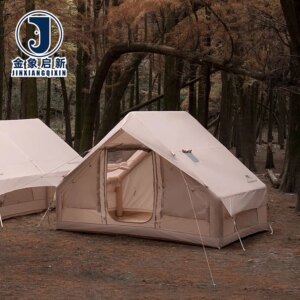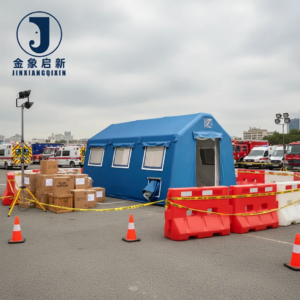
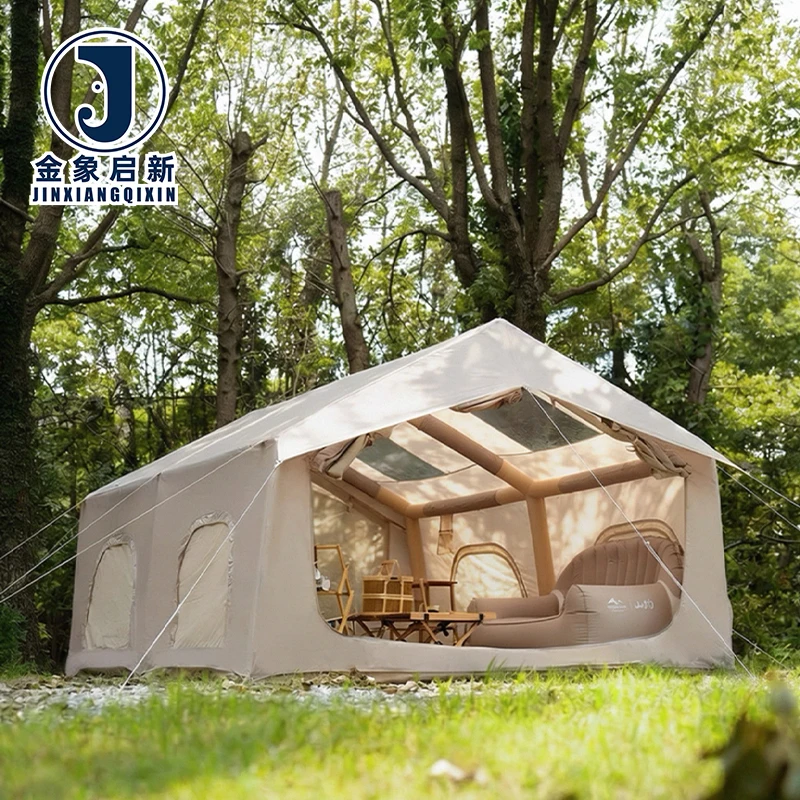
Coating Weight Control — PVC tarpaulin production on three dedicated lines with in-process adhesion testing ensures the coated fabric for inflatable tent structures arrives at the stated specification, batch after batch.
Technical Specifications
| Parameter | Value |
|---|---|
| Product Type | Inflatable Tent |
| Core Material | PVC tarpaulin |
| Construction | Single layer |
| Capacity | 1-12 Person |
| Product Form | Inflatable structure with automatic opening mechanism |
| Waterproof | Fully waterproof coated construction |
| UV Treatment | UV-resistant (test basis not stated — confirm validation standard required for your market) |
| Flame Retardant | Fire-retardant (grade not stated — confirm the grade required for your target market) |
| Anti-Static | Anti-static (standard and surface resistance not stated — specify compliance requirement at inquiry) |
| Tear Resistance | Tear-resistant (test standard not stated — request test report for your application) |
| Customization | OEM & ODM with sample customization and pattern printing |
| Production Facility | 9,180 m² with 3 full production lines |
| Processing Equipment | 36 sets of professional processing equipment |
| R&D Team | 10 technicians |
| Quality Control | Full-process inspection with dedicated QA & QC staff |
| Certifications | ISO 9001, ISO 14001, ISO 45001, CE |
Application Suitability
| Application | Exposure & Requirement |
|---|---|
| Disaster relief shelters | Rapid deployment, repeated inflation cycles, harsh weather exposure, fire safety compliance for occupied spaces |
| Construction site operations | Dust, debris impact, temporary enclosure against wind and rain, site safety colour visibility |
| Emergency response preparedness | Stockpiled storage, periodic deployment drills, multi-season outdoor exposure |
| Outdoor event management | High-visibility branding, crowd-adjacent fire safety requirements, frequent setup and teardown |
| Industrial storage enclosures | Chemical dust, UV degradation from prolonged sun exposure, structural load from wind |
| Temporary facility setup in remote locations | Transport damage risk, limited repair resources, self-supporting inflatable frame reliance |
Why "Fire-Retardant" Without a Grade Creates Compliance Risk on Site
When an inflatable tent arrives at a construction site or disaster relief staging area with only the words "fire-retardant" on the documentation, safety inspectors have no basis to approve it. Fire-retardant performance must be specified by grade and verified against a named test standard before the material enters production. Procurement teams routinely discover this gap at the moment of site inspection, when the shelter is already paid for and deployed. [NEED_CITE: fire classification standards for temporary structures and inflatable shelters]
The Inflatable Tent Fabric material PVC coating must carry documentation that names the exact standard — whether that is a national building code classification, a textile flammability method, or an industry-specific protocol for temporary occupied structures. Without that traceability, the entire shipment can be rejected at the gate, leaving project timelines exposed and replacement costs unbudgeted.
Coating Adhesion and Its Role in Inflatable Frame Integrity
The air-holding tubes of an inflatable tent depend entirely on the bond between the PVC coating and the base fabric. When coating adhesion is inconsistent, the layers separate under repeated inflation pressure, creating delamination channels that propagate with each setup and teardown cycle. The Inflatable Tent Fabric material PVC coating applied across three controlled production lines maintains consistent adhesion through monitored coating weight and curing parameters.
Delamination is not always visible from the surface. A tube that holds air during factory testing may begin to delaminate after a few field deployments, particularly at the weld seams where heat and pressure concentrate. Process control at the coating stage — not just at the welding stage — determines whether the inflatable frame survives its intended service life.
Fire-Retardant and Anti-static Treatment for Occupied Inflatable Structures
Inflatable tents used for disaster relief and emergency response house people in enclosed spaces where ignition sources include heating equipment, electrical distribution, and cooking facilities. Fire-retardant treatment must be specified to the grade demanded by the destination market, and anti-static treatment must be verified against a defined surface resistance standard where flammable atmospheres are possible. [NEED_CITE: anti-static surface resistance requirements for temporary industrial enclosures]
Treatment chemicals are incorporated during the coating process, not applied as a surface finish after production. This means the fire-retardant and anti-static properties must be confirmed at the formulation stage, with test samples drawn from the same production batch as the finished Inflatable Tent Fabric material PVC coating rolls. Batch-level traceability is the only way to ensure the material installed on site matches the material that was tested.
Understanding How Base Fabric and Coating Weight Work Together
Reading PVC Tarpaulin Specs Beyond the GSM Number
GSM alone does not predict how a PVC tarpaulin will perform in an inflatable tent application. The base fabric denier and weave density determine the tensile and tear baseline, while the coating weight adds waterproofing, UV protection, and treatment chemical loading. A lighter base fabric with a heavier coating may show acceptable GSM on paper but will tear more easily at stress points than a denser base with a lighter coating.
Coating method matters equally. Knife-over-roll coating builds thickness with each pass and produces strong adhesion suitable for welded seams on inflatable tubes. Lamination methods bond pre-formed films to the base and can be more economical but may show lower peel strength at the high-stress flex zones where inflatable frames bend during deployment.
The single-layer construction of this inflatable tent fabric balances transport weight against structural demands. Specifiers should evaluate tensile and tear test data alongside GSM, and request samples welded into tube sections to verify seam behaviour under inflation pressure before committing to bulk production. [NEED_CITE: tensile and tear test methods for coated fabrics per ISO 1421]
Coating and Base Fabric Cross-Section Detail
What Happens When Inflatable Tent Material Is Specified Incorrectly
A fire-retardant grade that does not match the destination country’s building code for temporary structures means the tent cannot be legally occupied, regardless of how well it performs in other respects. This rejection typically occurs after the tent has been manufactured, shipped, and inflated on site — multiplying the cost of correction.
Anti-static treatment specified without a target surface resistance value leaves compliance to chance. In industrial settings where inflatable enclosures protect against dust or chemical exposure, inadequate anti-static performance creates ignition risk that no amount of post-production treatment can correct. Colour inconsistency across units in the same order is visible immediately when multiple tents are erected side by side at an event or relief site, undermining professional credibility and sometimes triggering contractual penalties. [NEED_CITE: batch colour consistency standards for coated fabric orders]
Weld seam failure at the tube junction — where inflation pressure and mechanical flex concentrate — is often traced back to coating formulation rather than welding technique. If the PVC coating does not reach proper flow temperature at the weld interface, the seam will peel under load long before the fabric itself shows wear.
Why Source Inflatable Tent PVC Fabric From This Facility
Three full production lines and 36 sets of processing equipment provide the capacity to deliver batch-consistent Inflatable Tent Fabric material PVC coating across container-volume orders, with in-process QA checkpoints at every coating and finishing stage.
A 10-technician R&D team handles material formulation for specific fire-retardant and anti-static grades, develops welded tube samples for seam testing, and supports pattern printing for branded inflatable structures — all before bulk production begins.
Dedicated QA and QC staff conduct full-process inspection rather than end-of-line sampling, meaning coating weight, adhesion, and treatment integrity are verified at the point of production, not just before packing.
Nearly 30 years of coated fabric process control translates into repeatable coating formulations that hold their specified properties across production runs — critical for buyers who re-order the same inflatable tent material quarterly.
Sample development within days allows specifiers to weld test tubes, verify inflation behaviour, and confirm colour match before committing to the full order quantity.
Documentation & Verification
- Material specification sheet stating PVC coating weight, base fabric denier, and colour reference per batch
- Fire-retardant test report linked to production batch number for site inspector review
- Anti-static surface resistance data provided where treatment is specified for industrial inflatable use
- Pre-shipment inspection record confirming seam integrity and waterproof performance per unit
- ISO 9001, ISO 14001, ISO 45001, and CE certificates included in shipment documentation package
- Certificate of origin and customs documentation prepared for cross-border dispatch
Fabrication, Handling & Storage
- Weld inflatable tube seams using hot-air or wedge methods matched to the PVC coating thickness and formulation
- Reinforce tube junction and valve attachment points with additional PVC patches to distribute inflation load
- Store rolls vertically on pallets in a dry, shaded area to prevent coating adhesion loss from compression creasing
- Allow cold-stored rolls to reach ambient temperature before unrolling to avoid coating crack at low-temperature flex
- Use mild detergent and soft brush for cleaning; avoid solvent-based agents that may degrade the PVC coating surface
- Repair minor field punctures with PVC-compatible adhesive patches cut from the same coating specification material
What to Include in Your Material Inquiry
Specify the fire-retardant grade and anti-static standard required by your destination market so the coating formulation can be matched before sampling. Provide the inflatable tent tube diameter, wall thickness preference, and target colour or print design to allow the R&D team to develop accurate samples. Indicate whether you require roll stock for your own fabrication or finished inflatable structures with welded seams and valve fittings, along with estimated annual volume to align production scheduling.
Frequently Asked Questions
Q: What fire-retardant grade options are available for inflatable tent PVC fabric?
A: Fire-retardant treatment is available in multiple grades, but the correct grade depends on the fire safety code applicable in your destination market and the intended use classification of the inflatable structure. Provide your local regulatory requirement or the project specification at inquiry stage so the coating formulation can be matched and tested against that standard before production begins.
Q: How is anti-static performance verified on the finished inflatable tent material?
A: Anti-static treatment is incorporated during the PVC coating process, and surface resistance measurement is conducted on samples drawn from the production batch. The applicable standard and target resistance range should be specified at inquiry so the correct treatment chemistry is selected and test results are included with shipment documentation.
Q: How do you ensure GSM and coating weight match the quotation on arrival?
A: Every production batch undergoes in-process coating weight verification and 100% pre-shipment inspection. The material specification sheet included with each order states the actual GSM, coating weight, and base fabric denier measured during production, allowing you to verify the received material against the quoted specification at your receiving dock.
Q: Can I receive welded tube samples before placing a bulk roll order?
A: Yes. The R&D team produces welded tube samples from your specified PVC coating formulation, allowing you to test inflation behaviour, seam strength at flex points, and colour accuracy before committing to bulk production. Sample turnaround is typically within days of specification confirmation.
Q: What documentation ships with each inflatable tent fabric order?
A: Each order includes a material specification sheet with batch-specific GSM and coating data, fire-retardant and anti-static test reports where applicable, pre-shipment inspection records, ISO and CE certificates, certificate of origin, and a roll packing list. Additional compliance documents can be prepared based on your destination market requirements.