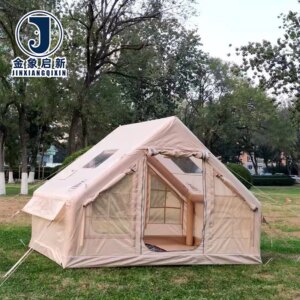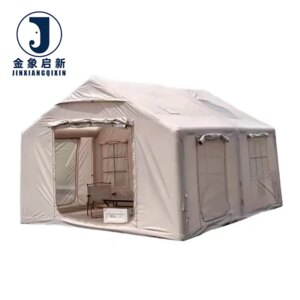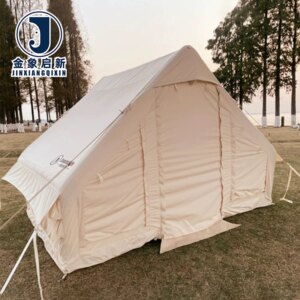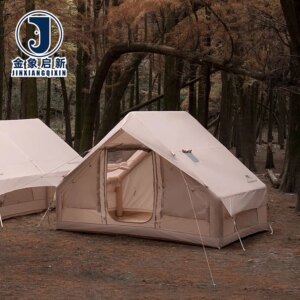
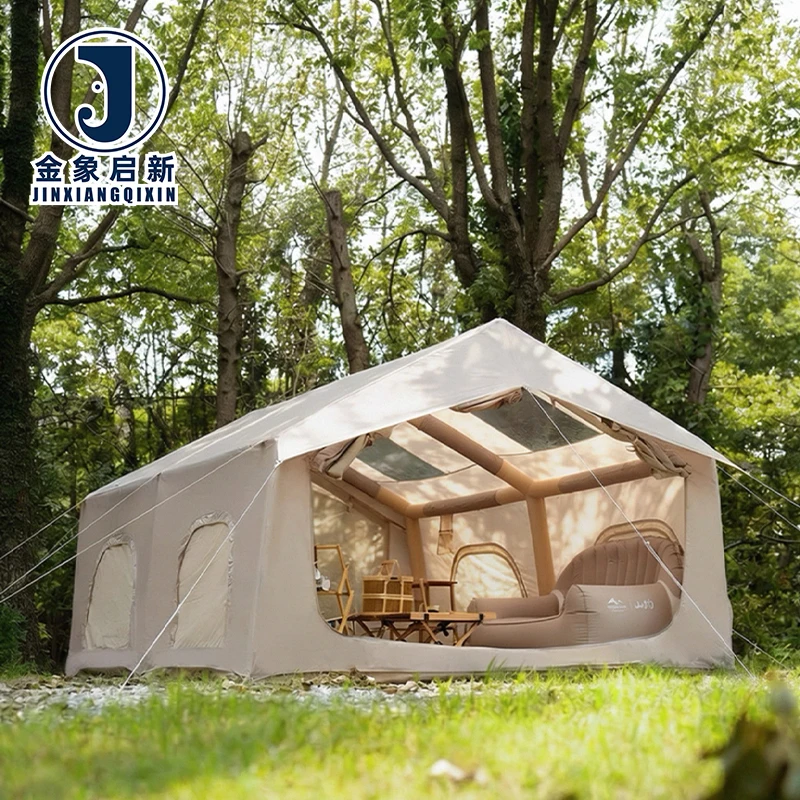
Process Control Mastery — nearly 30 years focused on coated fabric delivers deep control over coating weight and adhesion, critical for inflatable membrane performance under sustained internal pressure.
Technical Specifications
| Parameter | Value |
|---|---|
| Product Type | Inflatable Tent |
| Core Material | PVC tarpaulin |
| Waterproof | Yes |
| UV-resistant | Available — test basis not stated, confirm standard required for your market |
| Tear-resistant | Available — test standard not stated, request batch-specific test report |
| Flame-retardant | Available — grade not stated, confirm the grade required for your market |
| Anti-static | Available — surface resistance or standard not stated, verify against site requirements |
| Product Form | Inflatable structure with automatic opening mechanism |
| Capacity | 1-12 Person |
| Construction | Single layer |
| Customization | OEM & ODM (sample customization, pattern printing) |
| Standards | ISO9001, ISO14001, ISO45001, CE |
Application Suitability
| Application | Exposure & Requirement |
|---|---|
| Construction site operations | Wind loading, UV exposure, mechanical abrasion from equipment contact, rapid deployment demand |
| Disaster relief shelter | Immediate deployment under adverse weather, repeated inflation cycles, hygiene-sensitive environment |
| Emergency response preparedness | Storage across temperature extremes, rapid inflation integrity, flame safety in mixed-use zones |
| Outdoor event management | Crowd proximity fire safety, UV and moisture exposure, visual branding requirements |
| Industrial storage | Dust and water ingress protection, extended static inflation, forklift and material contact risk |
| Temporary facility setup in remote locations | Transport vibration, self-supporting structural demand, limited maintenance access |
Why "Inflatable Tent Fabric Material and Coating" Claims Fail Without Documented Proof
Every performance claim on inflatable tent fabric material and coating must carry a traceable test basis — otherwise the buyer carries the compliance risk.
Sourcing PVC inflatable tent fabric for industrial shelter projects often means reviewing data sheets filled with adjectives instead of numbers. A supplier states "fire retardant" but provides no grade, leaving the buyer to discover at site inspection that the fabric does not meet local fire codes. [NEED_CITE: flame retardant classification systems and regional building code requirements for temporary structures] Another common gap appears when UV resistance is declared without a test report, and the membrane degrades visibly within the first season of outdoor deployment. For inflatable tent fabric material and coating procurement, the only defensible position is documented, batch-specific testing that maps directly to the regulatory and environmental demands of the installation site.
Coating Weight and Adhesion: The Structural Backbone of Inflatable Chambers
Inflatable structures depend entirely on internal air pressure to maintain shape, which means the PVC coating must bond to the base fabric with sufficient peel strength to resist delamination under continuous stress. The coating method — whether knife-over-roll, lamination or calendering — directly determines how well the membrane holds at welded seams, the most vulnerable point in any inflatable chamber. Inflatable tent fabric material and coating selection should always specify both the GSM and the adhesion method, because a heavy coating applied with poor adhesion will fail at the weld line before the fabric body itself shows wear.
Base Fabric Construction and Its Role in Pressure Containment
The denier of the base yarn and the density of the weave dictate how the fabric distributes the hoop stress generated inside inflated tubes. A loosely woven base allows the coating to push through under pressure, creating thin spots that accelerate UV degradation and reduce tear propagation resistance. [NEED_CITE: tensile and tear test methods for coated fabrics per ISO 1421] When specifying inflatable tent fabric material and coating for large-capacity shelters rated at 1-12 persons, the base fabric must be matched to the expected inflation pressure and the maximum anticipated wind load to prevent panel distortion.
Interpreting the Specification Sheet for Inflatable Membrane Applications
The relationship between GSM, base fabric density and final tensile performance is not linear. A higher GSM achieved by adding filler to the coating compound rather than increasing base yarn count will produce a heavier fabric that tears more easily along the weft. Coating adhesion strength, measured as peel resistance between the PVC layer and the base textile, governs how well heat-welded seams on inflatable chambers survive repeated inflation and deflation cycles. Surface finish — glossy or matte — affects both cleanability in disaster relief environments and the adhesion of printed branding for event shelters. Flame-retardant and anti-static treatments are available in varying grades; the correct selection depends entirely on the fire code and electrostatic sensitivity requirements of the destination market, so always request the specific test standard that applies.
The Hidden Cost of Specifying Inflatable Membrane on Price Alone
When procurement decisions rest on quoted GSM without independent verification, the delivered fabric often arrives lighter than agreed, and the inflatable structure cannot hold pressure reliably under wind load. A flame-retardant claim unsupported by a test report matching the site’s jurisdiction means the entire shelter fails inspection upon arrival, triggering costly replacement and project delay. [NEED_CITE: common failure modes in coated fabric specifications for temporary industrial shelters] Batch-to-batch colour variation across a multi-tent order becomes visible only after installation, forcing the contractor to replace panels on a live site. These consequences compound quickly because inflatable structures are safety-critical — a seam or membrane failure does not merely inconvenience the user, it endangers the occupants.
Why Technical Buyers Source Inflatable Fabric Through This Facility
Deep process control over PVC coating weight and adhesion, maintained across three full production lines and 36 sets of professional equipment, ensures that every roll meets the stated specification without drift. A 10-person R&D team handles material selection, pattern printing and sample development for custom inflatable membrane requirements, with samples developed within days rather than weeks. Dedicated QA and QC staff inspect at every production stage, including 100% pre-shipment inspection that catches dimensional deviation and seam integrity issues before dispatch. Nearly 30 years of focused coated-fabric manufacturing means the process parameters for inflatable tent fabric material and coating are established from long production history, not trial runs. Full customization — from colour matching to OEM branding — is handled in-house without outsourcing critical coating steps.
Documentation & Verification
- Material specification sheet stating GSM, base fabric construction, coating method and colour reference for the inflatable membrane
- Test report for UV and flame-retardant grades where applicable — request batch-specific documentation tied to your order
- 100% pre-shipment inspection record covering dimensional accuracy and seam integrity of inflatable chamber sections
- ISO9001, ISO14001, ISO45001 and CE certificates confirming certified production management systems
- Certificate of origin and customs documentation supporting export clearance for North American and European markets
- Roll packing list with weight and dimensions for container loading planning
Fabrication, Handling & Storage
- Set heat-welding temperature and dwell time based on the PVC coating thickness to avoid burning through single-layer inflatable panels
- Reinforce all tie-down and valve attachment points with additional PVC patches bonded to the base fabric weave
- Store rolls upright on pallets in dry conditions to prevent permanent creasing that weakens the coating at fold lines
- Allow cold-stored fabric to reach ambient temperature before unrolling to prevent cracking of the PVC coating surface
- Use only PVC-compatible cleaners on the glossy or matte surface to preserve coating integrity and flame-retardant treatment
- Repair minor field punctures with PVC-compatible adhesive patches cut from remnant material matching the base fabric denier
Moving Your Inflatable Tent Fabric Project from Inquiry to Production
Share the intended deployment environment — wind zone, UV exposure duration, temperature range and proximity to ignition sources — so the correct base fabric and treatment combination can be recommended. Specify the target market’s fire classification and any anti-static requirements so the appropriate grade is applied and documented from the start. Indicate whether you need rolls for in-house fabrication or finished inflatable tent panels with welded seams and valve ports, along with estimated annual volume and colour or branding requirements.
Frequently Asked Questions
Q: How is the GSM of inflatable tent fabric verified and what does it indicate for tensile performance?
A: GSM is verified by cutting a measured sample from each production roll and weighing it against the stated specification. However, GSM alone does not determine tensile strength — the base fabric denier and weave density contribute equally. A heavier coating with a weak base will tear more easily than a balanced construction. Request the full material specification sheet showing both coating weight and base fabric details.
Q: What flame-retardant grades are available and which test standards apply to inflatable structures?
A: Flame-retardant treatment is available in multiple grades to match different regional fire codes. The applicable standard depends on the destination market and the structure’s classification as a temporary building. Confirm the required test standard for your jurisdiction before production begins so the correct additive package is applied and a matching test report is included with your shipment.
Q: What is the test basis for anti-UV treatment and how does it relate to field service life?
A: Anti-UV treatment is incorporated during the coating process, but the specific test basis and exposure rating must be confirmed for your deployment environment. Request a test report tied to a recognised accelerated weathering standard to validate suitability. Field service life depends on installation latitude, orientation and seasonal exposure patterns, so project-level validation is recommended.
Q: How does coating adhesion affect weld and seam behaviour in inflatable chamber construction?
A: Coating adhesion — the bond strength between the PVC layer and the base textile — determines whether a heat-welded seam holds under the internal pressure of an inflated chamber. Poor adhesion causes the coating to peel away from the base at the weld line, leading to air leakage. Specify peel strength requirements and verify them through sample testing before committing to full production.
Q: Can base fabric denier and weave be customised for specific pressure and load requirements?
A: Yes, base fabric denier and weave density can be adjusted to match the inflation pressure and structural load demands of your specific tent design. Higher denier yarns with tighter weaves improve tear propagation resistance for larger inflatable chambers. Submit your engineering requirements including target inflation pressure and maximum wind load for a material recommendation and sample development.