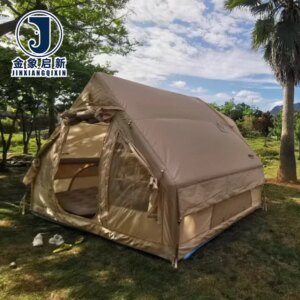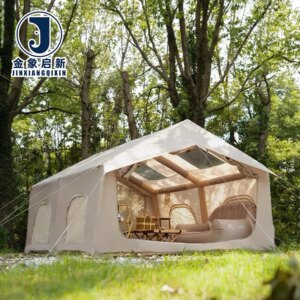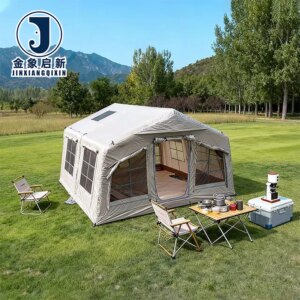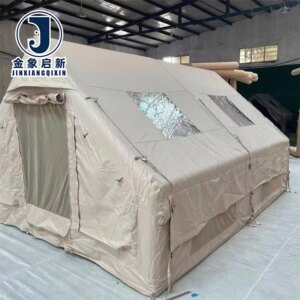
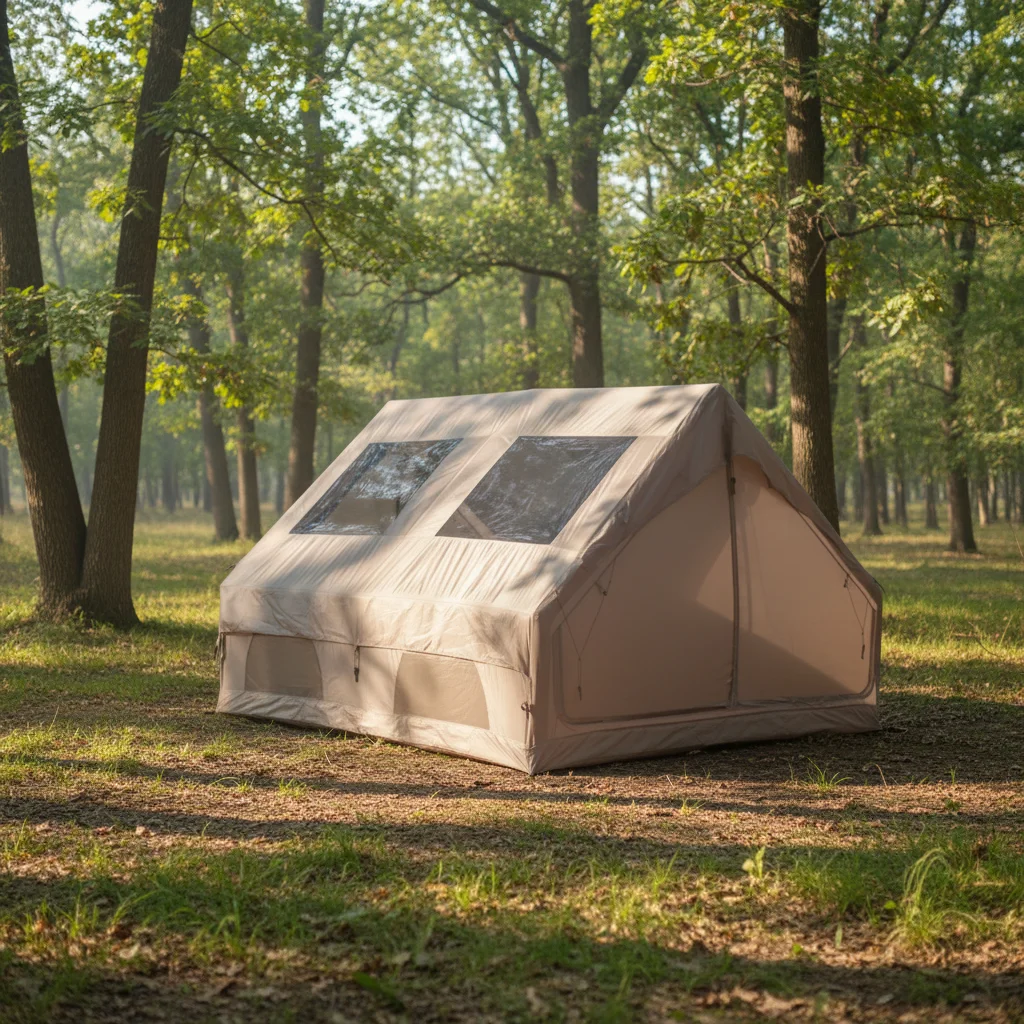
Coating Adhesion Control — every roll of inflatable tent fabric undergoes batch-tested peel strength verification before leaving our 36-set processing line, ensuring seams hold under inflation pressure.
Technical Specifications
| Parameter | Value |
|---|---|
| Product Type | Inflatable Tent |
| Core Material | PVC tarpaulin |
| Waterproof Rating | 3000mm |
| UV Treatment | UV-resistant (test basis not stated in source) |
| Flame Retardant Grade | Fire-retardant (grade not stated in source) |
| Tear Resistance | Tear-resistant (test standard not stated in source) |
| Season Rating | 4-Season |
| Deployment Mechanism | Quick automatic opening (inflatable) |
| Customization | OEM & ODM — sample customization, pattern printing, dimensions, color |
| Certifications | ISO 9001, ISO 14001, ISO 45001, CE |
| Production Facility | 9,180 m² with 3 full production lines |
| Processing Equipment | 36 sets of professional equipment |
| R&D Team | 10 technicians |
| Quality Control | Full-process QA/QC with dedicated on-site staff |
Application Suitability
| Application | Exposure & Requirement |
|---|---|
| Disaster relief medical shelters | Rapid deployment, repeated inflation cycles, contact with medical equipment and personnel traffic |
| Temporary site offices during recovery operations | Extended outdoor exposure across seasons, wind loading on inflated structure, UV degradation risk |
| Equipment storage shelters in emergency response | Abrasion from stored machinery, moisture ingress prevention, fire safety compliance on site |
| Mobile command centers for infrastructure projects | Communication equipment shielding, frequent relocation, professional appearance under field conditions |
| Temporary workspace for remote industrial sites | Isolation from dust and weather, thermal comfort across temperature swings, structural stability in wind |
What "Fire-Retardant" Means Without a Grade Behind It
Inflatable tent fabric must carry a verifiable fire classification to pass site safety audits — a generic claim is not enough for procurement sign-off.
When sourcing Inflatable Tent Fabric manufacturer custom options, buyers regularly encounter material data sheets that list "flame retardant" without referencing a specific standard or test method. For disaster relief and industrial command center deployments, site safety officers require documentation tied to recognized classifications — whether that is DIN 4102, NFPA 701, or a local building code equivalent. [NEED_CITE: DIN 4102 fire classification for building materials] Without a stated grade, the fabric cannot be validated against the fire safety requirements of the jurisdiction where the shelter will be erected, leading to rejected shipments and project delays. Our approach is to supply fire-retardant grades matched to your destination market — confirm the specific classification your site requires before ordering.
Base Fabric Density and Structural Behaviour Under Inflation
The base fabric denier and weave density determine how the inflatable tent fabric responds to internal air pressure and external wind loads. Higher denier yarns in the warp and weft provide the tensile backbone that prevents the structure from deforming under sustained inflation. When sourcing Inflatable Tent Fabric manufacturer custom material, specifying the base fabric construction alongside coating weight ensures the finished shelter maintains its intended geometry across varying weather conditions. Our R&D team works with buyers to select base fabric grades aligned with the structural demands of each shelter design.
Coating Weight and Waterproof Integrity Over Repeated Deployment Cycles
PVC coating weight directly governs waterproof performance and the fabric’s ability to withstand abrasion during packing, transport, and re-deployment. The 3000mm waterproof rating on this inflatable tent material is verified through batch testing, with records retained for traceability across production runs. For emergency shelters that may be inflated and deflated multiple times across different disaster response events, coating adhesion to the base fabric becomes critical — delamination at stress points compromises both waterproofing and structural integrity. [NEED_CITE: tensile and tear test methods for coated fabrics per ISO 1421] Our 7-stage quality inspection process includes peel strength checks at every production stage to catch adhesion issues before they reach the buyer.
Reading the Specification Sheet Beyond the Headline Numbers
A 3000mm waterproof rating indicates the hydrostatic pressure the PVC-coated surface can withstand before water penetration occurs — relevant for shelters deployed in heavy rain or flood-adjacent zones. The 4-season designation signals that the PVC formulation remains flexible at low temperatures without becoming brittle, while retaining dimensional stability under summer heat exposure. UV-resistant treatment slows the breakdown of polymer chains caused by solar radiation, though the specific test basis should be confirmed for your regional compliance framework. Fire-retardant classification must be matched to the fire safety standard enforced at the deployment site — a shelter used as a temporary medical facility in one jurisdiction may face different requirements than an equipment storage unit in another. Tear resistance governs how a puncture or cut propagates through the fabric under inflation pressure; higher tear values mean localized damage stays contained rather than unzipping across a panel.
The Hidden Cost of Unverified Material Claims
Batch-to-batch colour variation becomes visible the moment two inflatable shelter units are erected side by side at the same disaster response site — a problem that traces back to inconsistent pigment dosing or coating thickness variation across production runs. When inflatable tent fabric arrives with a stated fire-retardant treatment but no test report to back it up, the entire shelter order can be rejected during site safety inspection, forcing emergency procurement under compressed timelines. [NEED_CITE: quality inspection standards for coated technical textiles] Welded seams that fail before the fabric itself tears represent a specification mismatch — the heat-seal parameters were not calibrated to the actual coating composition and weight of the material received. These failures are preventable when buyers insist on batch-specific documentation rather than accepting generic product family claims.
Why Procurement Teams Source This Fabric Here
Nearly 30 years of focused PVC coated fabric production means our coating weight control and adhesion processes are refined through decades of volume manufacturing, not learned on your order. Three full production lines and 36 sets of professional equipment give us the capacity to deliver consistent inflatable tent fabric across large-volume orders without subcontracting to unverified mills. A 10-technician R&D team handles material selection, pattern printing specifications, and custom dimension development — sample turnaround is measured in days, not weeks. Dedicated QA/QC staff conduct 100% inspection before shipment, with batch-specific test records for waterproof performance and coating adhesion included in every dispatch. Every roll is traceable to its production batch, with quality records retained for five years to support warranty claims or re-order consistency.
Documentation & Verification
- Material specification sheet confirming PVC composition, waterproof rating, and handling instructions for inflatable tent fabric
- Batch-specific quality inspection report with waterproof performance test results included per shipment
- Fire-retardant and UV-resistance test documentation matched to production batch number
- Pre-shipment inspection record with dimensional verification against custom order specifications
- ISO 9001, ISO 14001, ISO 45001, and CE certification documents for cross-border procurement compliance
- Certificate of origin and customs support documentation provided as standard
Fabrication, Handling & Storage
- Heat-seal temperature and dwell time must be calibrated to this PVC coating weight to prevent seam delamination under inflation pressure
- Store rolls upright on pallets in climate-controlled conditions to avoid permanent creasing in the PVC coating layer
- Cut panels with allowance for welded seam overlap — the PVC coating composition requires specific overlap width for structural joints
- Avoid dragging inflatable tent fabric across abrasive surfaces during deployment to protect the coated waterproof layer
- Clean with pH-neutral detergent only — solvent-based cleaners degrade the PVC surface treatment and compromise waterproof rating
- Repair minor punctures with compatible PVC patch material heat-bonded at manufacturer-recommended temperature settings
Request a Specification Match for Your Shelter Program
To provide an accurate Inflatable Tent Fabric manufacturer custom quotation, share your shelter dimensions, target deployment climate, and the fire safety classification required at your end-user sites. If your program involves pattern printing or branded panels, supply artwork files and colour references so our R&D team can prepare a pre-production sample. Confirm whether you require fabric by the roll for your own fabrication line, or cut-to-size panels ready for welding. We will respond with a specification recommendation, sample development timeline, and batch consistency documentation for your review.
Frequently Asked Questions
Q: What customization options are available for inflatable tent fabric dimensions, color and printing?
A: We offer full OEM and ODM customization including bespoke dimensions, Pantone-matched color, and pattern printing directly onto the PVC-coated surface. Our 10-technician R&D team develops pre-production samples within days for buyer approval before mass production begins. Custom widths and lengths are available across our three production lines.
Q: How is batch-to-batch colour and material consistency controlled across production runs?
A: Every production batch of inflatable tent fabric passes through our 7-stage quality inspection process, which includes pigment dosing verification and coating thickness measurement. We use 36 sets of calibrated processing equipment to maintain consistency, and batch-specific inspection records are retained for five years to guarantee re-order matching.
Q: What fire-retardant and UV-resistance test documentation is supplied with shipment?
A: Each shipment includes batch-matched test reports for fire-retardant performance and UV-resistance treatment. We recommend buyers confirm the specific classification required by their destination market — such as DIN 4102 or NFPA 701 — so we can align the material grade and documentation package accordingly before production.
Q: What is the sample development and approval process before mass production?
A: Upon receiving your specification requirements, our R&D team produces a pre-production sample reflecting the exact PVC formulation, color, and dimensions requested. Once the sample is approved in writing, mass production commences with in-process QA checkpoints ensuring the final delivery matches the approved sample.
Q: How are inflatable tent units pressure-tested and inspected prior to dispatch?
A: Our dedicated QA/QC staff conduct 100% pre-shipment inspection including inflation pressure testing, welded seam integrity checks, and dimensional verification against the purchase order. A comprehensive inspection record accompanies each shipment, documenting waterproof performance, coating adhesion, and structural test results for buyer review.