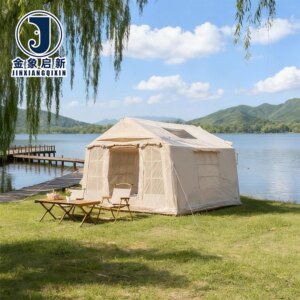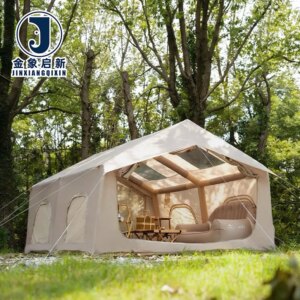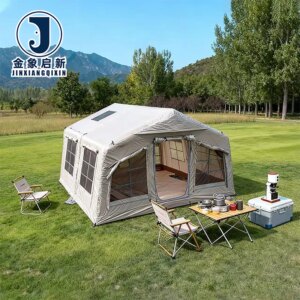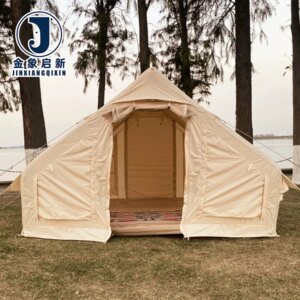
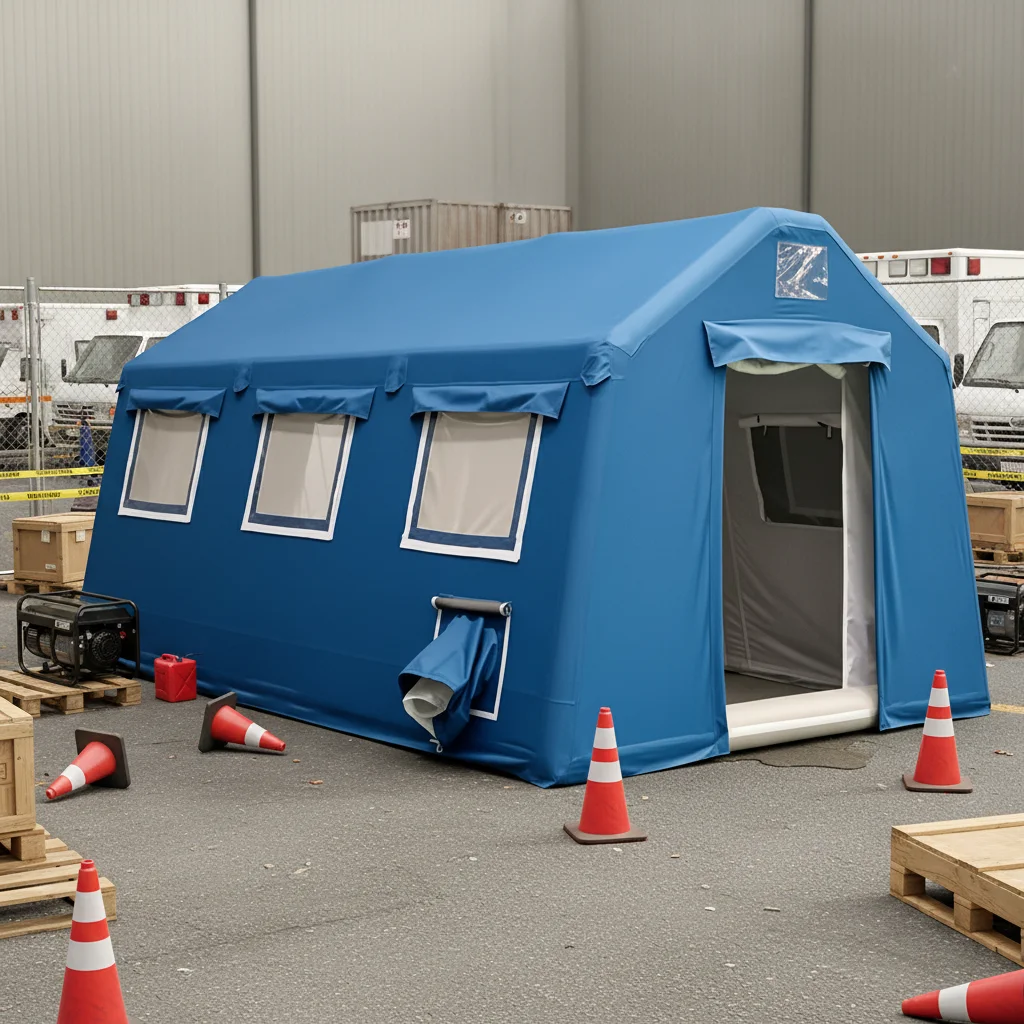
Precision coating control — Nearly 30 years of PVC formulation experience applied to every roll of inflatable tent fabric, with dedicated QA checkpoints ensuring consistent GSM and adhesion across batches destined for emergency shelter structures.
Technical Specifications
| Parameter | Value |
|---|---|
| Product Type | Inflatable Tent Fabric |
| Core Material | PVC tarpaulin, knife-coated construction |
| Flame Retardant | Available in flame retardant grades — confirm the grade required for your market (grade not stated in source) |
| UV Resistance | UV-resistant formulation (test basis not stated in source — request test report) |
| Waterproofing | Fully waterproof coated construction |
| Tear Resistance | Tear-resistant knife-coated fabric |
| Quality Testing | 24-hour air pressure retention test, seam tensile testing, environmental simulation (temperature cycling and UV exposure) |
| Production Capacity | 3 full production lines, 36 sets of processing equipment |
| Customization | OEM & ODM service, sample customization, pattern printing available |
| Certifications | ISO9001, ISO14001, ISO45001, CE |
Application Suitability
| Application | Exposure & Requirement |
|---|---|
| Emergency disaster relief shelters | Rapid deployment under unpredictable weather, repeated inflation cycles, wind load resistance |
| Emergency response command centers | Extended outdoor occupancy, structural integrity under continuous air pressure, interior climate separation |
| Temporary storage facilities during disaster recovery | Equipment and inventory protection from rain and UV degradation, large-span coverage |
| Mobile field operations bases | Four-season outdoor deployment across diverse climate zones, frequent setup and teardown |
| Infrastructure maintenance project shelters | Long-duration exposure to sun, wind, and precipitation at remote work sites |
What "Flame Retardant" Means Without a Documented Grade Behind It
Specifying inflatable tent fabric without a stated flame retardant grade leaves emergency shelter procurement teams exposed to compliance rejection at the point of deployment.
Purchasing managers reviewing tenders for disaster relief shelters often see "flame retardant" listed as a feature on PVC inflatable tent aftermarket supplier quotations. Yet without a specific classification — whether B1 per DIN 4102, M2 per NF P 92-507, or NFPA 701 — that claim cannot be verified against the fire safety regulations of the destination market. Emergency shelters deployed in public gathering scenarios or industrial sites face inspection against local fire codes. [NEED_CITE: fire classification standards applicable to temporary membrane structures] Fabric that arrives without a matching test certificate can result in an entire batch being held at site, delaying relief operations and triggering costly resubmission processes.
How Knife-Coated Construction Delivers Structural Reliability
The knife-coating process forces PVC compound directly into the interstices of the base fabric under controlled blade pressure, producing a bond that resists delamination under repeated inflation and deflation cycles. This coating method is what gives PVC inflatable tent aftermarket supplier fabric its tensile continuity across seam welds, which is critical when air beams flex under wind load.
UV-Resistant Formulation and Long-Term Outdoor Integrity
Emergency shelters often remain deployed through multiple seasons. UV exposure degrades unprotected PVC surfaces, leading to chalking, embrittlement, and eventual tear propagation at stress points. Our UV-resistant formulation is designed to slow this degradation pathway. Buyers should request the specific test report — whether QU-S or xenon arc exposure data — to validate suitability for their deployment duration. [NEED_CITE: accelerated weathering test methods for coated fabrics per ISO 4892]
Decoding Base Fabric, Coating Weight, and Seam Behaviour
The tensile and tear performance of PVC inflatable tent aftermarket supplier material is governed by the interplay of base fabric denier, weave density, and coating weight — not by any single parameter in isolation. A high-denier yarn in a low-density weave may show strong warp tensile values yet tear easily once a puncture initiates, because there are fewer yarn intersections to arrest the tear front. Knife-coated construction locks the coating into the weave, meaning peel strength at welded seams depends on both coating adhesion and the integrity of the yarns being fused together. Environmental simulation testing — temperature cycling combined with UV exposure — reveals how these properties hold up after the material has aged, which is what matters for shelters that must perform through their entire deployment lifecycle.
The Cost of Specifying on Claimed Performance Alone
When material arrives at an inflatable structure fabrication line without verifiable UV or flame retardant test data, the consequences compound. A shelter manufacturer may weld, cut, and assemble an entire production run before a client’s third-party inspector requests the missing documentation. Batch rejection at that stage means re-cutting, re-welding, and rescheduling deployment — all while the emergency timeline continues to compress. Similarly, coating weight that falls below the specified GSM may pass visual inspection yet produce weld seams that fail before the fabric itself does, because there is insufficient coating mass to form a continuous fusion zone. [NEED_CITE: common failure modes in welded seams on coated technical textiles]
Why Technical Buyers Source This Fabric Here
Material specification development begins with your application parameters — deployment duration, climate zone, fire safety jurisdiction — and our 10-technician R&D team translates those into base fabric denier, coating weight, and treatment package before any roll enters production.
Three full production lines and 36 sets of processing equipment provide the capacity to deliver container-volume orders on the schedules that emergency procurement timelines demand.
Full-process QA and QC includes 24-hour air pressure retention testing and standardized seam tensile evaluation, so the fabric you receive has been validated under conditions that mirror actual inflatable shelter operation.
OEM and ODM customization covers width, colour, and pattern printing with batch-to-batch consistency controls, ensuring that a follow-up order matches the material already in your production inventory.
ISO9001, ISO14001, ISO45001, and CE documentation is prepared per batch, giving your compliance team the traceability they need without a separate request cycle.
Documentation & Verification
- Material specification sheet stating base fabric denier, coating method, and weight per roll
- UV and flame retardant test reports provided where applicable to stated grades
- ISO and CE certificates issued with batch-level traceability for each shipment
- Pre-shipment inspection record including 24-hour air pressure retention and seam tensile results
- Roll packing list with gross and net weight for container loading planning
- Certificate of origin and customs documentation support per destination market
Fabrication, Handling & Storage
- Heat-weld parameters must be tuned to the specific PVC coating weight to ensure full seam fusion without scorching the base fabric
- Store rolls horizontally on pallets in a shaded area to prevent flat-spot deformation on the coating surface
- Allow cold-transported rolls to acclimate to workshop temperature before unrolling to avoid coating micro-cracking
- Use PVC-compatible cleaners only — solvent-based products will attack the knife-coated surface layer
- Pattern-printed sections require matched heat input during welding to prevent colour shift at the seam line
How to Structure Your Fabric Inquiry
Tell us the deployment scenario — disaster relief shelter, field command center, or infrastructure maintenance cover — along with the expected duration and climate conditions. Specify the fire safety classification required in your destination market so we can align the flame retardant grade and provide the matching test certificate. Indicate whether you need roll stock for your own fabrication line or finished cut-to-size panels, and confirm any colour or pattern printing requirements for your project branding.
Frequently Asked Questions
Q: What UV test data is available to support long-term outdoor exposure claims?
A: Our inflatable tent fabric is produced with a UV-resistant formulation. The specific test basis — whether accelerated xenon arc exposure per ISO 4892 or natural weathering data — depends on the product grade. Request the test report matching your deployment duration requirement during the inquiry stage so your engineering team can validate suitability before specification.
Q: Which flame retardant grades can be supplied and how do they align with different markets?
A: Flame retardant grades are available across our inflatable tent fabric range, but the applicable classification depends on your destination market’s fire safety regulations. Communicate the required standard — such as DIN 4102, NFPA 701, or local equivalent — when requesting a quotation, and we will align the treatment package and provide the corresponding test certificate with your shipment.
Q: How do base fabric denier and coating weight together determine tensile and tear performance?
A: Denier defines individual yarn thickness while coating weight determines how thoroughly the PVC compound penetrates and binds the weave. Both parameters together govern tensile continuity and tear propagation resistance. Our technical team can recommend the denier and coating weight combination suited to your inflatable shelter’s wind load and inflation cycle requirements during sample development.
Q: What weld and seam strength testing is performed before shipment?
A: Every production batch undergoes standardized tensile testing on welded seams, alongside 24-hour air pressure retention testing on fabricated samples. Environmental simulation including temperature cycling and UV exposure is also conducted. These results are documented in the pre-shipment inspection record that accompanies your order, providing evidence of seam integrity under operational conditions.
Q: Can custom width, colour, and pattern printing be supplied with consistent quality across rolls?
A: OEM and ODM customization covers custom widths, colours, and pattern printing for inflatable tent fabric orders. Batch consistency is controlled through full-process QA and QC at each production stage, and 100 percent inspection is completed before dispatch. Request a production-grade sample to confirm colour and print registration before your full order enters the production line.