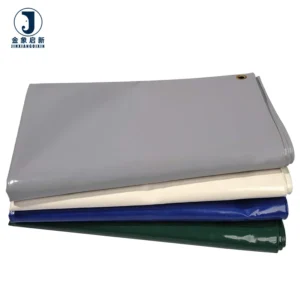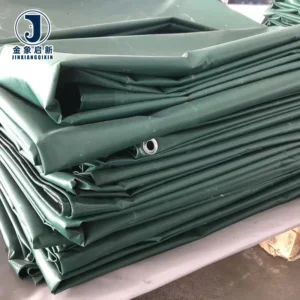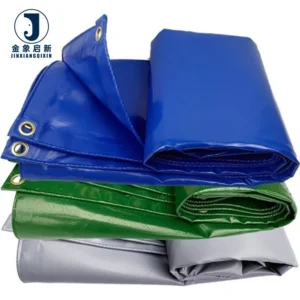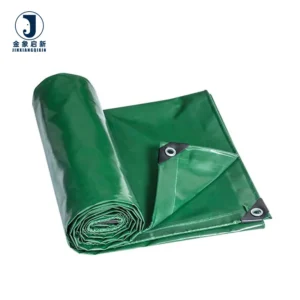
Coating Process Control — Every roll of Fire Retardant PVC Coated Tarpaulin Fabric is backed by a material specification sheet stating exact GSM, base fabric denier and coating weight for incoming inspection.
Technical Specifications
| Parameter | Value |
|---|---|
| Product Type | Fire Retardant PVC Coated Tarpaulin Fabric |
| Material | 100% high toughness polyester yarn with PVC coating |
| Coating Technology | Lamination and hot melt coating |
| Thickness (Medium-duty) | 0.35-0.45 mm |
| Weight (Medium-duty) | 400-500 g/m² |
| Yarn Denier (Medium-duty) | 500D |
| Tensile Strength (Medium-duty) | Warp 1500-2000 / Weft 1200-1800 N/5cm |
| Thickness (Heavy-duty) | 0.70-1.0 mm |
| Weight (Heavy-duty) | 700-1000 g/m² |
| Yarn Denier (Heavy-duty) | 1000D |
| Tensile Strength (Heavy-duty) | Warp 2000-2500 / Weft 1800-2200 N/5cm |
| Thickness (Super Heavy-duty) | 1.2-1.5 mm |
| Weight (Super Heavy-duty) | 1100-1500 g/m² |
| Yarn Denier (Super Heavy-duty) | 500D-2000D |
| Tensile Strength (Super Heavy-duty) | Warp 2500-3000 / Weft 2200-2800 N/5cm |
| Flame Retardant Grade | B1 (test basis not stated) |
| Treatment Options | Flame retardant (B1), Anti-static, Cold resistant, Mold proof, UV resistant |
| Welding Tear Strength | Excellent |
| Color Fastness | Best grade |
Application Suitability
| Application | Exposure & Requirement |
|---|---|
| Warehouse cover | Permanent UV exposure, wind load, water ingress, thermal expansion of steel frame |
| Construction cover | Abrasion from scaffolding and debris, high wind uplift, site fire safety compliance |
| Truck side curtain | Constant flexing at hinges and straps, road debris impact, daily retraction cycles |
| Heavy truck tarpaulin | High-speed wind flap, tie-down tension at flex points, diesel soiling and chemical wash |
| Engineering protective cloth | Puncture from sharp metal offcuts, UV degradation, moisture entrapment against stored steel |
| Industrial pipe canopy | Tensioned membrane loads, weld seam stress at anchor points, snow or water pooling |
| Tensioned structural fabric | Biaxial stress at connection nodes, long-term creep under constant load, UV reflection |
Why PVC Coated Tarpaulin Fabric GSM Coating Technology Requires More Than a Weight Number
A quoted GSM figure becomes meaningless if the coating weight and base fabric density are not verified against the delivered roll.
Technical buyers routinely encounter situations where the material specification sheet states one weight, but the roll arriving on the dock measures lighter. When the coating technology is not documented, the buyer cannot tell if the shortfall came from a thinner PVC layer, a lighter base yarn, or both. The relationship between base fabric denier and total GSM determines the tensile and tear behaviour under load, not the weight alone. [NEED_CITE: tensile and tear test methods for coated fabrics per ISO 1421]
Base Yarn Denier and Weave Density
The PVC coated tarpaulin fabric uses a high-toughness polyester yarn, with denier grades ranging from 500D for medium-duty applications up to 2000D for super heavy-duty structural uses. The base fabric weave density controls how the load transfers from the coating into the yarn structure. A tighter weave at 1000D or above distributes point loads across more yarn intersections, reducing the risk of tear propagation at eyelet and seam locations. The coating technology then locks this structure in place.
Hot Melt Coating Versus Lamination Technology
The choice between hot melt coating and lamination directly affects the peel strength and welding behaviour of the PVC coated tarpaulin fabric. Hot melt coating penetrates the base fabric weave, creating a mechanical bond that resists delamination under repeated flexing. Lamination bonds a pre-formed PVC film to the fabric surface, delivering a more uniform coating weight and a smoother finish suitable for tensioned membrane applications. [NEED_CITE: DIN 4102 fire classification for building materials]
Reading Thickness Against GSM Grade
Total thickness ranges from 0.35 mm in the medium-duty grade to 1.5 mm in the super heavy-duty grade. This measurement correlates with the PVC coating weight applied to each side of the base fabric. A thicker coating does not automatically mean a stronger fabric — a 1.2 mm sheet with a 500D base will tear more easily than a 0.7 mm sheet with a 1000D base. Technical buyers must specify both parameters together to match the mechanical demands of the application.
Specification Mismatches and Their Field Consequences
Selecting a medium-duty grade for a heavy truck tarpaulin leads to early failure at the tie-down points, where the fabric cannot distribute the strap tension across a sufficient number of yarn intersections. A flame retardant grade stated without a test report causes rejection at the site inspection, delaying the project until compliant documentation is produced. Colour variation between rolls from the same order becomes visible once the panels are welded side by side on a warehouse facade, forcing the contractor to reject the entire batch. [NEED_CITE: colour fastness testing standards for coated fabrics]
Process Control Backed by Documentation
The manufacturing workflow begins with material selection matched to the duty class, followed by in-process QA at the coating stage where GSM and coating adhesion are checked before the roll leaves the line. A 10-person R&D team handles custom GSM, colour and treatment requirements, developing samples within days. Dedicated QA/QC inspects every roll before shipment, generating a pre-shipment inspection record. The documentation package includes a material specification sheet, test reports for applicable treatments, and a roll packing list.
Documentation & Verification
- Material specification sheet stating GSM, base fabric denier and coating type for every roll
- Test report for flame retardant B1 grade and UV treatment where applicable
- 100% pre-shipment inspection record with roll-by-roll weight verification
- Roll packing list with colour reference and batch number for incoming inspection
- ISO and CE certificates included for customs and site compliance
Fabrication, Handling & Storage
- Hot air welding parameters must be adjusted to the coating technology and thickness of the selected grade
- Reinforce tie-down points with extra PVC patches matching the base fabric denier to prevent tear propagation
- Store rolls vertically on a flat pallet to avoid compression marks on the coating surface
- Allow super heavy-duty rolls to acclimatise before unrolling in cold conditions to prevent coating crack
- Clean with neutral detergent to protect the colour fastness and any anti-static treatment applied
- Nest patterns on custom-width rolls to minimise weld seams and maximise fabric utilisation
Requesting a Sample for Your Application
To confirm the correct duty class and coating technology, specify the end-use application, the mechanical loads the fabric will face, and the fire safety or anti-static standards required in your target market. State the required roll width, annual volume, and whether you need custom colour or pattern printing. Request a sample roll to verify GSM, tensile strength and weld behaviour before committing to bulk production.
Frequently Asked Questions
Q: How is GSM verified and how should I conduct incoming inspection on arrival?
A: Every roll ships with a material specification sheet stating the exact GSM, base fabric denier and coating type. On arrival, cut a test piece of known dimensions from each roll and weigh it on a calibrated scale. Compare the result against the specification sheet. Any discrepancy beyond the stated tolerance should be reported with photographs before fabrication begins.
Q: What does B1 flame retardant certification cover and how does it map to my target market’s fire safety requirements?
A: The B1 grade indicates the material’s reaction to fire under the test method referenced on the test report. Building codes in different regions may require additional classifications such as M2 or NFPA 701. Provide the specific fire safety standard required by your local authority, and the test report can be cross-referenced to confirm compliance before the order is placed.
Q: What is the relationship between base fabric denier, GSM and tensile strength across your three duty classes?
A: Base fabric denier and weave density determine how the load is distributed across the yarn structure, while GSM reflects the total weight of coating and base combined. A higher denier at the same GSM delivers greater tensile and tear strength because more of the weight is in the load-bearing yarn rather than the PVC coating. The three duty classes map denier and coating weight together.
Q: How do hot melt coating and lamination differ, and which method suits my welding and fabrication process?
A: Hot melt coating penetrates the base fabric, creating a strong mechanical bond suited to applications with repeated flexing and high peel stress at weld seams. Lamination bonds a PVC film to the fabric surface, producing a more uniform finish for tensioned membranes and printed applications. State your fabrication method and end-use to receive a recommendation.
Q: What anti-static and anti-mildew treatment options are available, and what test data supports the claim?
A: Anti-static and mold proof treatments are available as optional additions to the base PVC formulation. When these treatments are specified, a test report documenting the performance level is included in the documentation package. Confirm the test standard required for your application environment so the correct treatment grade can be selected before sample development.