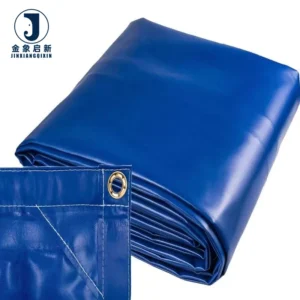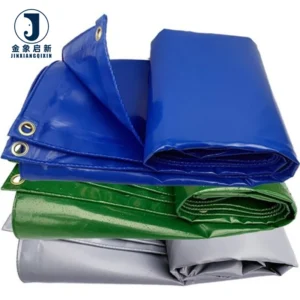
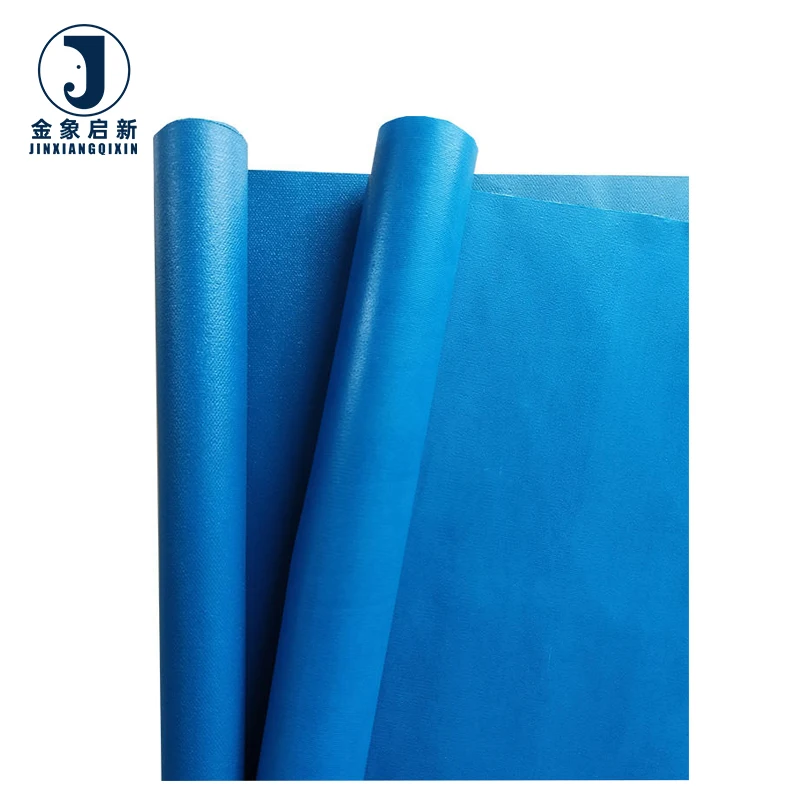
Consistent Coating Weight — verified GSM per roll against material specification before dispatch, matching the ordered grade of PVC coated tarpaulin roll.
Technical Specifications
| Parameter | Value |
|---|---|
| Product Type | PVC Coated Tarpaulin Roll |
| Coating Material | PVC |
| Base Fabric | High-strength polyester mesh fabric |
| Coating Method | Laminated technology & Hot-melt Coating technology |
| Weight (GSM) | 350gsm / 420g / 500gsm / 550gsm / 600gsm / 750gsm |
| Total Thickness | 0.32mm / 0.35mm / 0.4mm / 0.45mm / 0.5mm / 0.65mm |
| Roll Width | 2m / 2.1m |
| Roll Length | 75m (2m width) / 50m (2.1m width) |
| Color Options | Blue / Red / Yellow / Light blue / Grey (Customized) |
| Flame Retardant | Available in flame retardant grades — confirm the grade required for your market |
| Anti-Static | Available in anti-static grades — confirm the standard required for your site |
| Anti-Mildew | Treated (test basis available on request) |
| UV Treatment | Treated (test basis available on request) |
| Cold Crack Resistance | Treated (test standard available on request) |
| Waterproof | Fully waterproof coated construction |
| Color Fastness | Treated (grade available on request) |
| Custom Printing | Available |
| Custom Sizing | Available |
| Standards | ISO / CE |
Application Suitability
| Application | Exposure & Requirement |
|---|---|
| Truck awning and side curtain fabric | Constant flexing at folds, road debris abrasion, UV and weather exposure, weld integrity under tension |
| Tent and inflatable structure cover | Wind load tension, repeated assembly and teardown, flame retardant compliance for public venues |
| Scaffolding and building enclosure | Wind-driven rain, prolonged UV, scaffolding tie-off abrasion, municipal fire code compliance |
| Marine and offshore maintenance cover | Salt spray, permanent moisture contact, high tensile demand from rigging attachment points |
| Plant and refinery maintenance enclosure | Chemical splash, hot work proximity, certified flame retardant and anti-static grades required |
| Cargo ship deck cargo cover | Saltwater immersion risk, heavy cargo abrasion, UV degradation from open-deck stowage |
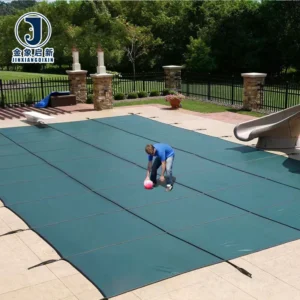
| Fish tank and pool liner | Continuous water immersion, anti-mildew requirement, coating adhesion under hydrostatic pressure |
| Construction and equipment cover | Job-site dirt, equipment sharp edges, repeated handling and repositioning |
Why a Stated GSM Does Not Guarantee the PVC Coated Tarpaulin Roll You Receive
Coating weight, base fabric denier, and total thickness must each be specified and verified independently — GSM alone is an incomplete picture.
Buyers regularly quote a GSM figure and expect it to define everything about the material. In practice, the base fabric construction carries the tensile and tear load, while the PVC coating contributes waterproofing, chemical resistance, and surface properties. A roll that arrives lighter than the quotation stated often has a thinner coating or a lower-denier base yarn substituted during production [NEED_CITE: ISO 1421 tensile and tear test methods for coated fabrics]. Without a material specification sheet that breaks down each component, there is no basis for a receiving inspection. The consequence is fabric that fails at welded seams or tears under loads that the quoted GSM should have withstood.
Coating Methods and Their Effect on Weld Performance
The PVC coated tarpaulin roll range includes both laminated and hot-melt coating technologies. Laminated construction bonds a pre-formed PVC film to the polyester mesh under heat and pressure, producing a smooth, uniform surface with consistent thickness across the roll. Hot-melt coating applies molten PVC directly into the mesh, penetrating the yarn intersections for higher adhesion between coating and base fabric. The choice affects how the material behaves at heat-welded seams — hot-melt coated fabric typically shows stronger peel resistance at the weld line because the coating is mechanically locked into the weave structure.
Base Fabric Construction and Dimensional Stability
The high-strength polyester mesh base fabric provides the structural backbone of every roll in this range. Polyester yarn is selected for its low elongation under load, which keeps the PVC coated tarpaulin roll dimensionally stable when tensioned over scaffolding or welded into truck side curtains. The mesh weave pattern distributes load across multiple yarn intersections, resisting tear propagation when a puncture occurs [NEED_CITE: tear propagation behavior in coated polyester mesh per ISO 13937]. Yarn denier and weave density vary across GSM grades — higher GSM grades use heavier yarn or denser weave to achieve the required tensile and tear performance.
Reading the GSM-to-Thickness Mapping Across Six Grades
The six available weight grades — 350gsm, 420g, 500gsm, 550gsm, 600gsm, and 750gsm — map to corresponding thickness values from 0.32mm to 0.65mm. This mapping matters because thickness alone does not predict strength; a 0.5mm roll with a dense, high-denier base fabric will outperform a 0.5mm roll with a loose weave and heavy coating fill. GSM reflects the combined weight of base fabric plus coating, so two rolls at the same GSM can have very different performance profiles depending on how that weight is distributed. Technical specification should always state base fabric denier and weave density alongside GSM so that the receiving inspector can verify what was ordered. Available special treatments — flame retardant, anti-static, anti-cold, and anti-mildew — add chemical compounds to the coating formulation and must be confirmed against the test standard your project requires before order confirmation.
The Cost of Specifying on GSM Without Verifying the Full Construction
When a roll arrives with less coating weight than specified, the base fabric is more exposed to abrasion and UV degradation, shortening service life in outdoor applications. When the base fabric denier is lower than expected, tensile strength drops and welded seams become the first failure point under load — the seam fails before the fabric does, precisely where the load flexes most [NEED_CITE: welded seam failure in coated fabrics under cyclic flex loading]. Batch-to-batch colour variation between rolls creates visible differences once installed side by side on a large enclosure or tent structure, triggering rejection and rework. These outcomes are avoidable with a specification sheet that locks down every variable and a pre-shipment inspection that measures actual values per roll.
What This Supply Chain Delivers on Material Consistency
Deep process control over coating weight and adhesion is maintained across all three production lines, with dedicated QA/QC inspection at every stage from base fabric incoming check to final roll winding. The 10-person R&D team develops custom formulations for flame retardant, anti-static, and anti-cold treatments matched to specific market requirements, and produces samples within days for buyer approval. Roll-to-roll colour consistency is verified during production — critical when multiple rolls of the PVC coated tarpaulin roll are installed adjacent to each other on a single structure. Custom widths, colours, and printed branding are handled on the same lines as stock grades, with the same inspection protocol applied regardless of order size. Pre-shipment inspection covers measured GSM, thickness, and visual quality per roll before dispatch.
Documentation & Verification
- Material specification sheet stating exact GSM, base fabric denier, coating method, and colour reference for the ordered PVC coated tarpaulin roll
- Test reports for UV and flame retardant grades matched to the specific production batch
- Pre-shipment inspection record with actual measured GSM and thickness values per roll
- Roll packing list showing individual roll weight, dimensions, and production batch number
- Certificate of origin and customs documentation for cross-border shipment
Fabrication, Handling & Storage
- Heat-weld parameters must be adjusted for laminated versus hot-melt coated rolls to achieve full seam adhesion
- Store rolls upright on pallets to prevent flat-spot deformation on the outer coating layers
- Allow cold-stored rolls to reach ambient temperature before unrolling to avoid coating crack at low GSM grades
- Use compatible PVC adhesive patches for field repairs, matching the coating method of the parent roll
- Plan cutting layout across 2m or 2.1m roll widths to minimize offcut waste and cross-grain seams
How to Structure Your Inquiry
Provide the end-use application, exposure conditions, and any fire or anti-static compliance standards required by your local jurisdiction. Specify the target GSM grade or the tensile and tear performance you need, along with preferred roll width and annual volume. If colour matching or custom printing is required, submit a reference sample or Pantone code so that a production sample can be developed for your approval before the bulk order runs.
Frequently Asked Questions
Q: How is GSM verified on arrival, and what is the relationship between stated weight, base fabric, and coating thickness?
A: Each roll is measured for actual GSM, thickness, and base fabric construction during pre-shipment inspection, with recorded values supplied in the inspection report. GSM reflects the combined weight of polyester base fabric and PVC coating, so the specification sheet breaks down each component separately. This allows your receiving team to verify that the roll matches what was ordered across all three variables.
Q: What test basis supports flame retardant and anti-static claims, and which grades are available?
A: Flame retardant and anti-static treatments are formulated to match the compliance standard required by your market or project specification. Test reports for the specific batch are provided to confirm the grade achieved. Buyers should state the exact standard — such as a national fire code or mining regulation — at inquiry stage so the correct formulation is selected and documented before production begins.
Q: Laminated vs. hot-melt coating — how do they differ in adhesion strength and weld behaviour?
A: Laminated coating bonds a PVC film to the mesh surface under heat and pressure, producing a smooth finish with consistent thickness. Hot-melt coating penetrates the mesh weave, locking coating into the yarn intersections for higher peel resistance at heat-welded seams. Fabricators producing high-stress items like truck side curtains often prefer hot-melt coated rolls for superior weld integrity under flex load.
Q: How does cold crack resistance vary across GSM grades, and what test standard applies?
A: Anti-cold treatment is available across the GSM range and is formulated for the target low-temperature environment of the end-use application. The specific test standard and pass temperature depend on the compound selected for your order. State your minimum operating temperature at inquiry so the appropriate formulation is applied and verified with a test report for your batch.
Q: What colour fastness performance can be expected, and how is batch-to-batch colour consistency controlled?
A: Colour is matched to a reference standard during production, and roll-to-roll consistency is verified visually and by measurement before shipment. When multiple rolls are ordered for a single installation, they are produced in the same batch run to minimize variation. A production sample can be provided for buyer approval before bulk manufacturing begins.