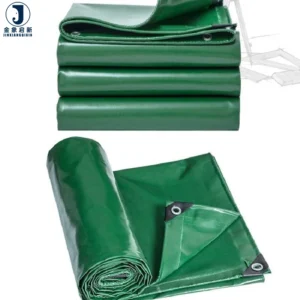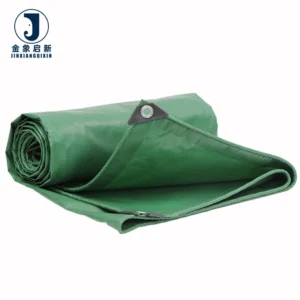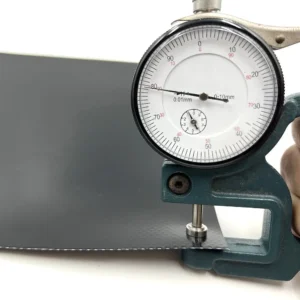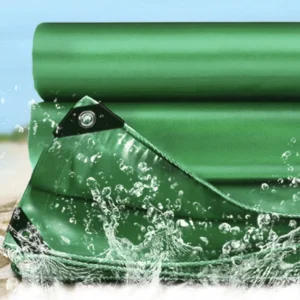
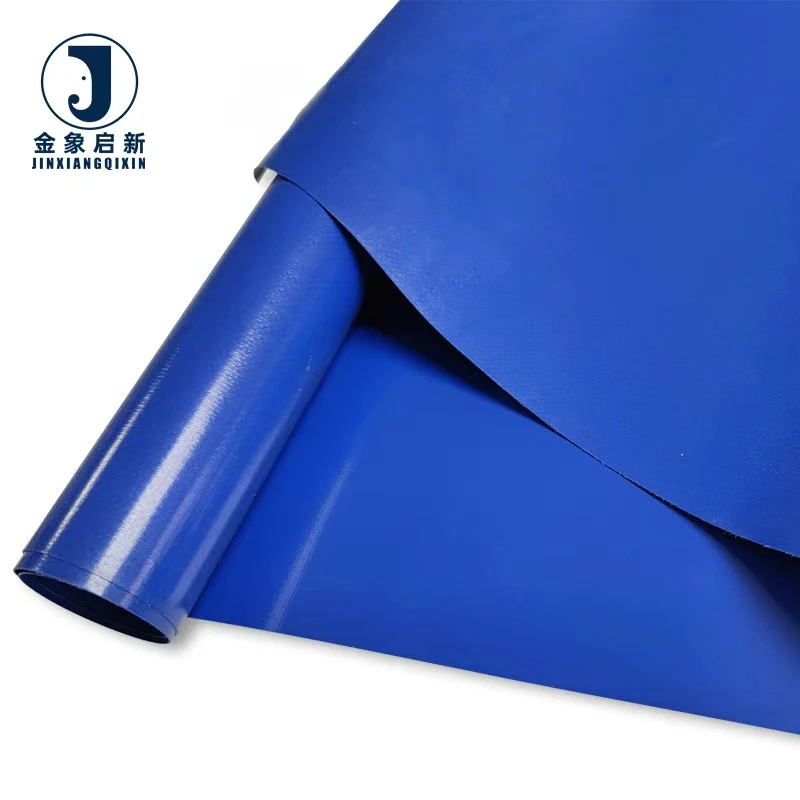
Process-Controlled Coating Weight — Every roll of laminated PVC tarpaulin fabric is verified against the stated GSM at each production stage, ensuring technical buyers receive material that matches the specification sheet before it leaves the factory.
Technical Specifications
| Parameter | Value |
|---|---|
| Product Type | PVC Tarpaulin Fabric |
| Material | PVC + High-strength polyester mesh fabric |
| Coating Technology | Laminated technology & Hot-melt coating technology |
| Weight Options | 350 gsm / 420 gsm / 500 gsm / 550 gsm / 600 gsm / 750 gsm |
| Total Thickness | 0.32 mm / 0.35 mm / 0.4 mm / 0.45 mm / 0.5 mm / 0.65 mm |
| Roll Size | 2 m width × 75 m length / 2.1 m width × 50 m length |
| Color | Blue / Red / Yellow / Light Blue / Grey (Customized) |
| Key Features | Cold crack resistance, anti-mildew, waterproof, sunproof (test basis not stated in source), flame retardant (grade not stated in source), anti-static (grade not stated in source) |
| Standards | ISO 9001 / CE |
Application Suitability
| Application | Exposure & Requirement |
|---|---|
| Construction and scaffolding enclosure | Wind load, abrasion from scaffolding tubes, prolonged UV exposure |
| Temporary industrial equipment covers | Outdoor weathering, chemical dust, mechanical puncture risk |
| Truck awning and side curtain | Constant flexing at hinge points, road spray, tie-down tension |
| Fish tank and pond liner | Permanent water contact, hydrostatic pressure, soil chemistry |
| Tent and inflatable structure cover | Repeated assembly stress, wind uplift, weld seam integrity |
| Marine and offshore maintenance cover | Salt spray, high humidity, UV degradation in open environments |
Why Coating Method Matters More Than GSM Alone on PVC Tarpaulin Fabric
A quoted GSM tells you what the roll should weigh — the coating technology determines whether that weight translates into real tensile and tear strength at the weld line.
Technical buyers reviewing PVC laminated tarpaulin roll gsm specifications often discover that two rolls with the same stated weight perform very differently once fabricated. The base fabric denier, mesh density, and whether the PVC is applied by lamination or hot-melt double coating all shift the mechanical behaviour. A heavier coating does not automatically produce a stronger panel if the adhesion to the polyester mesh is uneven or if the laminate layer delaminates under flex stress [NEED_CITE: tensile and tear test methods for coated fabrics per ISO 1421]. The specification sheet must break down total GSM into base fabric weight and coating weight separately, so the buyer can verify that the performance claim is supported by construction, not just a scale reading.
Hot-Melt Coating and Laminated Construction Explained
The PVC tarpaulin fabric in this range uses two distinct coating approaches — laminated technology and hot-melt coating technology — applied to a high-strength polyester mesh base. Laminated construction bonds a pre-formed PVC film to the mesh under heat and pressure, producing a uniform surface with consistent PVC coated fabric specifications across the roll width. Hot-melt double coating applies molten PVC directly to both sides of the mesh, allowing deeper penetration into the weave and stronger mechanical interlock. For fabricators who heat-weld panels, the hot-melt variant typically delivers higher peel strength at the seam because the coating has fully encapsulated the yarn rather than sitting on the surface.
Matching GSM Grade to Fabrication Method
Selecting the correct GSM grade depends on how the finished product will be assembled and loaded. Lighter grades such as 350 gsm or 420 gsm suit applications where the fabric is cut, folded, and sewn — tent panels, temporary covers, or light agricultural enclosures — because the thinner coating accommodates needle penetration without cracking. Heavier grades from 550 gsm upward are specified where heat-welding is the primary joining method, as the additional coating thickness provides enough material at the overlap zone to form a fused seam that outlasts the fabric itself. Welding a thin-grade PVC tarpaulin fabric at excessive temperature burns through the coating and exposes the polyester mesh, creating a failure path that shows up under the first load cycle [NEED_CITE: heat welding parameters for PVC coated polyester fabrics].
What Thickness, GSM, and Mesh Density Mean Together
The total thickness range of 0.32 mm to 0.65 mm correlates with the available GSM grades, but thickness alone does not predict performance. A 0.5 mm roll built on a dense, high-denier mesh with moderate coating weight will resist tear propagation better than a 0.5 mm roll that achieves the same thickness through a heavier coating on a lighter mesh. The mesh density — warp and weft yarn count per centimetre — governs how far a tear spreads before encountering the next crossover point. Coating weight controls surface abrasion resistance and waterproofing integrity. Buyers specifying PVC laminated tarpaulin for structural or load-bearing covers should request the base fabric denier and weave density in addition to the total GSM and thickness, so the mechanical data on the material specification sheet can be cross-referenced with the intended stress profile.
The Hidden Cost of Specifying on Weight Without Verification
When rolls arrive lighter than the quoted PVC coated fabric specifications, the consequences compound through the fabrication process. Panels cut to a pattern assume a certain stiffness and drape; a lighter material sags under its own weight and transfers load unevenly to the fixing points. Welded seams that were calibrated for a stated thickness receive too much heat relative to the actual coating present, burning through and leaving the polyester yarns exposed at exactly the point where the load flexes most. Colour variation between rolls in the same shipment becomes visible once panels are installed side by side on a building enclosure or truck curtain, forcing the contractor to sort, re-cut, or reject entire sections [NEED_CITE: batch colour consistency standards for PVC coated fabrics]. These failures are not random — they trace back to a procurement step where the specification sheet listed a GSM value but the pre-shipment inspection did not verify it roll by roll.
Why Fabricators Source This PVC Tarpaulin Fabric Here
Three full production lines and 36 sets of professional coating equipment give this facility the capacity to hold tight GSM tolerances across large roll orders, which matters when a container load must deliver uniform weight from the first roll to the last. A dedicated 10-person R&D team handles material selection and sample development, so fabricators can test weld parameters and colour matches before committing to bulk volume. Every production run passes through stage-by-stage QA with 100% inspection before shipment, meaning the coating weight, colour, and dimensional accuracy of each roll are documented rather than sampled. Custom widths, colours, and surface finishes are supported without the extended minimums that typically block small-to-medium fabricators from ordering made-to-spec material.
Documentation & Verification
- Material specification sheet listing GSM, base fabric denier, coating method, and colour reference per roll
- Test report for flame retardant and anti-static grades where applicable to the ordered batch
- Pre-shipment inspection record confirming weight and dimensional accuracy across all rolls
- ISO 9001 and CE certificates covering the production facility and coating process
- Roll packing list with individual roll weight and running meter count for receiving verification
- Certificate of origin and customs documentation prepared per destination country requirements
Fabrication, Handling & Storage
- Heat-weld overlap zones at temperatures matched to the selected coating thickness to avoid burn-through on thinner grades
- Store rolls horizontally on racking to prevent permanent creasing in the PVC coating layer
- Allow cold-stored rolls to reach ambient temperature before unrolling to protect cold-crack-resistant coating integrity
- Cut panels from 2 m or 2.1 m widths with nesting software to maximise yield from each roll length
- Use PVC-compatible cleaners only; solvent-based products degrade the hot-melt coating surface
- Reinforce eyelet and tie-down zones with additional PVC patches welded over the high-strength polyester mesh base
What to Include in Your Enquiry
Provide the end-use application, expected environmental exposure, and any fire-retardant or anti-static compliance requirements for the destination market. Specify the target GSM grade, thickness, roll width, and whether you need stock colours or a custom colour match with a Pantone or RAL reference. Confirm whether the order is for roll stock only or if you require cut-to-size panels, and indicate annual volume so lead time and production scheduling can be aligned to your fabrication calendar.
Frequently Asked Questions
Q: How is the GSM of each roll verified before dispatch?
A: Every roll is weighed and measured during the pre-shipment inspection. The recorded weight is divided by the measured area to calculate actual GSM, which is compared against the specification sheet value. Rolls outside the stated tolerance are flagged and replaced before the container is sealed. The inspection record accompanies the shipment.
Q: What test reports are available for flame-retardant and anti-static grades?
A: Test reports are provided for the specific production batch when flame-retardant or anti-static treatment is ordered. The applicable standard — such as DIN 4102 or NFPA 701 for flame retardancy — is confirmed during the specification phase. Buyers should state the regulatory requirement of the destination market so the correct formulation and documentation can be prepared.
Q: Can I order custom widths or colours with a low minimum?
A: Custom widths within the production line capability and custom colours matched to a Pantone or RAL reference are available. Minimum order quantities depend on the specific width and colour requested. Samples are developed before bulk production so the fabricator can verify colour, surface finish, and weld compatibility before the full run is scheduled.
Q: How is colour consistency maintained across multiple rolls?
A: Colour is controlled at the compounding stage using calibrated pigment dosing, and each roll is checked against the approved colour reference during inspection. Rolls from the same order are produced in a single batch run to minimise variation. The pre-shipment inspection record documents the visual check so any deviation is caught before dispatch.
Q: What is the difference between laminated and hot-melt coated construction?
A: Laminated technology bonds a pre-formed PVC film to the polyester mesh, giving a smooth and uniform surface. Hot-melt coating applies molten PVC directly to both sides of*or higher peel strength. Hot-melt construction is generally preferred for heat-welded fabrications where seam integrity is critical.