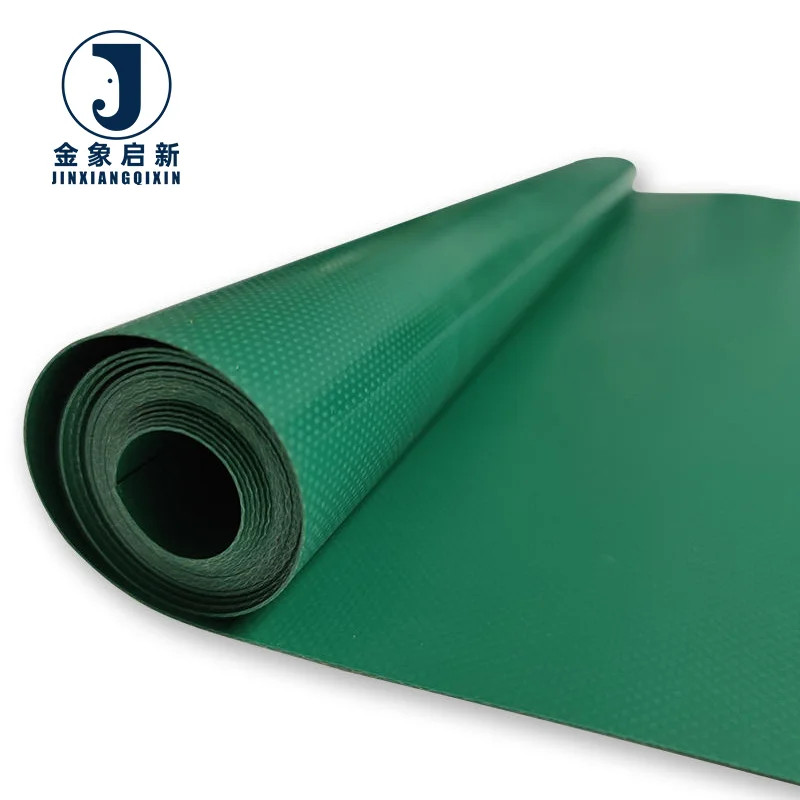
Precision Coating Control — Every PVC Coated Tarpaulin Roll from 350 to 900 GSM is tied to a verified yarn count, mesh density, and coating thickness, giving technical buyers transparent material data instead of marketing claims.
Technical Specifications
| Parameter | Value |
|---|---|
| Product Type | PVC Coated Tarpaulin Roll |
| Base Fabric Denier | 500D×840D / 500D×1000D / 1000D×1000D / 1000D×1300D / 1300D×1300D / 1000D×2000D |
| Weight (GSM) | 350 / 400 / 420 / 500 / 600 / 650 / 750 / 900 |
| Total Thickness | 0.29 mm (350 GSM) to 0.65 mm (900 GSM) |
| Mesh Count / Density | 30×19 (350–500 GSM) / 20×20 (600–750 GSM) / 30×15 (900 GSM) |
| Tensile Strength (Warp) | 1650 N (350 GSM) to 3900 N (900 GSM)¹ |
| Tensile Strength (Weft) | 1600 N (350 GSM) to 3500 N (900 GSM)¹ |
| Coating Material | Double-sided PVC on polyester base fabric |
| Flame Retardant | Available in flame-retardant grades — confirm the grade required for your market² |
| UV Treatment | Anti-UV treated — confirm test basis and expected service conditions² |
| Waterproof Performance | Fully sealed PVC coating construction |
| Temperature Range | Brittle ≤ −50 to −60 °C; Softening ≥ 80 °C; Melting point 212 °C |
| Density | 1.15–2.00 g/cm³ |
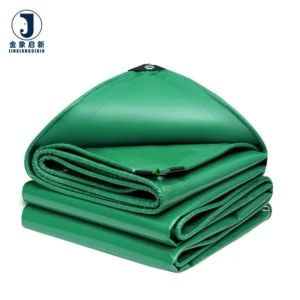
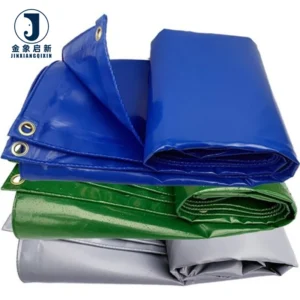
| Color | Customizable |
| Edge Finishing | High-temperature heat-sealed seamless edge wrapping |
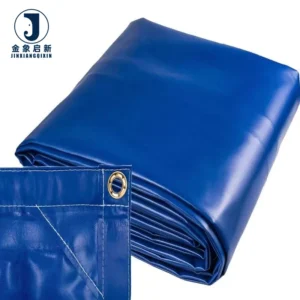
| Eyelet Option | 3 cm enlarged aluminum alloy buttonhole |
| Corner Reinforcement | Reinforced corners on all sides |
| Rope | 5 mm thick rope, no splicing |
¹ Test basis not stated in source — request test standard before specification.
² Grade and test report available on request — specify the standard required by your market.
Application Suitability
| Application | Exposure & Requirement |
|---|---|
| Truck side curtains | Constant flexing, road abrasion, UV exposure — high warp tensile and tear resistance needed |
| Trailer covers | Wind load, tie-down stress at eyelets — reinforced corners and heat-sealed edges critical |
| Tent and awning structures | Prolonged UV, rain, and wind uplift — coating adhesion and dimensional stability essential |
| Machine and equipment covers | Outdoor storage, dust ingress, chemical splash — full waterproof sealing required |
| Terrace pergola rain covers | Seasonal weather cycles, pooled water on flat sections — puncture and hydrolysis resistance |
Why GSM Alone Does Not Tell You the Full Story on PVC Coated Tarpaulin Material and Coating Technology
The same GSM can hide entirely different base fabric constructions and coating weights.
A buyer receives a roll quoted at 650 GSM and assumes adequate strength for a truck side curtain application. The fabric tears at the first flex point because the base fabric denier was 500D×840D instead of the 1000D×1000D the tensile load actually demanded. The PVC coated polyester tarpaulin GSM tensile strength relationship depends on yarn count, mesh density, and how the coating mass is distributed — not on weight alone [NEED_CITE: tensile and tear test methods for coated fabrics per ISO 1421]. Specifying by GSM without verifying the underlying construction is the most common route to premature field failure.
How Base Fabric Denier Defines the Structural Backbone
The base fabric carries the mechanical load; the PVC coating protects it. A 1000D×2000D polyester weave provides substantially higher tear propagation resistance than a 500D×1000D weave at the same coating weight. For fabricators cutting panels for truck side curtains or tensioned awning structures, the denier selection determines how the material behaves at welded seams and eyelet rows. Every grade in this PVC Coated Tarpaulin Roll range is matched to a documented yarn count so that specification starts from the base fabric, not from the coating alone.
Coating Weight, Thickness, and the Peel Strength Question
Double-sided PVC coating on a polyester base fabric delivers the waterproof barrier and surface durability. The total thickness ranges from 0.29 mm at 350 GSM through 0.65 mm at 900 GSM, with each step corresponding to a defined mesh density. Thicker coating does not automatically mean better peel strength — the adhesion between PVC and polyester depends on the coating method and process temperature [NEED_CITE: coating adhesion test methods for PVC on polyester substrates]. Technical buyers comparing roll stock should request peel strength data alongside GSM and thickness values to assess how well the coating will survive repeated flexing and hot-air welding.
Reading the Tensile and Mesh Data Together
Mesh density — expressed as ends and picks per unit area — determines how load distributes across the fabric. A 30×19 mesh at 500 GSM spreads tension differently than a 20×20 mesh at 650 GSM, even when warp tensile values appear comparable. The warp tensile figures range from 1650 N at 350 GSM to 3900 N at 900 GSM, with weft values from 1600 N to 3500 N across the same span. These values should be evaluated alongside the mesh count and denier to determine suitability for high-stress applications such as tensioned membrane structures or heavy-duty trailer covers [NEED_CITE: relationship between mesh count and tensile performance in woven coated fabrics].
The Hidden Cost of Specifying on Marketing Claims Instead of Material Data
A shipment arrives and the color shifts visibly between rolls when installed side by side on a fleet of trailers. The flame-retardant claim on the quotation cannot be matched to any recognized standard, and the site inspector rejects the material. Welded seams split before the fabric itself fails because the coating composition was not disclosed and the hot-air welding temperature was guessed [NEED_CITE: common weld failure modes in PVC coated tarpaulin fabrication]. These outcomes trace back to sourcing decisions made on unverified claims rather than on documented base fabric denier, mesh density, coating weight, and certified treatment grades.
Why Technical Buyers Source This PVC Coated Tarpaulin Roll Range Here
Three full production lines and 36 sets of professional equipment support bulk roll output with consistent coating weight across the entire order. The 10-person R&D team handles material selection and sample development, providing test-backed specification sheets rather than generic catalog data. Dedicated quality control at every production stage with 100 percent pre-shipment inspection catches GSM drift and color variation before rolls leave the facility. ISO and CE certified processes underpin the documentation package that accompanies each dispatch. Custom widths, colors, and flame-retardant grades are developed as samples within days, allowing fabricators to validate material before committing to production volumes.
Documentation & Verification
- Material specification sheet stating GSM, base fabric denier, mesh count, and coating weight per roll
- Test report for UV and flame-retardant grades — specify the standard required for your market
- Pre-shipment inspection record confirming roll-to-roll consistency in color, weight, and thickness
- ISO and CE certificates included with the documentation package
- Roll packing list and certificate of origin for customs clearance
Fabrication, Handling & Storage
- Hot-air welding temperature must match the PVC coating thickness — 0.29 mm and 0.65 mm grades require different heat settings
- Reinforced corners and 3 cm aluminum eyelets distribute tie-down loads — place eyelets at intervals matched to the tensile grade
- Store rolls upright on pallets to prevent flat-spotting and creasing of the PVC coating surface
- Allow cold-stored rolls to reach ambient temperature before unrolling to avoid coating crack at brittle threshold
- Clean with mild detergent only — solvents can degrade the PVC coating and compromise UV treatment
- Use hot-air welding for field repairs on seams and punctures, matching the filler rod to the coating grade
Preparing Your Specification Inquiry
Provide the intended application and the mechanical loads the fabric will face — wind uplift, tie-down tension, or flexing frequency. State the fire classification or compliance standard required in your destination market so the correct flame-retardant grade can be quoted. Specify the roll width, color reference, and whether you need raw roll stock or finished panels with eyelets and edge finishing. If a custom color or printed branding is required, request a sample for approval before production begins.
Frequently Asked Questions
Q: How is GSM verified on each roll and what tolerance applies?
A: Every roll undergoes weight verification during pre-shipment inspection. The material specification sheet documents the actual GSM per roll against the quoted value. Acceptable tolerance depends on the grade and coating method — request the inspection record and compare the stated GSM with your incoming goods check.
Q: What flame-retardant standards can be supplied with this material?
A: Flame-retardant treatment is available in multiple grades. The specific standard — such as DIN 4102, NFPA 701, or other regional classifications — must be confirmed at inquiry stage. A test report from a recognized laboratory is provided with the shipment when a certified grade is ordered.
Q: How does double-sided PVC coating compare to PE woven tarpaulin?
A: PVC coated polyester fabric offers higher tensile strength per unit weight, superior abrasion resistance, and hot-air weld repairability that PE woven material cannot match. The coating structure also provides better long-term dimensional stability under tension, making it the preferred choice for fabricated covers and tensioned structures.
Q: What denier and mesh count suit high-tensile applications like truck side curtains?
A: Higher denier base fabrics such as 1000D×1300D or 1000D×2000D with a tighter mesh count deliver the tear propagation resistance needed for constant-flex applications. Specify by tensile requirement and flex cycle exposure rather than by GSM alone, and request sample panels for weld testing.
Q: Can I order custom widths or colors with verified batch consistency?
A: Custom widths and colors are available, and samples are developed within days for approval. Pre-shipment inspection covers color consistency across all rolls in the order. The inspection record documents roll-to-roll uniformity in GSM, thickness, and color reference before dispatch.