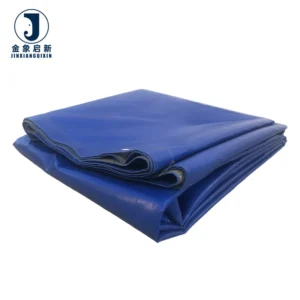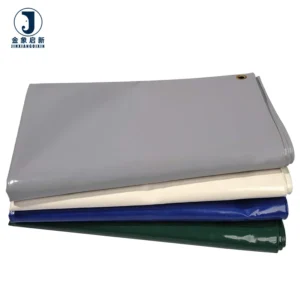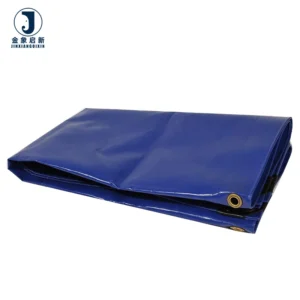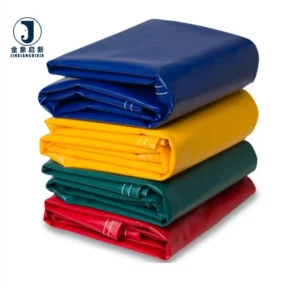
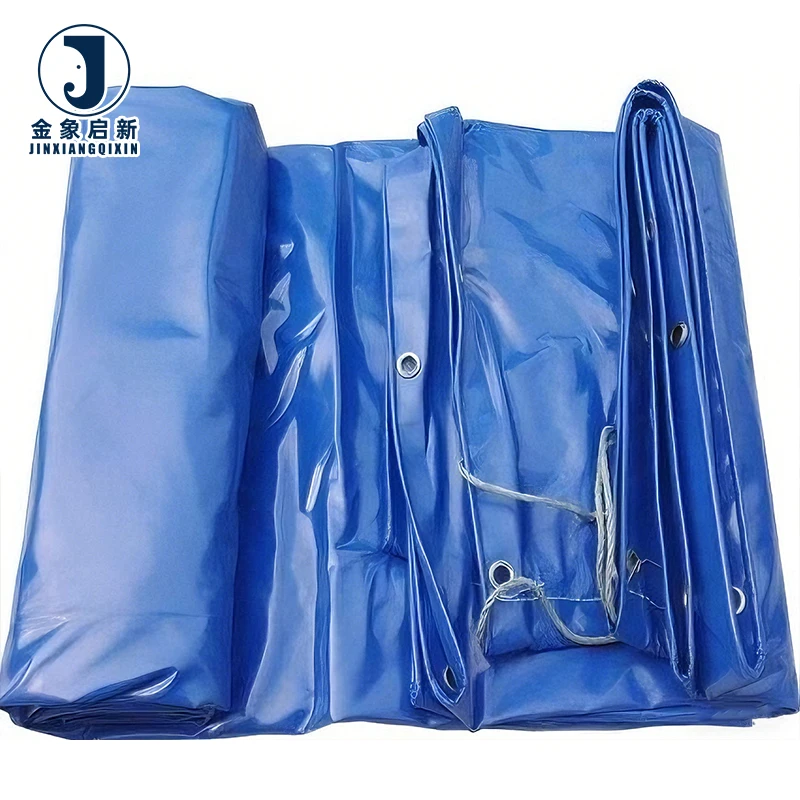
Process Control Over Coating Weight — Every roll of PVC coated tarpaulin fabric leaves the production line with documented GSM verification matched against the purchase order specification.
Technical Specifications
| Parameter | Value |
|---|---|
| Product Type | PVC Coated Tarpaulin |
| Weight (GSM) | 250gsm-1500gsm |
| Base Fabric Denier | 200DX300D / 500DX500D / 840DX840D / 1000DX1000D |
| Coating Material | PVC |
| Surface Finish | Glossy or matte |
| Colour Options | Blue, yellow, black, green, white, and custom colours |
| Standard Sizes | 3x4m / 6x8m / 8x10m / 10x12m or custom made |
| Temperature Range | -15°C to 70°C |
| Waterproof | Yes |
| UV Treatment | Customized (test basis not stated in source) |
| Flame Retardant | Treated (grade not stated in source) |
| Anti-Fungal | Treated |
| Key Features | Water-proof, rain-resistant, tear-resistant, durable, good flexibility, adhesion strength, abrasion resistance |
Application Suitability
| Application | Exposure & Requirement |
|---|---|
| Truck and trailer load covering | Constant flexing at tie-down points, road debris abrasion, sustained UV exposure, rain ingress at seams |
| Construction site and equipment covers | Prolonged weathering, wind uplift stress, contact with alkaline dust and mortar splatter |
| Tent and awning manufacturing | Repeated folding and unfolding, UV load, welded seam integrity at frame contact zones |
| Agricultural and aquaculture pond lining | Permanent water immersion, soil chemistry contact, puncture risk from substrate |
| Inflatable and membrane structures | Internal air pressure stress, continuous UV load, seam adhesion under tension |
Why Coating Adhesion Matters More Than Stated GSM
A 650 GSM fabric with poor coating adhesion will delaminate at the weld before the base fabric reaches its tensile limit.
Buyers frequently specify PVC coated tarpaulin fabric by weight alone, assuming heavier GSM guarantees stronger performance in the field. Yet when coated fabric is heat-welded at seams — the most common fabrication method for truck side curtains and tent panels — the failure point is often the coating-to-yarn bond, not the yarn itself. [NEED_CITE: tensile and tear test methods for coated fabrics per ISO 1421] A material that tests well on a grab tensile machine may still fail at the welded seam under cyclic flex loading if the PVC compound does not penetrate the base weave adequately. This is why coating process control and adhesion strength deserve the same scrutiny as GSM and denier when evaluating roll stock for fabrication.
Base Fabric Denier and Its Role in Structural Performance
The base fabric denier — ranging from 200DX300D to 1000DX1000D across this PVC coated tarpaulin fabric family — defines the yarn thickness in both warp and weft directions. Heavier denier yarns provide higher inherent tensile and tear resistance, making grades such as 840DX840D and 1000DX1000D suited to high-stress applications like truck side curtains that endure constant wind load and tie-down tension. Lighter denier options serve applications where weight and pack-down size matter more than ultimate strength, such as temporary event covers or light-duty equipment wraps.
Coating Weight and the GSM Specification Chain
Coating weight expressed as GSM represents the total mass per square metre of the finished PVC coated tarpaulin fabric, combining both the base fabric and the PVC coating layers. A higher GSM can result from a heavier base fabric, a thicker coating, or both — and these three scenarios produce very different material behaviours. A fabric with a light base but heavy coating may show good waterproofing yet poor tear propagation resistance. [NEED_CITE: relationship between coating weight and base fabric contribution to tensile performance in PVC coated textiles] Specifiers should always request the base fabric denier alongside GSM to understand how the weight is distributed between yarn and coating.
Surface Finish, Temperature Range, and Fabrication Behaviour
The glossy or matte surface finish available on this fabric range influences more than appearance. Glossy finishes shed water and dirt more readily and accept printed branding with sharper definition, while matte surfaces reduce glare for architectural and event applications. The operating temperature range of -15°C to 70°C sets the boundaries for deployment: below -15°C the PVC compound stiffens and becomes susceptible to cracking under flex, while sustained exposure above 70°C can soften the coating and reduce seam peel strength. Fabricators planning hot-air welding should confirm their welding temperature profile against the coating formulation to avoid burn-through or insufficient bonding.
The Hidden Cost of Specifying on Weight Alone
When PVC coated tarpaulin fabric is purchased on GSM without verifying base fabric denier or coating adhesion, the consequences appear at the fabrication stage. Rolls that measure correct weight on the scale may still produce weak welded seams if the PVC compound has poor yarn penetration, leading to seam failure under the first significant load cycle. [NEED_CITE: weld seam peel strength testing for PVC coated polyester fabrics] Colour inconsistency between rolls from the same order becomes visible only after installation, when panels mounted side by side reveal batch variation. And flame-retardant treatment claimed without a supporting test report can result in failed site inspections, forcing removal and replacement at the contractor’s expense. These failures share a common root: specification based on a single number rather than a complete material profile.
Why Fabricators and Technical Buyers Source This Range
Three full production lines and 36 sets of professional equipment support bulk roll output with consistent coating weight across the entire production run. The 10-person R&D team handles material selection, custom sizing, and sample development — enabling fabricators to confirm denier, finish, and colour before committing to a container order. Dedicated QA and QC inspection at every production stage, with 100% roll-by-roll verification before shipment, catches GSM deviation and surface defects before they reach the loading dock. [NEED_CITE: DIN 4102 fire classification for building materials] ISO and CE certification underpins the quality management framework, and nearly 30 years of focused coated fabric production means the coating formulation and process parameters are refined through sustained operational experience rather than trial and error.
Documentation & Verification
- Material specification sheet stating GSM, base fabric denier, coating type, and colour reference per roll
- Test reports for UV and flame-retardant grades where applicable, identifying the standard and grade
- Pre-shipment inspection record with 100% roll-by-roll GSM and visual verification before dispatch
- ISO and CE certificates included with shipment documentation
- Roll packing list detailing weight, dimensions, and roll count for container loading planning
- Certificate of origin and customs support documentation provided per destination market
Fabrication, Handling & Storage
- Heat-weld temperature profiles must match the PVC coating formulation — confirm parameters for glossy or matte finish before production runs
- Store rolls upright on pallets to prevent flat-spot creasing that weakens the coating at the fold line
- Unroll and allow fabric to acclimatise before fabrication when ambient temperature is near -15°C to restore flexibility
- Use compatible PVC-based adhesive for field repairs to maintain coating adhesion continuity across patched areas
- Plan cutting layout to minimise off-cuts and ensure welded seams fall away from high-flex zones on truck curtains
Requesting a Specification-Matched Quotation
To receive an accurate quotation for this PVC coated tarpaulin fabric, provide your target base fabric denier, required GSM grade, surface finish preference, and intended roll width and length. If your end-use application requires flame-retardant or UV-treated fabric, specify the standard your market demands so the correct grade and supporting test report can be matched to your order. Confirm whether you need roll stock for in-house fabrication or finished cut-to-size panels with eyelets and reinforced hems.
Frequently Asked Questions
Q: How is GSM verified before each shipment?
A: Every roll undergoes coating weight measurement during the pre-shipment inspection. The measured GSM is recorded against the purchase order specification, and any roll falling outside the agreed tolerance is held back before dispatch. The inspection record ships with the batch for your own verification on arrival.
Q: Which flame-retardant grades are available, and what test reports accompany them?
A: Flame-retardant treatment is available in grades suited to various market requirements. The specific grade — such as M2, B1, NFPA 701, or DIN 4102 — must be confirmed at inquiry so the correct formulation and matching test report can be supplied with your documentation package.
Q: How does base fabric denier affect tensile and tear strength at the same GSM?
A: At equal GSM, a fabric woven from higher denier yarns such as 1000DX1000D typically delivers higher tear propagation resistance than one using lighter yarns with a thicker coating. The yarn carries the structural load while the coating provides waterproofing — both must be specified together to predict real-world performance.
Q: Can custom width, colour, and surface finish be combined in one roll order?
A: Custom roll width, non-standard colours, and glossy or matte finish can be produced to your specification. Minimum order quantities and lead times depend on the specific combination requested. Submit your requirements early so samples can be developed and approved before the production run begins.
Q: What documentation ships with each batch?
A: Each shipment includes a material specification sheet, pre-shipment inspection record, roll packing list, ISO and CE certificates, and certificate of origin. Where UV or flame-retardant grades are specified, the corresponding test report identifying the standard and result is included alongside the batch documents.