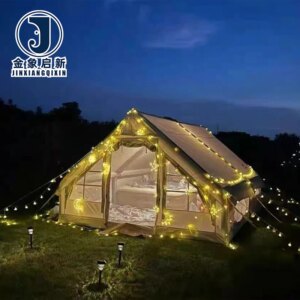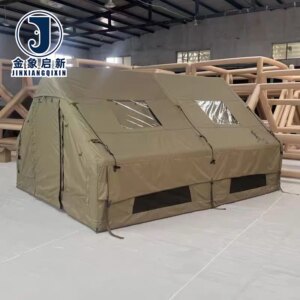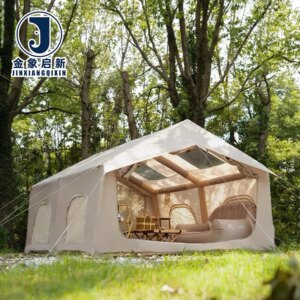
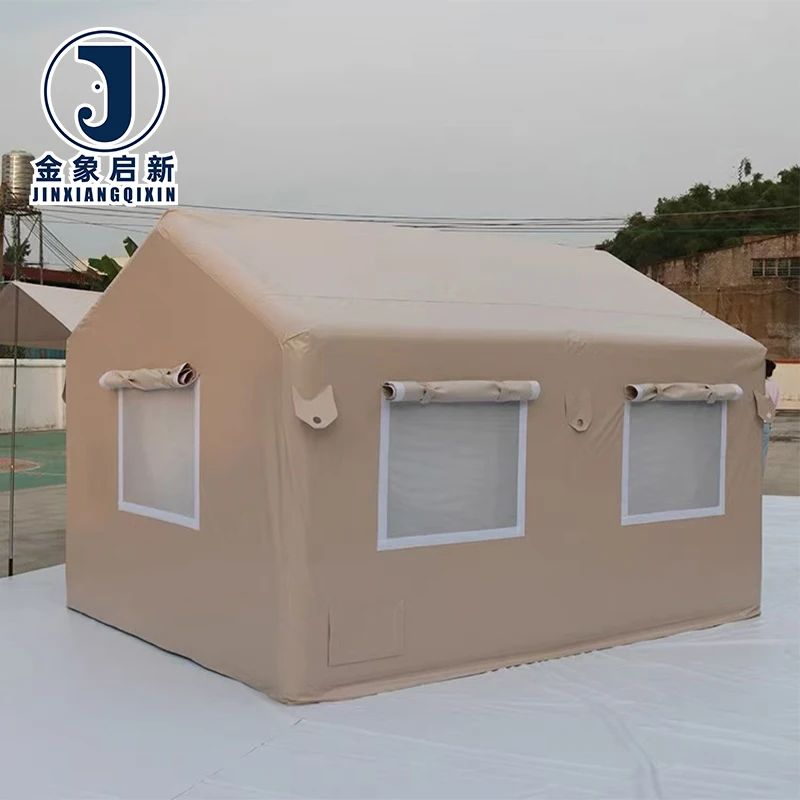
Proven coating control — strict batch-level consistency enforced across every production run of PVC inflatable tent fabric, backed by dedicated QA at each stage and full test documentation on request.
Technical Specifications
| Parameter | Value |
|---|---|
| Product Type | Inflatable Tent |
| Core Material | PVC tarpaulin |
| Capacity | 8-10 Person |
| Waterproof Performance | Fully waterproof coated construction |
| UV Resistance | UV-resistant treatment available (confirm specific grade and test standard required for your market) |
| Tear Resistance | Tear-resistant PVC construction |
| Fire Retardancy | Fire-retardant grades available (confirm the grade required for your market) |
| Anti-Static Treatment | Available for applications requiring static discharge control (standard not stated) |
| Season Rating | Four-season outdoor suitability |
| Customization | OEM & ODM including sample customization and pattern printing |
| Certifications | ISO 9001, ISO 14001, ISO 45001, CE |
Application Suitability
| Application | Exposure & Requirement |
|---|---|
| Temporary site offices | Wind loading, sun exposure, fire-retardant compliance for occupied structures |
| Equipment storage shelters | Water ingress prevention, abrasion from stored machinery, extended outdoor deployment |
| Emergency response command centers | Rapid deployment reliability, all-weather waterproofing, visibility for rescue operations |
| Temporary event venues | Crowd safety fire codes, UV exposure over multi-day events, branding and print clarity |
| Year-round industrial shelters | Thermal cycling, snow load on inflatable beams, long-term coated fabric durability |
Why Fire-Retardant Claims Fail at Site Inspection
Purchasing PVC inflatable tent fabric with a verbal promise of flame resistance but no accompanying test certificate is a recurring procurement failure. When safety inspectors arrive at a construction site or event venue, a general claim carries no weight — only documented grades and recognised test standards satisfy compliance officers.
Specify the exact fire-retardant grade and test standard your local authority requires before placing your order.
Across multiple deployments, inflatable shelters have been rejected at commissioning because the fabric supplier could not produce a valid test report matching the jurisdiction’s fire code. The cost of replacing an entire batch of fabricated units far exceeds the time spent confirming grades upfront. An inflatable tent fabric manufacturer that cannot supply the supporting documentation for its fire-retardant claims is transferring compliance risk directly onto your project. [NEED_CITE: fire classification standards for temporary structures and textile building materials]
Coating Technology Behind the Inflatable Beam
The structural integrity of any air-beam shelter depends on the PVC tarpaulin material resisting sustained internal pressure without creep or delamination. This PVC inflatable tent fabric is produced using coated construction methods that bond the PVC layer to the base fabric, creating a composite that holds air under continuous inflation. The adhesion between coating and substrate determines whether the beam maintains its profile through repeated inflation cycles or begins to soften and deform over a season of use.
Selecting the right inflatable shelter material requires understanding how coating weight interacts with the base fabric’s tensile properties. A heavier coating adds waterproof reliability but also increases roll weight and handling difficulty during fabrication. Our R&D team evaluates these trade-offs for each custom inflatable tent fabric specification, ensuring the material performs as a structural element, not just a weather barrier.
Weld Integrity Under Cyclic Pressure Loading
Every seam on an inflatable shelter is a potential failure point where cyclic pressurisation concentrates stress. The PVC tarpaulin used for this inflatable tent product is engineered for thermal welding compatibility, allowing fabricators to create seams that match or exceed the parent material strength. Proper heat-welding parameters must be established for each production batch, as coating formulation affects the temperature window for reliable joint formation. [NEED_CITE: tensile and tear test methods for coated fabrics per ISO 1421]
When welded seams fail before the fabric itself does, the root cause typically traces back to incorrect temperature settings or insufficient dwell time during fabrication. We support fabricators with material-specific welding guidance and provide sample rolls for parameter optimisation before bulk production begins. This pre-production validation step eliminates costly seam failures in the field.
Reading the Specification Sheet Correctly
The core material designation as PVC tarpaulin covers a range of constructions that behave differently under load. Base fabric denier and weave density determine how tear forces propagate once the surface is punctured — a tighter weave arrests tear spread more effectively than an open construction, regardless of overall coating weight. This is why GSM alone does not predict field performance; two fabrics at the same weight can exhibit markedly different tear behaviour depending on their base cloth architecture.
Coating method — whether knife-over-roll, dip, or calender — influences peel strength between the PVC layer and the polyester substrate. Higher peel strength translates directly to better weld performance and longer service life under the flexing that inflatable beams experience. Surface finish, whether glossy or matte, affects both cleaning ease and the adhesion of printed branding for corporate event deployments. Confirming these parameters against your application requirements ensures the PVC inflatable tent fabric you receive matches the environment it will serve.
The Real Cost of Undocumented Material Properties
Procuring inflatable shelter material on price alone, without verifying batch-to-batch consistency, surfaces as colour variation across rolls delivered in the same shipment. When adjacent panels on a large event tent show visible shade differences once erected, the entire structure may need to be re-covered or replaced, and the reputational damage to the event organiser is immediate. Similarly, fabric that tests adequately for UV resistance on the sample roll but lacks batch-level test documentation can degrade prematurely when deployed in high-sun environments, leading to warranty claims that the supply chain cannot resolve. [NEED_CITE: batch consistency verification methods for coated textile products]
Fire-retardant grades claimed without supporting certificates have resulted in site shutdowns, where inspectors refuse to allow occupancy until compliant documentation is produced. The project delay costs multiply daily, and the original fabric supplier is often unreachable or unable to retroactively certify material that was never tested to the claimed standard.
Why Fabricators Source This PVC Inflatable Tent Fabric Here
Nearly three decades of continuous PVC coated fabric production provide process knowledge that shows up in roll-to-roll consistency — every batch of inflatable shelter material is held to the same coating weight and adhesion standards. Three full production lines with 36 sets of processing equipment deliver the volume capacity needed for multi-unit shelter deployments without sacrificing lead-time reliability. A dedicated ten-person R&D team handles material selection, pattern printing specifications, and sample development, resolving technical questions before your fabrication line starts cutting. Full-process quality inspection with dedicated QA and QC staff means every roll is checked against specification before it leaves the facility. Documentation accompanies each shipment — from material specification sheets to pre-shipment inspection records — so your quality team can verify without delay. [NEED_CITE: quality management system requirements for coated fabric manufacturing per ISO 9001]
Documentation & Verification
- Material specification sheet stating GSM, base fabric construction, coating type, and colour reference for every roll
- Test reports for UV and fire-retardant grades supplied where applicable, matched to batch numbers
- Pre-shipment inspection record confirming weight verification and visual quality before dispatch
- ISO 9001, ISO 14001, ISO 45001, and CE certificates available with each order
- Certificate of origin and customs documentation provided for international inflatable tent fabric shipments
Fabrication, Handling & Storage
- Establish thermal welding parameters on sample pieces before cutting full panels from the PVC tarpaulin roll
- Store rolls vertically on pallets in a covered area to prevent flat-spot deformation of the coated surface
- Allow material to acclimatise to workshop temperature before unrolling to avoid creasing in cold PVC tarpaulin
- Use compatible PVC-based repair patches and adhesive for field fixes on inflatable beam seams
- Plan cutting layouts to minimise offcuts and maximise yield from each roll width supplied
- Avoid dragging rolls across unprotected concrete floors to prevent surface abrasion on the coating
How to Structure Your Enquiry
To receive an accurate specification recommendation for your inflatable tent project, share the deployment environment — including expected wind loads, temperature range, and duration of continuous inflation. Specify the fire-retardant grade or test standard required by your local jurisdiction so we can confirm material compliance before sampling. If you require OEM branding or pattern printing on the PVC tarpaulin surface, provide artwork files and confirm whether finished panels or roll stock is needed for your fabrication process.
Frequently Asked Questions
Q: How is batch colour consistency controlled across multiple rolls for the same inflatable tent order?
A: Each production run of PVC inflatable tent fabric is managed with dedicated QA oversight at every stage, from coating preparation through final winding. Colour reference standards are established during sample approval, and subsequent batch rolls are checked against these references before dispatch. If your project requires multiple rolls for a single structure, request a pre-shipment inspection record that documents colour consistency across the entire order lot.
Q: What fire-retardant grades and test standards are available for inflatable tent fabric?
A: Fire-retardant treatment is available in multiple grades depending on your market’s regulatory requirements. The applicable test standard must be confirmed before production, as different jurisdictions mandate different classifications for temporary structures. Provide your local fire code reference when enquiring, and the supporting test report will be supplied with the batch documentation for your inspector’s review.
Q: What is the sample development and approval process for custom inflatable tent material?
A: Sample development for custom PVC tarpaulin specifications is completed within days once your requirements for colour, coating weight, and treatment are confirmed. The approved sample serves as the production reference for your bulk order, ensuring the material you receive matches the tested prototype. OEM pattern printing can also be validated on sample pieces before full roll production begins.
Q: How are UV-resistance claims validated, and what test documentation is provided?
A: UV-resistant treatment is applied during the PVC coating process, and the specific grade should be confirmed against your deployment environment and expected exposure duration. Where test documentation is applicable, reports are matched to batch numbers and included with shipment paperwork. Always specify the UV test standard relevant to your target market when placing your order so the correct validation is supplied.
Q: What OEM printing and branding options are supported for inflatable tent fabric rolls?
A: Pattern printing and branding are available through the OEM and ODM customisation service, supporting corporate event shelters and branded emergency response structures. Artwork is reviewed by the R&D team for compatibility with the PVC tarpaulin surface, and print samples are produced for approval before bulk roll printing proceeds. Confirm colour references and print dimensions early to align with your project timeline.