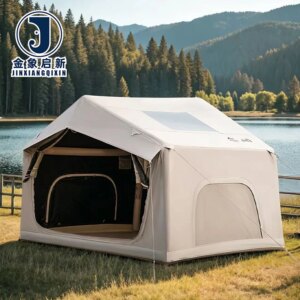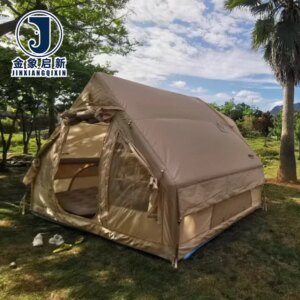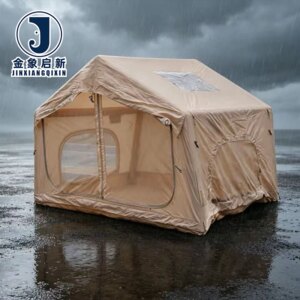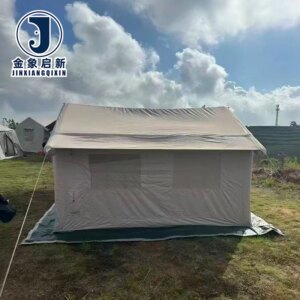
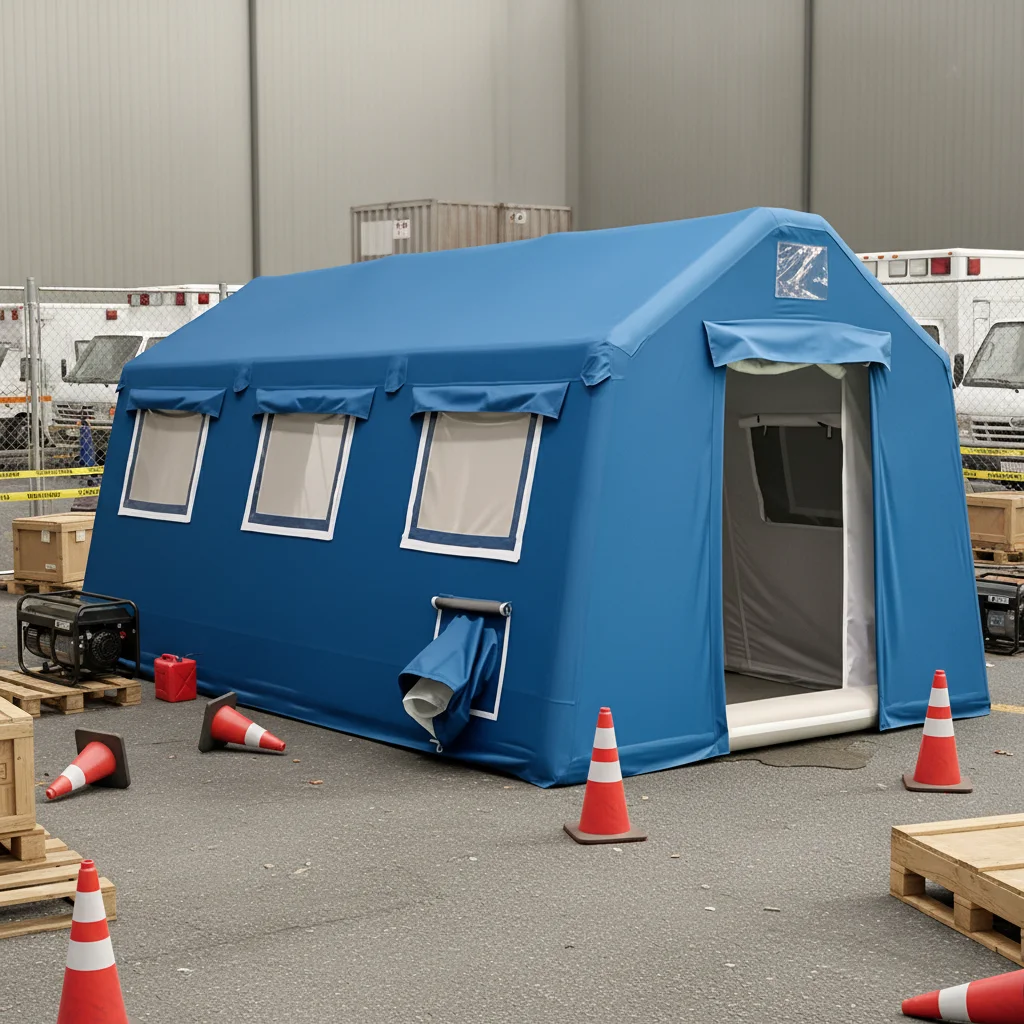
Coating Adhesion Control — every roll of PVC inflatable tent fabric is verified for coating weight and bond strength before leaving the production line, ensuring consistent seam performance across rapid-deployment shelter orders.
Technical Specifications
| Parameter | Value |
|---|---|
| Product Type | Inflatable Tent Fabric |
| Core Material | PVC knife-coated fabric |
| Product Forms | Quick automatic opening, single layer construction, extended type |
| Waterproof | Fully waterproof coated construction |
| UV Resistance | UV-resistant treatment (test basis not stated in source) |
| Fire-Retardant | Fire-retardant properties claimed (grade not stated in source) |
| Tear Resistance | Tear-resistant PVC coated structure |
| Customization | OEM & ODM customization, sample customization, pattern printing |
| Quality Control | Full-process inspection with dedicated QA & QC staff |
| Air Pressure Test | Minimum 24-hour inflation system integrity test |
| Certifications | ISO9001, ISO14001, ISO45001, CE |
Application Suitability
| Application | Exposure & Requirement |
|---|---|
| Emergency response command centers | Immediate deployment under variable weather, repeated inflation cycles, wind loading on membrane panels |
| Temporary storage during disaster recovery | Water ingress prevention, UV exposure during extended outdoor staging, puncture from stored equipment |
| Mobile field operations bases | Frequent transport and redeployment, abrasion from ground contact, seam stress during pressurization |
| Rapid deployment shelters for infrastructure maintenance | Four-season outdoor exposure, fire-retardant compliance for temporary site structures, weld integrity under thermal cycling |
Why Coating Weight Matters More Than GSM Alone for PVC Inflatable Tent Fabric
GSM tells you the total mass, but coating adhesion and base fabric denier determine whether the welded seams hold under inflation pressure.
Buyers reviewing PVC inflatable tent fabric quotations often focus on the stated GSM without verifying how that weight is distributed between the base fabric and the PVC coating layers. A higher GSM achieved through heavy coating on a light base fabric may inflate correctly on the first test but fail at the heat-welded seams once the structure is pressurized and flexed in wind. [NEED_CITE: tensile and tear test methods for coated fabrics per ISO 1421] The coating-to-substrate bond is the variable that separates a membrane that holds pressure through a storm from one that delaminates at the seam line.
Knife-Coated Construction and Membrane Integrity
The PVC inflatable tent fabric produced here uses a knife-coating process that forces PVC compound into the interstices of the base fabric, creating a mechanical lock between coating and yarn. This method delivers superior adhesion compared to simple lamination, which is critical when the membrane is subjected to internal air pressure and external wind loads simultaneously. The coating penetrates the weave rather than sitting on top, reducing the risk of delamination at high-stress points such as valve ports and structural bends.
UV and Fire-Retardant Treatment Considerations
The PVC coating formulation includes UV-resistant additives intended to slow polymer degradation during extended outdoor deployment, though the specific test basis should be confirmed against your target-market requirements. Fire-retardant treatment is similarly incorporated into the PVC compound — available in flame retardant grades that should be confirmed for your specific market safety standard before production. [NEED_CITE: fire classification standards for temporary membrane structures] Always request the test report matching the grade required by your end-use jurisdiction rather than relying on a general flame-retardant claim.
Reading the Specification Sheet Beyond Weight
Base fabric denier and weave density work together with coating weight to produce the final tensile and tear performance of PVC inflatable tent fabric. A high-denier yarn in a tight weave provides the structural skeleton; the PVC knife-coated layer adds mass, waterproofing, and welding capability. Coating method matters equally: knife coating yields better peel strength at welded seams than calendered or laminated alternatives, which directly affects how the fabric behaves during heat-welding fabrication. Surface finish — whether glossy or matte — influences both cleaning behaviour in field conditions and the adhesion of any printed markings or branding applied to the shelter exterior. Width and roll length determine cutting yield and the number of welded joins required for a given tent pattern, which in turn affects overall structural continuity.
The Hidden Cost of Specification Misalignment
Selecting PVC inflatable tent fabric without verifying coating adhesion against the intended inflation pressure leads to seam failure that appears only after deployment — not on the factory floor. Batch-to-batch variation in coating weight causes inconsistent heat-welding parameters, forcing fabricators to recalibrate between rolls and increasing scrap rates. [NEED_CITE: heat-welding parameters for PVC coated fabrics and seam peel strength] When the fire-retardant grade stated on the quotation does not match the certification documentation provided, the entire shelter order may be rejected at the project inspection stage. Colour drift between production batches creates visible mismatches once multiple shelters are erected side by side at a disaster-relief site.
Why Technical Buyers Source This Fabric Here
Three full production lines and 36 sets of processing equipment provide the capacity to deliver consistent PVC inflatable tent fabric across bulk orders without sacrificing coating control. A 10-technician R&D team handles material selection, custom sizing, and sample development — critical when inflatable membrane geometry requires non-standard widths or specific coating weights. Full-process quality inspection with dedicated QA and QC staff means every roll is checked for coating weight, adhesion, and visual consistency before dispatch, not just sampled from the batch. The 9,180 m² production facility supports the workflow from raw base fabric through coating, inspection, and packing under one roof. Sample development within days allows buyers to validate welding parameters and inflation behaviour before committing to production volume.
Documentation & Verification
- Material specification sheet stating base fabric denier, weave, coating method, and GSM for the inflatable tent fabric order
- UV resistance and fire-retardant test reports matched to the grade specified at quotation stage
- ISO9001, ISO14001, ISO45001, and CE certificates tied to production batches
- Pre-shipment inspection record including coating weight check and visual consistency across rolls
- 24-hour air pressure retention test record for completed inflatable shelter units
- Certificate of origin and customs documentation for cross-border shipment
Fabrication, Handling & Storage
- Heat-weld PVC knife-coated fabric at manufacturer-recommended temperature and speed to ensure coating-to-coating fusion at every seam
- Store rolls horizontally on racking to prevent permanent creasing in the PVC coating layer
- Allow cold-stored rolls to reach workshop temperature before unrolling to avoid coating crack in the PVC layer
- Use compatible PVC solvent or hot-air welding for field repairs on the knife-coated inflatable membrane surface
- Plan cutting layout to minimize cross-grain welds and maximize yield from the available roll width
- Clean with mild detergent only to preserve the UV-resistant and fire-retardant additives in the PVC coating
What to Include in Your Inquiry
Provide the intended deployment environment and expected exposure conditions — wind loading, temperature range, and duration of outdoor use — so the correct base fabric denier and coating weight can be recommended. Specify the fire-retardant grade required by your local authority or project standard, and confirm whether you need rolls for your own fabrication or finished inflatable shelter units. Include target colour references, any pattern printing requirements, and expected annual volume to support accurate lead-time and production planning.
Frequently Asked Questions
Q: How can I verify the stated GSM and coating weight when the PVC inflatable tent fabric arrives?
A: Request a pre-shipment inspection record that documents the measured coating weight and base fabric mass for each roll in your order. On arrival, you can perform a simple peel-and-weigh cross-check by cutting a measured sample, separating the coating from the base fabric with solvent, and weighing each component independently against the specification sheet values.
Q: What fire-retardant grades are available, and how do I confirm alignment with my market safety standards?
A: The PVC coating can be produced in fire-retardant grades, but the specific classification must be confirmed against your destination market requirements before production begins. Ask for the test report corresponding to your required standard — such as DIN 4102, NFPA 701, or M2 — and verify that the report references the production batch being shipped.
Q: What is the basis for the UV-resistance claim, and how does it affect extended outdoor deployment?
A: UV-resistant additives are incorporated into the PVC coating formulation, but the specific test method and exposure duration should be confirmed for your deployment scenario. Request the UV test report to understand the validated exposure period, and discuss with the R&D team whether additional surface treatment is advisable for your climate zone.
Q: What heat-welding guidelines apply to this PVC knife-coated inflatable fabric?
A: Knife-coated PVC requires hot-air or wedge welding at temperatures and speeds matched to the specific coating weight and thickness. Request the manufacturer’s welding parameter recommendation sheet for your fabric specification, and run test welds on sample material to calibrate your equipment before processing the full roll stock.
Q: How is batch-to-batch colour and coating consistency managed across custom inflatable shelter orders?
A: Each production batch undergoes visual inspection and coating weight verification before dispatch. For orders spanning multiple production runs, request a colour reference panel from the first batch to hold as the acceptance standard, and specify this requirement at the quotation stage so the QC team can plan inter-batch matching checks.