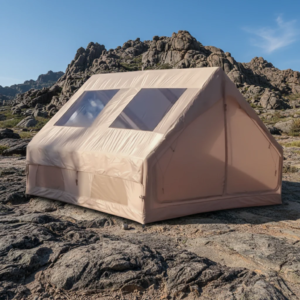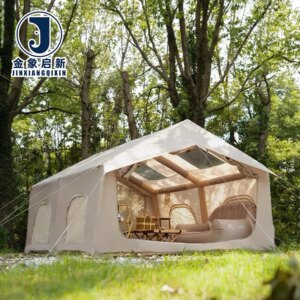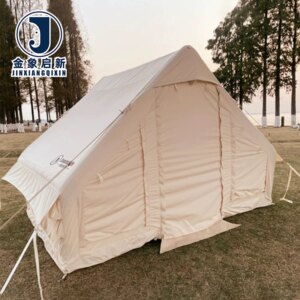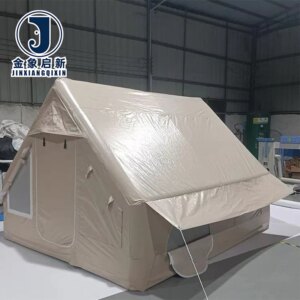
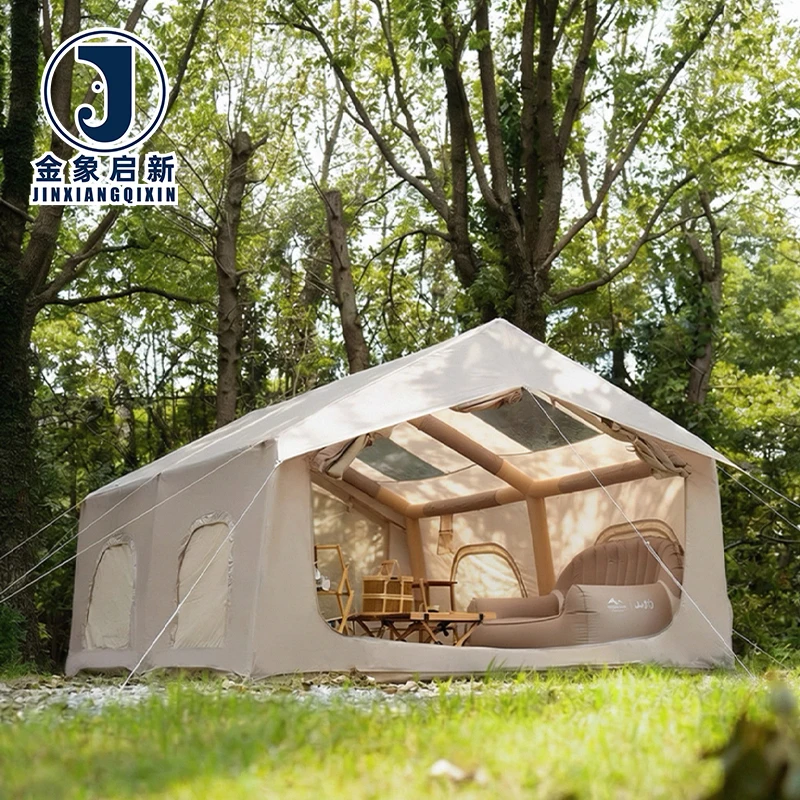
Proven Coating Control — nearly 30 years focused on PVC coated fabric delivers consistent GSM and adhesion across every roll of inflatable tent material shipped.
Technical Specifications
| Parameter | Value |
|---|---|
| Product Type | Inflatable Tent |
| Core Material | PVC waterproof fabric |
| UV Resistance | UV resistant treatment applied (test standard and exposure hours — confirm for your project requirements) |
| Waterproof Performance | Fully waterproof PVC coated construction |
| Construction Type | Single Layer Construction, Extended Type |
| Design Feature | Four-season capability |
| Deployment Method | Quick automatic opening |
| Customization | OEM & ODM support, material selection, design modifications, pattern printing |
| Certifications | ISO9001, ISO14001, ISO45001, CE |
Application Suitability
| Application | Exposure & Requirement |
|---|---|
| Emergency disaster relief shelters | Rapid deployment under unpredictable weather, continuous UV and rain exposure, transport to remote zones |
| Construction site temporary offices | Seasonal temperature swings, wind loading on inflated structure, daily entry and exit abrasion |
| Remote infrastructure maintenance camps | Isolation from supply chains requiring durable fabric, prolonged outdoor standing, equipment protection |
| Mobile command centers for industrial events | Quick setup and teardown cycles, public-facing appearance, repeated inflation and deflation |
Why "UV Resistant" Means Nothing Without the Test Data Behind It
Specifying inflatable shelter fabric demands documented coating performance, not marketing claims on a data sheet.
Technical buyers sourcing PVC inflatable tent fabric for emergency and industrial deployment face a recurring problem: the quotation states UV resistance, but the test standard, exposure duration, and intensity are absent. When the tent deploys into continuous sunlight at a disaster relief site or a remote construction camp, the coating must retain flexibility and colour integrity far beyond what consumer-grade fabrics endure. Without a verifiable test report tied to the specific batch, buyers cannot distinguish between a surface treatment that degrades in one season and a formulation engineered for extended outdoor service. [NEED_CITE: UV degradation test methods for PVC coated fabrics used in temporary structures]
PVC Coating Formulation and Waterproof Construction
The waterproof performance of this PVC inflatable tent fabric depends on the coating method and the weight applied to the base fabric. PVC coating creates a continuous barrier that prevents water penetration through the fabric body, while the seam construction determines whether water enters at the joints. For inflatable tent applications, the airbeam channels must maintain airtight seals under repeated inflation cycles, placing additional demand on both the coating adhesion and the welding integrity of the material.
Single Layer and Extended Type Structural Implications
Single layer construction reduces overall weight and packed volume, making transport to remote emergency sites more practical. The extended type configuration provides additional interior space for equipment storage or command operations without requiring multiple connected units. Both configurations rely on the PVC inflatable tent fabric maintaining dimensional stability when the airbeams are pressurised, which is governed by the base fabric denier, weave density, and the coating bond strength.
How Base Fabric and Coating Weight Interact in Inflatable Tent Performance
The relationship between base fabric construction and PVC coating weight determines how the inflatable tent material behaves under operational stress. A higher denier yarn in the base fabric provides greater tensile strength along the warp and weft directions, which is critical when airbeams are inflated to full pressure and the fabric is stretched taut. The coating weight contributes to puncture resistance and surface durability but does not independently determine tear strength — a heavily coated fabric with a loosely woven base will still propagate tears rapidly once initiated. [NEED_CITE: relationship between base fabric denier, weave density, and tear propagation in coated technical textiles] The coating method, whether knife-over-roll, laminating, or calendering, directly affects peel strength between the PVC layer and the base fabric, which in turn influences how well heat-welded seams hold during repeated inflation and deflation cycles. For inflatable tent applications where the airbeam structure flexes constantly with wind loading, a coating with strong adhesion to the base prevents delamination at stress concentration points. Surface finish — glossy or matte — affects dirt accumulation, cleanability, and the adhesion of printed branding or identification markings applied to the tent exterior.
The Hidden Costs of Specifying Inflatable Tent Fabric on Price Alone
When coating weight is reduced to lower material cost, the inflatable tent fabric may pass initial inspection but fail prematurely in the field. Thinner coatings abrade faster at contact points where the tent meets the ground or where equipment is moved in and out. Inadequate UV treatment formulation leads to surface chalking and embrittlement, causing the fabric to crack at fold lines during packing after a deployment. [NEED_CITE: common failure modes of PVC coated fabrics in temporary shelter applications] Colour variation between rolls within the same order becomes visible when multiple tent units are erected side by side at a single site, forcing rejection or acceptance of an inconsistent appearance. Welded seams that fail before the fabric itself indicate a mismatch between the heat welding parameters and the actual coating composition received.
Why Technical Buyers Source Inflatable Tent Fabric Here
Three full production lines and 36 sets of professional processing equipment support bulk capacity for PVC inflatable tent fabric with reliable delivery schedules. A 10-person R&D team handles material selection, design modifications, and pattern printing directly, enabling custom specifications to be developed and sampled within days. Dedicated QA and QC staff conduct in-process inspection at every production stage, with 100% pre-shipment inspection verifying coating weight and material consistency before dispatch. The manufacturing facility holds ISO9001, ISO14001, ISO45001, and CE certifications, providing compliance documentation required for international procurement. Nearly three decades of focused coated fabric production ensures deep process control over coating adhesion and base fabric tensioning.
Documentation & Verification
- Material specification sheet stating base fabric denier, PVC coating weight, and coating method for each inflatable tent fabric order
- UV resistance test report with stated test standard and exposure duration, available per batch using order reference
- ISO9001, ISO14001, ISO45001, and CE certificates provided for procurement compliance verification
- Pre-shipment inspection record confirming actual coating weight against quoted specification before container loading
- Roll packing list with individual roll identifiers for traceability from production to site delivery
Fabrication, Handling & Storage
- Heat welding temperature and dwell time must be calibrated to the specific PVC coating weight to avoid seam delamination on inflatable airbeam channels
- Store rolls upright on end cores in a dry, shaded environment to prevent permanent creasing of the PVC coated surface
- Avoid dragging rolls across unsealed floors to protect the PVC coating surface from abrasion before fabrication
- Use PVC-compatible adhesive for field repairs on punctured airbeam sections to maintain airtight integrity
- Plan cutting layout to maximise yield from the supplied roll width and minimise welded seam count in airbeam construction
- Clean PVC surface with neutral pH detergent only; solvent-based cleaners may soften the coating and reduce waterproof performance
What to Include in Your Inflatable Tent Fabric Enquiry
Provide the deployment environment and expected exposure conditions — including climate zone, anticipated UV intensity, and temperature range — so the correct coating formulation can be recommended. Specify whether you require rolls for your own fabrication facility or finished tent components, along with any pattern printing or colour matching requirements. Indicate your target market compliance standards, including any fire classification or safety certifications needed at the destination.
Frequently Asked Questions
Q: What UV test standard and exposure duration data is provided for the inflatable tent PVC fabric?
A: UV resistance treatment is applied to the PVC coating, and test reports documenting the specific test standard and exposure hours are available upon request. We recommend confirming the UV performance requirement for your deployment climate and requesting batch-specific data using your order number before production begins.
Q: How can buyers verify the actual coating weight of inflatable tent fabric upon receipt against the quoted specification?
A: Every roll undergoes pre-shipment inspection where the actual PVC coating weight is measured and recorded against the quoted value. Upon receipt, buyers can conduct independent GSM verification using standard cut-and-weigh methods, and the pre-shipment inspection record provides a baseline for comparison.
Q: How is colour consistency maintained across multiple rolls of inflatable tent fabric within the same order?
A: Colour consistency is controlled through batch-level pigment dosing and inline monitoring during the coating process. All rolls within a single order are produced in the same production run to minimise variation, and 100% pre-shipment inspection includes visual comparison of adjacent rolls under standardised lighting conditions.
Q: What welding and seam construction guidelines apply to single-layer inflatable tent PVC fabric?
A: Heat welding parameters including temperature, pressure, and dwell time should be calibrated to the specific PVC coating weight and base fabric thickness of the material received. We recommend conducting test welds on sample pieces before full production to verify seam peel strength meets the requirements for inflatable airbeam pressurisation.