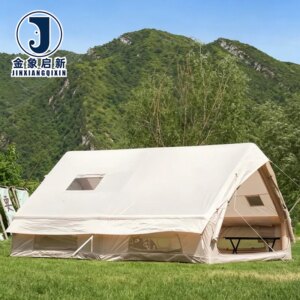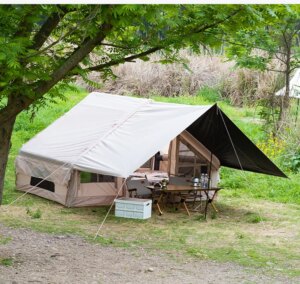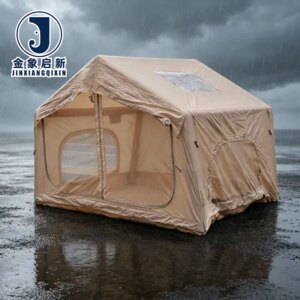
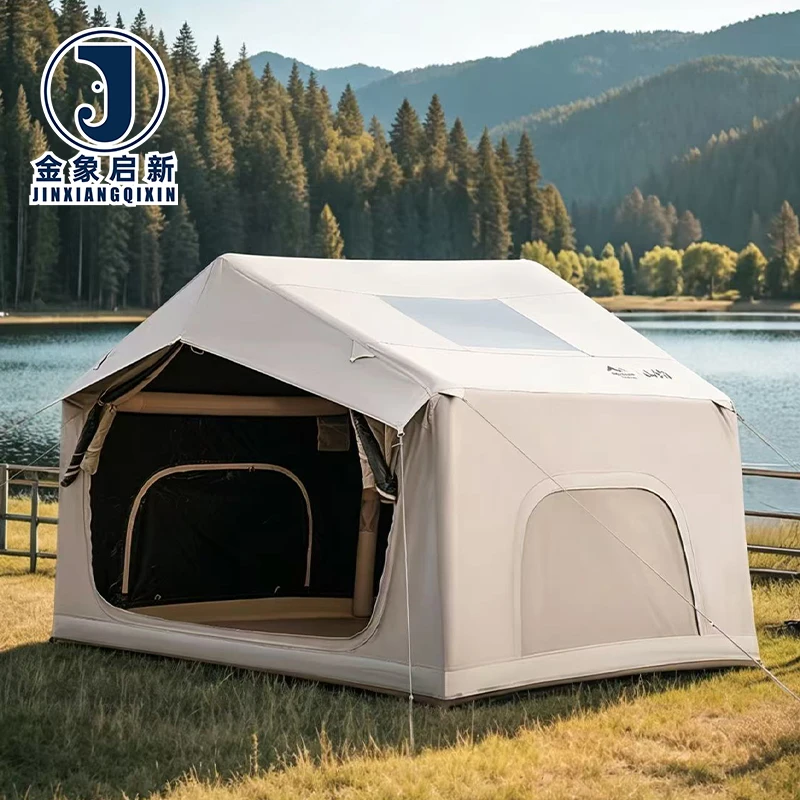
Precision in Coating Control — every roll of PVC tarpaulin for inflatable tent production is coated under monitored weight parameters to maintain batch-to-batch adhesion consistency, supporting manufacturers who need reliable heat-seal performance across large production runs.
Technical Specifications
| Parameter | Value |
|---|---|
| Product Type | PVC Inflatable Tent |
| Core Material | PVC tarpaulin |
| Key Performance | Waterproof, UV-resistant (test basis not stated), tear-resistant |
| Customization Service | OEM & ODM (sample customization, pattern printing) |
| Production Facility Area | 9,180 m² |
| Production Lines | 3 full production lines |
| Processing Equipment | 36 sets of professional processing equipment |
| R&D Team Scale | 10 technicians |
| Certifications | ISO9001, ISO14001, ISO45001, CE |
Application Suitability
| Application | Exposure & Requirement |
|---|---|
| Commercial glamping equipment manufacturing | Repeated inflation cycles, prolonged outdoor UV exposure, waterproof integrity under rainfall, frequent setup and teardown stress |
| Event temporary shelter fabrication | Rapid deployment demands, wind load on inflated structure, surface abrasion during transport and ground contact |
| Construction on-site storage structures | Dust and debris ingress prevention, equipment weight bearing, sustained inflation pressure holding, rough terrain contact |
Why Material Batch Consistency Matters More Than Stated GSM for Inflatable Tent Fabric
Uniform coating weight and verified test data at dispatch protect manufacturers from production line stoppages and field warranty claims.
When an Inflatable Tent Fabric manufacturer custom produces material for commercial glamping lines, a shift in coating thickness between rolls changes how heat-sealed seams behave under inflation pressure. Manufacturers scaling production have encountered situations where a roll that sealed cleanly at a given temperature setting produces weak bonds on the next roll from a different batch. The cost is not just the wasted fabric — it is the dismantled half-finished tent, the delayed shipment, and the erosion of buyer confidence. Sourcing from a facility with dedicated QA/QC at every production stage addresses this directly through in-process coating weight checks and pre-shipment inspection records. [NEED_CITE: tensile and tear test methods for coated fabrics per ISO 1421]
Coating Process Control for Repeatable Heat-Seal Performance
Inflatable tent structures depend entirely on welded seams holding air pressure across multiple inflation cycles. The PVC tarpaulin used for these applications must deliver consistent coating adhesion so that heat-seal parameters set on the factory floor remain valid across every roll in a production batch. Our three full production lines run with monitored coating application, meaning the PVC Inflatable Tent Material aftermarket supplier maintains the coating-to-base-fabric bond strength within controlled tolerances. This repeatability allows inflatable tent manufacturers to standardize their welding equipment settings rather than adjusting for each new roll delivery.
Tensile and Tear Behaviour Under Inflation Load
Once inflated, a glamping tent places continuous tensile stress on the fabric at panel junctions and around valve openings. The tear-resistant weave construction in this PVC tarpaulin addresses the propagation risk — a small puncture or cut from ground contact during setup must not extend into a structural failure. The base fabric denier and weave density work together with the coating to resist tear spread, which is critical when commercial campsites deploy and pack these structures dozens of times per season. Manufacturers specifying material for such demanding use cycles should request batch-specific tear strength data before committing to volume orders. [NEED_CITE: coated fabric tear propagation resistance testing standards]
Reading Beyond the Weight Specification
GSM alone does not define how well a PVC tarpaulin will perform in an inflatable tent application. A heavier coating does not automatically deliver higher tear resistance if the base fabric weave is loosely constructed. The interplay between base fabric denier, thread count in warp and weft directions, and coating penetration depth determines the final tensile and tear values. For inflatable tent manufacturers, requesting the full material specification sheet — including base fabric construction data alongside the coating weight — enables a meaningful comparison between material options. This approach also makes pre-production sample evaluation more informative, as testers know which parameter to focus on during inflation cycle testing.
What Happens When Specification Assumptions Go Unchecked
Manufacturers who approve material based on a single sample roll, then scale to bulk without verifying batch documentation, risk discovering performance drift mid-production. A coating weight that shifts even slightly between batches can alter heat-seal behaviour, leaving welded seams that fail during inflation testing on the finished tent. For inflatable tent producers supplying commercial glamping operators, a seam failure in the field translates into guest disruption, negative reviews, and replacement logistics that far exceed the material cost differential. Securing pre-shipment inspection records with verified coating weight and tear strength data for each production batch is a practical safeguard against this scenario. [NEED_CITE: field failure analysis of heat-welded seams in inflatable structures]
Procurement Advantages Through Process Depth
The 10-person R&D team handles material specification alignment for inflatable tent projects, developing pre-production samples that reflect the exact coating and weave configuration required. Three production lines with 36 sets of processing equipment provide the capacity to fulfil bulk roll orders within typical multi-week lead times for custom specifications. The dedicated QA/QC team inspects every production stage — from base fabric receipt through coating application to final roll winding — rather than relying on end-of-line spot checks. ISO9001, ISO14001, and ISO45001 management systems are maintained and audited, providing documentation traceability that commercial buyers require. OEM and ODM customization, including pattern printing and colour matching, is developed in-house with sample turnaround supporting tight project timelines.
Documentation & Verification
- Material specification sheet listing base fabric denier, coating weight, and colour reference for each roll
- Batch-specific test data covering waterproof performance, tear strength, and UV resistance parameters
- ISO9001, ISO14001, ISO45001, and CE certificates available for compliance documentation
- Pre-shipment inspection record confirming coating weight verification against order specification
- Roll packing list with individual roll identification for traceability through fabrication
Fabrication, Handling & Storage
- Heat-seal temperature and dwell time settings should be validated against each new PVC tarpaulin roll batch before production
- Store rolls upright on core supports to prevent flat-spot deformation of the coating surface
- When cutting panels for inflatable tent shapes, orient pattern pieces to align tear-resistant weave direction with primary stress lines
- Avoid dragging PVC tarpaulin rolls across unsealed concrete floors to protect the coating finish from abrasion damage
- Allow cold-stored rolls to reach workshop temperature before unrolling to prevent coating surface micro-cracking
Requesting a Specification Match for Your Inflatable Tent Project
Provide the intended application environment, expected inflation cycle frequency, and any fire safety or compliance requirements specific to your target market. Include required roll widths, annual volume estimates, and whether pattern printing or custom colour matching is part of the project scope. If pre-production sample approval is needed before bulk commitment, indicate the evaluation criteria your team will apply during inflation testing.
Frequently Asked Questions
Q: What customization options exist for inflatable tent material thickness and performance?
A: The R&D team adjusts coating weight, selects base fabric construction, and configures UV-resistant or waterproof treatments based on your inflatable tent design requirements. Pattern printing and colour matching are available for OEM projects. Pre-production samples are developed to align specifications before bulk production begins, allowing your team to validate heat-seal parameters and inflation performance on the actual material configuration.
Q: Does this PVC tarpaulin carry certifications for commercial inflatable tent applications?
A: ISO9001, ISO14001, ISO45001, and CE certifications are maintained at the production facility. Specific test reports covering waterproof rating, tear strength, and UV resistance are generated per batch. Buyers requiring fire-retardant grades should specify the classification needed for their market — available grades can be confirmed during the sample development stage to ensure compliance documentation accompanies the final shipment.
Q: Can pre-production samples be provided before bulk orders?
A: Yes. The 10-person R&D team develops samples reflecting your specified coating weight, base fabric construction, and any pattern printing requirements. Sample turnaround is designed to fit commercial project timelines. Manufacturers use these samples to validate heat-seal settings on their welding equipment and conduct preliminary inflation cycle tests before authorizing bulk roll production.
Q: What quality documentation accompanies each material batch?
A: Each shipment includes a material specification sheet, batch-specific inspection data, a pre-shipment inspection record with verified coating weight, a roll packing list with individual identification, and relevant certificates. This documentation package supports traceability from raw material through to finished inflatable tent fabrication and satisfies compliance requirements for commercial glamping equipment supply contracts.
Q: How is batch-to-batch consistency maintained across large production runs?
A: Dedicated QA/QC staff inspect at every production stage — base fabric verification, coating weight monitoring during application, and final roll inspection before dispatch. Three full production lines allow batch assignments that minimize changeover variables. Pre-shipment inspection records document the actual measured parameters for each roll, giving inflatable tent manufacturers verified data rather than relying solely on nominal specification claims.