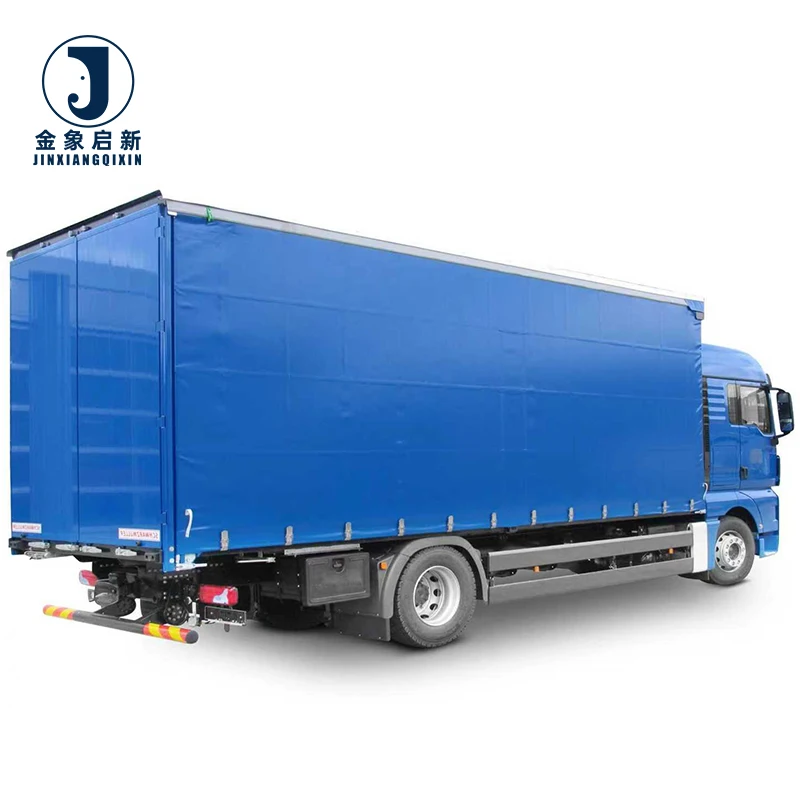
Precision Coating Control — Every PVC coated truck tarpaulin we produce is verified for coating weight and adhesion at each production stage, ensuring the fabric that arrives on your dock matches the specification you approved.
Technical Specifications
| Parameter | Value |
|---|---|
| Product Type | Truck Cover / Side Curtain |
| Coating Material | PVC |
| Fabric Construction | Double-faced PVC coating |
| Water Resistance | Water resistant — protects against rain, road spray and mildew |
| Anti-UV Treatment | Available — confirm grade required for your market |
| Flame Retardant Treatment | Available — confirm the grade required for your regional compliance |
| Side Faces | Double-faced with uniform strength and resistance on both surfaces |
| Color Options | Multiple colors available |
| Printing Capability | Logo and advertising printing available |
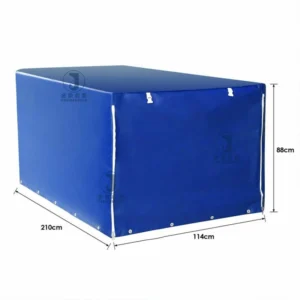
| Custom Sizing | Cut to specific truck and trailer model dimensions |
Application Suitability
| Application | Exposure & Requirement |
|---|---|
| Trailer side curtain systems | Constant flexing at load points, road abrasion, lateral wind load, daily UV exposure |
| Long-haul truck cargo covers | Sustained highway weather exposure, tie-down tension at hems, rain and road salt |
| Fleet branding and advertising tarpaulins | Printed logo legibility under sun and weather, colour consistency across vehicles |
| Transport equipment OEM integration | Dimensional accuracy to trailer frame geometry, weld seam integrity at curtain tracks |
Why a Generic-Size PVC Truck Tarpaulin Manufacturer Cannot Solve Your Fitment Problem
A truck cover cut to a standard rectangle will always leave gaps at the corners and stress concentrations at the hem — the two places cargo gets wet first.
When a fleet operator orders covers by width and length alone, the resulting product rarely matches the actual geometry of the trailer. Wheel arches, door frames, and curtain track profiles all create voids where a flat-cut tarpaulin pulls away from the body. At highway speeds, these gaps channel water directly onto the cargo. I have watched operators spend hours re-tensioning covers at loading docks because the hem reinforcement sits in the wrong position for their tie-down hardware. [NEED_CITE: dimensional tolerance standards for vehicle cover fitment in transport applications]
Double-Faced Coating for Balanced Performance Under Load
A PVC truck tarpaulin manufacturer that applies coating to both faces of the base fabric produces a material with symmetrical mechanical behaviour. When a side curtain flexes repeatedly at the same hinge point — typically where the fabric meets the curtain track — unequal coating thickness causes the lighter face to crack first. Double-faced construction distributes stress evenly across the cross-section, so the fabric ages at a comparable rate on the cargo-facing interior and the weather-facing exterior. This matters particularly for operators running routes through regions with large day-night temperature swings, where thermal cycling accelerates differential ageing.
Custom Cut-and-Weld Fitment to Your Trailer Geometry
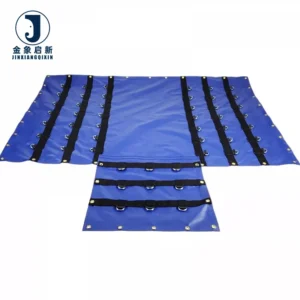
Rather than supplying covers in generic width-by-length dimensions, we cut each PVC truck tarpaulin to the specific trailer model in your fleet. This means the eyelet spacing aligns with your existing tie-down rails, the hem reinforcement lands on the structural frame members rather than spanning open gaps, and any welded seams sit in low-flex zones. [NEED_CITE: best practice for seam placement on flexible truck side curtains] Transport equipment builders integrating side curtain systems into new trailer builds benefit from this approach because the cover becomes part of the structural envelope rather than an afterthought draped over it.
How Coating Method and Base Fabric Interact to Define Real-World Durability
The relationship between base fabric denier, weave density, and PVC coating weight determines how a truck tarpaulin performs under combined mechanical and environmental stress. A heavier base fabric with a tighter weave provides higher tensile and tear resistance, but only if the coating penetrates the weave structure fully — partial penetration leaves uncoated fibre bundles that wick moisture and degrade from the inside. The coating method controls this penetration: knife coating forces PVC into the weave under pressure, while dip or roller methods may leave a surface film that separates from the base fabric at the weld line. For side curtain applications where the fabric is welded to curtain track profiles, coating adhesion to the base fabric is as important as the coating’s own tensile properties. Surface finish — whether glossy or matte — affects how road grime adheres and how well printed logos resist abrasion from automated wash systems.
The Hidden Cost of Specifying by Weight Alone
Buyers who select PVC truck tarpaulin material based on GSM alone often discover that two fabrics at the same weight can behave very differently in service. A fabric with a heavier coating and a lighter base fabric may meet the quoted GSM while offering lower tear resistance than a balanced construction with less coating and a denser weave. When this imbalance shows up in the field, it typically appears as coating delamination at welded seams — the coating is thick enough to be rigid, but the base fabric underneath is too sparse to carry the load transfer at the weld boundary. [NEED_CITE: coating-to-substrate adhesion failure modes in PVC coated technical textiles] Fleet operators then face premature cover replacement, and the root cause is never obvious from a weight measurement taken with a scale.
Why Fabrication Control Matters More Than Raw Material Grade
Our production process keeps coating weight and adhesion under continuous control across all three production lines, with dedicated QA/QC checkpoints at every stage from base fabric inspection through final roll winding. The 10-person R&D team handles material selection, pattern printing specifications, and custom sizing development so that sample approval translates directly to production consistency. Each PVC truck tarpaulin undergoes 100% pre-shipment inspection, where dimensions are verified against your specified trailer model and coating integrity is confirmed at weld zones and hem reinforcements. Samples for custom requirements — whether a specific colour match, a logo print layout, or a non-standard hem configuration — are developed within days so you can validate fitment and appearance before committing to a production run. [NEED_CITE: pre-shipment inspection protocols for custom-fabricated coated textile products]
Documentation & Verification
- Material specification sheet stating GSM, base fabric denier, and coating weight for each roll
- Test report for UV and flame-retardant grades supplied where applicable to your compliance requirements
- Pre-shipment inspection record confirming cut dimensions match your specified trailer model
- Colour reference documentation ensuring batch-to-batch consistency across fleet orders
- Roll packing list with individual roll identification for traceability through installation
Fabrication, Handling & Storage
- Weld PVC truck tarpaulin seams using hot-air or wedge welding calibrated to the specific coating weight and thickness
- Reinforce hem edges with additional PVC strip or webbing at tie-down and eyelet attachment points
- Store rolls horizontally on padded racks to prevent permanent creasing of the double-faced coating
- Allow cold-stored rolls to reach ambient temperature before unrolling to avoid coating surface cracking
- Clean printed logo areas with mild detergent only — avoid solvents that degrade the PVC topcoat layer
- Lay out cut panels flat on a clean surface before welding to prevent trapped wrinkles at seam junctions
What We Need to Quote Your Project Accurately
Provide the specific truck or trailer model designations in your fleet, along with the number of units per model and any dimensional drawings or photographs of the existing cover fitment. Specify whether you require the PVC truck tarpaulin supplied as finished cut-and-welded covers or as roll stock for your own fabrication. Confirm the fire-retardant or UV treatment grade your market or site requires, and share any logo artwork or colour references for printed branding.
Frequently Asked Questions
Q: How do you cut truck covers to fit specific trailer models rather than generic sizes?
A: We work from the dimensional profile of your specific trailer — including wheel arch cutouts, door frame clearances, and curtain track mounting positions. Each PVC truck tarpaulin is cut to these coordinates rather than a standard rectangle, so hem reinforcements align with structural members and eyelet spacing matches your tie-down hardware.
Q: How is GSM verified on arrival to ensure the quoted weight matches the delivered material?
A: Every roll is weighed and measured during pre-shipment inspection, and the GSM is calculated from actual weight divided by actual area. We include a weight verification record with the shipment documentation so you can cross-check against the material specification sheet upon receipt.
Q: What flame-retardant grades and test standards are available for truck tarpaulins?
A: Flame-retardant treatment is available in multiple grades depending on your regional compliance requirements. We recommend confirming the specific standard — such as a national vehicle safety regulation or a site-specific fire safety code — at the inquiry stage so we can supply the correct grade with supporting test documentation.
Q: How do you control colour consistency across multiple covers in the same fleet order?
A: All covers in a single fleet order are produced from the same coating batch using a shared colour reference standard. The pre-shipment inspection includes a visual colour comparison across rolls to ensure no visible variation when covers are installed side by side on adjacent vehicles.