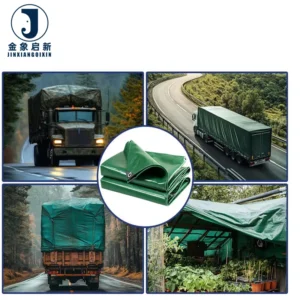
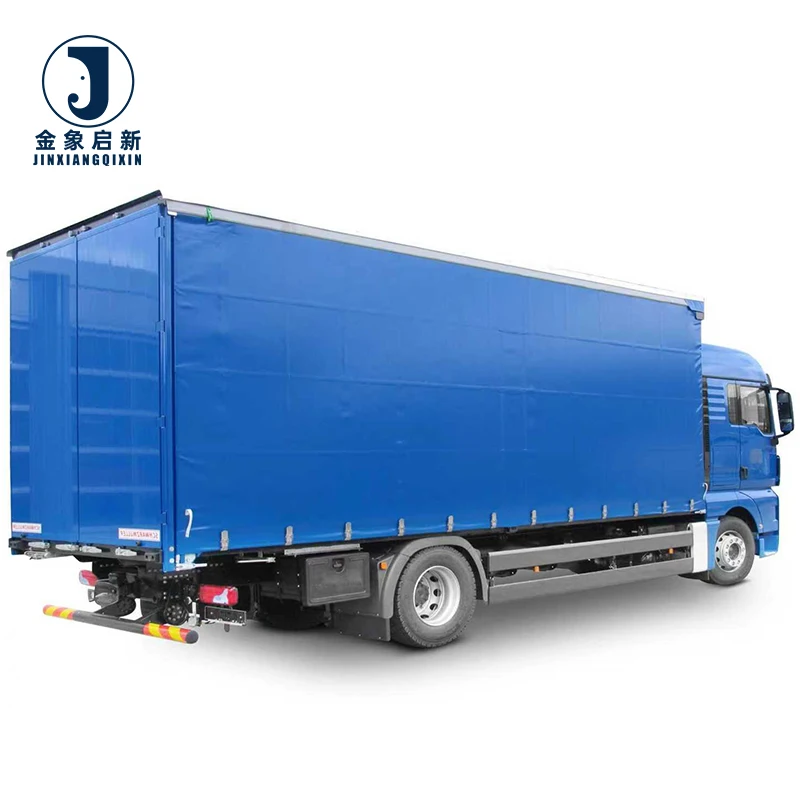
Three full production lines — supporting bulk PVC Tarpaulin Truck Cover output with coating weight control verified at every run before it leaves the factory.
Technical Specifications
| Parameter | Value |
|---|---|
| Product Type | PVC Tarpaulin Truck Cover |
| Coating Material | PVC |
| Side Configuration | Double-Faced |
| Water Resistance | Water Resistant |
| UV Treatment | Anti-UV (test basis not stated in source — confirm grade required for your market) |
| Flame Retardant | Yes (grade not stated in source — available in flame retardant grades, confirm the grade required for your market) |
| Color Options | Multiple Colors |
| Customization | Logo Printing, Custom Sizes |
Application Suitability
| Application | Exposure & Requirement |
|---|---|
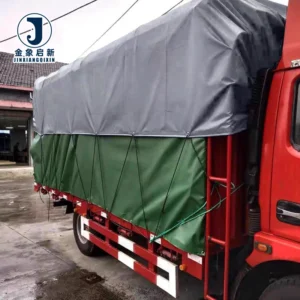
| Truck and trailer side curtains | Constant flexing at load stress points, road abrasion, wind load, UV exposure |
| Rainproof cargo cover for transport fleets | Water ingress prevention, tie-down tension, repeated folding and unfolding |
| Advertising truck tarpaulins | Print surface adhesion, outdoor weathering, colour retention under sun exposure |
| Vehicle tarpaulin curtains | Daily roll and unroll cycles, edge abrasion against trailer rails |
Why a Quoted GSM Does Not Guarantee Curtain Longevity
Coating adhesion and base fabric denier determine how long a PVC tarpaulin truck cover survives on a trailer, not the weight printed on the invoice.
Fleet operators regularly receive covers that meet the stated GSM on the scale yet fail within months at the welded seams or along the hem lines where flexing concentrates. The reason is that GSM blends base fabric weight and coating weight into one number, masking how the load is distributed between the two layers. A cover can hit its target weight through heavy coating on a thin base, which then cracks at fold points. [NEED_CITE: tensile and tear test methods for coated fabrics per ISO 1421]
Base Fabric Denier and Weave Density
The base fabric carries the structural load of any PVC Tarpaulin Truck Cover in service. Denier defines yarn thickness, while thread count per centimetre in warp and weft directions sets the spacing between those yarns. A higher denier with open weave may weigh the same as a lower denier with tight weave, yet the two behave very differently when a side curtain flexes under wind load. Tight weave distributes point loads across more yarns, slowing tear propagation at eyelet and hem stress zones.
Coating Method and Its Effect on Weld Behaviour
The PVC coating process — whether knife-over-roll, laminating or calendering — controls how deeply the compound*es peel strength between coating and yarn, which directly affects how the material responds to hot-air or wedge welding at seam joints. A PVC Tarpaulin Truck Cover that delaminates at the weld has typically been coated with insufficient penetration rather than insufficient GSM. [NEED_CITE: DIN 4102 fire classification for building materials]
UV and Flame-Retardant Treatment Integration
UV stabilisers and flame-retardant compounds are either blended into the PVC compound before coating or applied as a surface finish. Blended treatment remains active throughout the coating thickness, so abrasion on the road does not remove it. Surface-applied treatment may show strong initial test results but degrades as the outer layer wears. Available in flame retardant grades — confirm the grade required for your market and request the matching test report before production.
How Specification Mismatches Surface in the Field
A cover specified by GSM alone often reveals its weakness at the first winter or the first long highway run. Insufficient base fabric denier shows up as tearing at the eyelet line when tie-down straps pull against a frozen, stiffened curtain. A coating formulated without adequate low-temperature flexibility cracks along fold creases after cold-weather transport. Batch colour variation between rolls becomes visible the moment two panels hang side by side on the same trailer, forcing a full replacement rather than a panel swap. [NEED_CITE: coating adhesion failure modes in heavy-duty PVC tarpaulin applications]
Why Procurement Verification Matters Here
Our production workflow assigns a batch reference to every roll, linking it to the coating compound lot and base fabric source for traceability. In-process QA checks coating weight at set intervals across each run, catching drift before it becomes a full-roll deviation. The 10-person R&D team develops custom sizing and print samples within days, allowing you to verify fit and colour on your trailer model before committing to volume. Every PVC Tarpaulin Truck Cover order undergoes full pre-shipment inspection, not statistical sampling.
Documentation & Verification
- Material specification sheet listing base fabric denier, coating compound type, and colour reference for each roll
- UV and flame retardant test reports matched to the specific compound grade used in your batch
- Pre-shipment inspection record with individual roll coating weight checks before dispatch
- Roll packing list with batch reference linking each roll to its production run data
- ISO and CE certificates supporting export compliance documentation
Fabrication, Handling & Storage
- Hot-air weld temperature must match PVC coating formulation — request our recommended heat settings for the double-faced coating on this truck cover
- Eyelet placement should account for base fabric weave direction to prevent tear propagation under tie-down tension
- Store rolls upright on pallets to avoid flat-spot creasing that transfers into permanent fold lines on the PVC Tarpaulin Truck Cover surface
- Clean printed logo areas with mild detergent only — aggressive solvents degrade the coating surface and soften print adhesion
- Allow cold-stored rolls to reach ambient temperature before unrolling to prevent low-temperature cracking at fold lines
- Overlap panels by minimum width when heat-welding side curtain sections to distribute load away from the joint line
What We Need to Move Your Enquiry Forward
Share the trailer model or exact curtain dimensions so we can confirm sizing tolerances before sampling. Let us know your target market and any fire-safety classification the cover must meet at destination. Specify whether you need blank rolls for your own fabrication or finished covers with hem and eyelet reinforcement already applied.
Frequently Asked Questions
Q: How do I confirm the GSM of my PVC Tarpaulin Truck Cover matches the quote on arrival?
A: We supply a pre-shipment inspection record showing individual roll weight per square metre measured during production. On receipt, cut a known-area sample from each roll and weigh it on a calibrated scale. Compare your result against the inspection record and the material specification sheet we include with every dispatch. Any deviation beyond normal tolerance is flagged before the goods leave our facility.
Q: What flame retardant documentation ships with a PVC tarpaulin truck cover order?
A: Available in flame retardant grades — we provide the test report matching the specific compound grade used in your production run. The report references the standard applied and the classification achieved. Confirm the fire safety grade required at your destination market before we begin compounding, so the correct additive package is integrated into the coating from the start.
Q: Can batch colour stay consistent across a multi-roll PVC Tarpaulin Truck Cover order?
A: Every roll in a single order is produced from the same coating compound batch and linked by a shared batch reference number. In-process colour checks run at set intervals during the coating run. If your order spans multiple production runs, we flag this before scheduling and confirm with you, so no two batches hang side by side on the same trailer without your approval.
Q: Why do welded seams fail before the curtain fabric itself?
A: Weld failure typically traces back to coating adhesion rather than fabric strength. If the PVC compound does not penetrate the base fabric deeply enough during coating, the weld bond separates from the yarn structure under repeated flex. We control coating penetration through our compounding and application process, and weld seam behaviour is part of the specification discussion before your PVC Tarpaulin Truck Cover enters production.