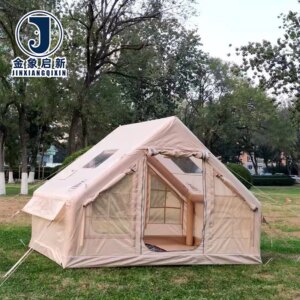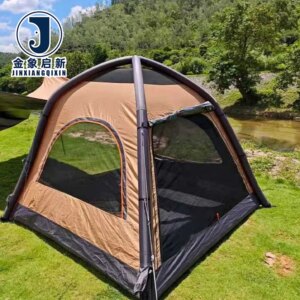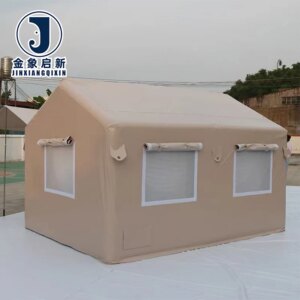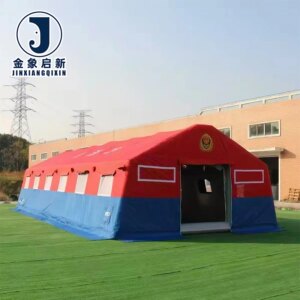
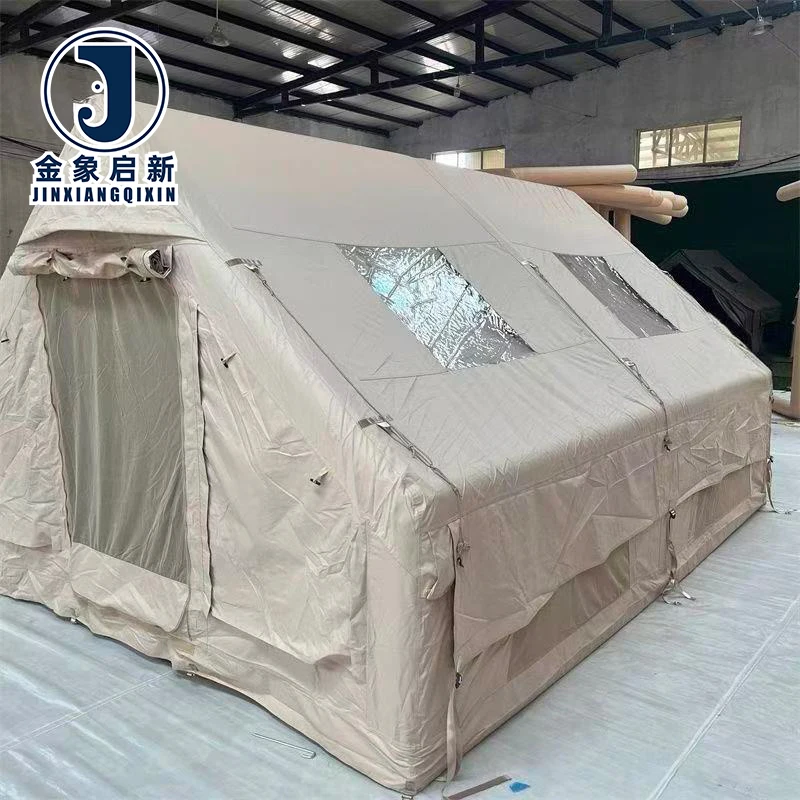
Deep Coating Process Control — Our knife-over-edge coating lines maintain uniform PVC adhesion across every roll, ensuring inflatable tent fabric delivers predictable airtightness and weld strength for commercial shelter manufacturing.
Technical Specifications
| Parameter | Value |
|---|---|
| Product Type | Inflatable Tent Fabric |
| Core Material | PVC Tarpaulin |
| Key Performance | Waterproof, UV-resistant (test basis not stated), Tear-resistant |
| Season Rating | 4 Season |
| Customization Service | OEM & ODM, sample customization, pattern printing |
| Quality Control System | Strict full-process inspection with dedicated QA & QC staff |
| Certifications | ISO 9001, ISO 14001, ISO 45001, CE |
Application Suitability
| Application | Exposure & Requirement |
|---|---|
| Commercial outdoor event shelters | Repeated inflation cycles, public safety compliance, UV exposure across seasons |
| Construction site temporary housing | Wind load, dust ingress, rapid deployment for crew accommodation |
| Industrial camping operations | Extended outdoor deployment, abrasion from ground contact, frequent relocation |
| Outdoor gear manufacturing | Batch-consistent roll stock for automated cutting and heat-welding lines |
| Recreational facility supply | High-traffic use, cleaning chemical resistance, colour fastness under sun exposure |
Why Batch Consistency in Inflatable Tent Fabric Matters More Than Stated GSM
A uniform coating weight across every roll prevents weld failures that occur when the heat settings are tuned to one roll but applied to the next.
Manufacturers of commercial inflatable shelters frequently report that seams fail before the fabric body does, often traced back to subtle GSM variation between production batches. When the PVC coating thickness shifts from roll to roll, the heat-welding temperature that produced a perfect seam on Monday causes burn-through or incomplete bonding on Wednesday. The result is a shelter that deflates under wind load, damaging both reputation and revenue. Sourcing from an Inflatable Tent Fabric manufacturer custom-oriented facility with dedicated in-process QA addresses this at the coating stage rather than at final inspection. [NEED_CITE: relationship between coating weight variation and thermal weld integrity in PVC-coated fabrics]
How Coating Weight Influences Airtightness in Inflatable Structures
Inflatable tent structures depend entirely on the airtight integrity of the coated fabric envelope. The PVC Tarpaulin base material used for this Inflatable Tent Fabric is processed on knife-coating lines that control the exact coating mass applied to each face of the woven substrate. Consistent coating fill across the weave prevents micro-pores through which pressurised air escapes, extending the interval between re-inflation cycles during commercial use. This is critical for 4-season deployment where temperature fluctuations cause the internal air pressure to cycle continuously.
Weld Seam Strength and Fabric Compatibility
The tear-resistant construction of this inflatable tent fabric is engineered so that heat-welded seams achieve strength comparable to the fabric body itself. Manufacturers producing 6-8 person commercial shelters require the PVC coating to melt and bond uniformly at the overlap zone. When the coating formulation and weight are consistent, fabricators can lock in welding parameters for an entire production run without mid-batch adjustments. Our 10-technician R&D team works directly with OEM clients to validate weld settings during the sample development stage before bulk production begins. [NEED_CITE: ISO 1421 tensile and tear test methods for coated fabrics]
Reading the Specification Sheet Beyond the GSM Number
The stated GSM of any PVC-coated fabric combines the base fabric weight and the coating mass, but it is the base fabric denier and weave density that primarily govern tensile and tear strength. A heavy coating on a low-denier open-weave base may reach the target GSM while offering poor tear propagation resistance. For inflatable tent applications, the fabric must resist tearing at stress concentration points — corners, valve cut-outs, and anchor attachments — where inflation pressure multiplies the load. Evaluating the full specification sheet, including base fabric construction and coating method, gives a far more reliable picture of field performance than GSM alone. Surface finish selection — available in glossy or matte — also affects how readily the fabric accepts pattern printing and branding, an important consideration for commercial event shelters and branded recreational products.
The Hidden Cost of Specifying on Price Per Kilogram Alone
Buyers who select inflatable tent fabric primarily on cost per kilogram often encounter downstream expenses that erase the initial saving. Coating applied below the minimum weight needed to fill the base fabric weave results in pinhole leakage, causing inflatable structures to lose pressure faster than the blower can compensate. Colour variation between rolls in the same shipment becomes visible once panels are joined side by side on a large event tent. Flame-retardant treatment claimed without a verifiable test report leads to rejected shipments at the destination port when the local inspector requests documentation. These are recurring pain points in the coated fabric supply chain, and they originate at the procurement stage when specifications are not fully defined or verified. [NEED_CITE: common causes of coated fabric failure in tensioned and inflatable structures]
What This Production Setup Delivers for Your Inflatable Fabric Order
Three full production lines with 36 sets of professional processing equipment support bulk roll output while maintaining coating consistency across the entire order. The dedicated QA and QC staff inspect every production stage — incoming yarn, base fabric weaving, coating application, and finished roll — rather than relying solely on end-of-line sampling. Sample development is completed within days for custom width, colour, and printing requirements, allowing fabricators to confirm material behaviour on their own welding equipment before committing to volume. The 10-technician R&D team handles material selection guidance and design validation for OEM and ODM inflatable shelter projects. ISO 9001, ISO 14001, ISO 45001, and CE certifications underpin the quality management framework, with documentation provided for each shipment.
Documentation & Verification
- Material specification sheet detailing base fabric construction, coating type, and confirmed GSM for engineering validation
- Batch quality inspection report recording coating weight, colour reference, and visual defect count per roll
- ISO 9001, ISO 14001, ISO 45001, and CE certificates supporting export compliance and procurement audits
- Pre-shipment inspection record confirming 100 percent roll inspection before container loading
- UV and flame-retardant test reports available in applicable grades — confirm the grade required for your market
Fabrication, Handling & Storage
- Heat-weld temperature and dwell time must be calibrated to the specific PVC coating mass on this inflatable tent fabric
- Store rolls upright on pallets to prevent permanent creasing that compromises airtightness at the fold line
- Avoid dragging roll edges across abrasive surfaces during warehouse handling to protect the PVC coating face
- Allow cold-stored rolls to reach ambient temperature before unrolling to prevent low-temperature coating crack
- Use PVC-compatible solvent cleaners for field maintenance to preserve the waterproof coated surface
- Pattern printing adhesion should be validated on sample swatches before full-roll production
Preparing Your Inquiry for Inflatable Tent Fabric
To move from initial inquiry to sample approval efficiently, share your intended application and the environmental conditions the finished shelter will face, including wind load expectations and deployment duration. Specify the target market so that we can align flame-retardant and UV treatment grades to the applicable regional standards. Indicate your required roll width, annual volume, and whether you need plain stock or custom colour with pattern printing. If your production line uses a specific heat-welding process, provide the equipment details so our R&D team can factor that into sample development.
Frequently Asked Questions
Q: What customization options are available for inflatable tent fabric?
A: We offer full OEM and ODM customization including custom roll width, colour matching, and pattern printing. The 10-technician R&D team develops samples within days, allowing you to validate coating behaviour on your welding equipment before bulk production. Material specifications including GSM and base fabric construction are confirmed and locked prior to order.
Q: How is batch-to-batch consistency maintained across large fabric roll orders?
A: Three full production lines with dedicated QA and QC staff at every stage — from base fabric weaving through coating application — ensure uniform coating weight and colour across all rolls. A 100 percent pre-shipment inspection verifies each roll against the approved specification sheet and batch quality records.
Q: What certifications support export compliance for inflatable tent products?
A: Manufacturing is certified to ISO 9001, ISO 14001, and ISO 45001 with CE marking. Full documentation including material specification sheets, inspection reports, and certificates of origin accompanies each shipment to support customs clearance and procurement audits in the destination market.
Q: How can UV-resistant and tear-resistant performance be verified before shipment?
A: UV and flame-retardant treatments are available in specific grades with corresponding test reports — confirm the grade required for your market before ordering. Tear and tensile performance data are documented per batch through in-process testing, and results are included in the batch quality inspection report provided before dispatch.
Q: What is the process for sample approval before full production?
A: Upon receiving your application details and specification requirements, the R&D team produces custom samples within days. You evaluate weld compatibility, colour accuracy, and coating performance on your equipment. Once the sample is approved, the specification is locked and bulk production proceeds with identical material parameters.