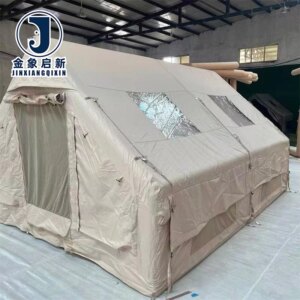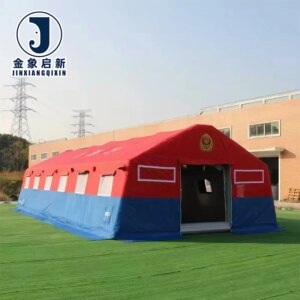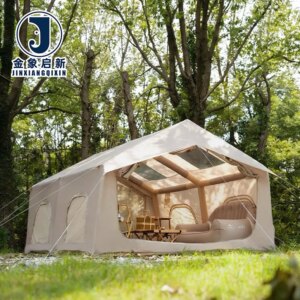
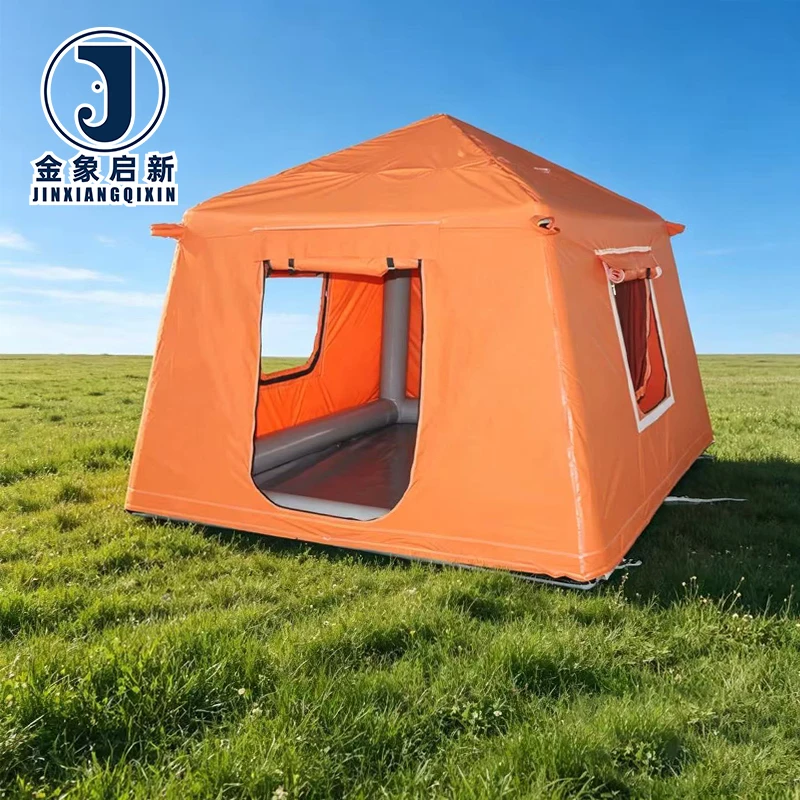
Deep Coating Control — Thirty years of process refinement applied to 420D Oxford inflatable fabric, where coating adhesion and base fabric integrity are verified at every production stage before a single roll leaves the facility.
Technical Specifications
| Parameter | Value |
|---|---|
| Product Type | Inflatable Tent |
| Core Material | 420D Oxford |
| Capacity | 5-8 Person |
| Season Suitability | 4-Season |
| Opening Mechanism | Quick Automatic Opening |
| Construction Type | Single Layer |
| Design Type | Extended Type |
| Customization Service | OEM & ODM (Sample customization, pattern printing) |
| Production Facility Area | 9,180 m² |
| Production Lines | 3 full production lines |
| Processing Equipment | 36 sets of professional equipment |
| R&D Team Scale | 10 technicians |
| Quality Control System | Full-process QA & QC with 100% pre-shipment inspection |
| Flame Retardant Grade | Available in flame retardant grades — confirm the grade required for your market |
| UV Treatment | Available with UV treatment — request test report before order |
| Anti-Static | Available upon request — confirm compliance requirements |
| Certifications | ISO 9001, ISO 14001, ISO 45001, CE |
Application Suitability
| Application | Exposure & Requirement |
|---|---|
| Emergency disaster relief shelters | Rapid deployment under time pressure, four-season weather exposure, repeated inflation and deflation cycles |
| Construction site temporary shelters | Continuous outdoor UV and rain exposure, wind loading on inflated structure, abrasion from site debris |
| Logistics mobile storage units | Frequent relocation and repacking, temperature fluctuation across seasons, mechanical wear from loading operations |
| Industrial outdoor event structures | High visibility requirements, multi-day continuous inflation, crowd proximity demanding fire safety compliance |
Why Base Fabric Denier Matters More Than Coating Weight Alone
420D Oxford delivers tear resistance that coating thickness alone cannot achieve — the woven base carries the structural load while the coating seals and protects.
When sourcing custom inflatable tent material, buyers often fixate on coating weight as the primary indicator of durability. I have seen heavy-coated fabrics with low-denier base yarns tear along the warp line during inflation, because the coating cannot compensate for insufficient yarn tensile strength. The 420D Oxford construction in this inflatable tent fabric manufacturer range addresses that failure mode directly — the denier count refers to the mass per 9,000 meters of yarn, and at 420D the individual filaments are substantial enough to resist tear propagation under the cyclic stress of repeated inflation. [NEED_CITE: tensile and tear test methods for coated fabrics per ISO 1421]
How 420D Oxford Construction Supports Inflation Pressure Cycles
The weave pattern in 420D Oxford creates a balanced load distribution across both warp and weft directions. When an inflatable tent is pressurised, the internal air load transfers to the fabric in multiple vectors simultaneously. This inflatable tent fabric manufacturer product uses a base fabric where the yarn intersection points resist the peeling forces that lower-denier constructions struggle with during sustained inflation.
Coating Adhesion and Seam Welding Under Pressure
The relationship between coating composition and base fabric surface determines how well welded seams hold under repeated inflation cycles. Single-layer construction concentrates all structural demand on one material interface — there is no secondary layer to share the load. Our 10-person R&D team develops coating formulations matched to the 420D Oxford surface profile, ensuring that heat-welded seams achieve adhesion strength approaching the base fabric tear strength itself. [NEED_CITE: welding parameters for PVC-coated Oxford fabrics]
What Single-Layer Extended Design Means for Transport and Setup
The extended type geometry increases internal volume without requiring additional structural panels, which reduces the number of welded joints in the finished tent. Fewer seams mean fewer potential failure points during emergency deployment. Single-layer construction keeps packed weight manageable for transport logistics — a critical factor when disaster relief organisations need to air-freight shelter units to remote locations.
Reading the Specifications That Actually Determine Field Performance
The 420D Oxford denier specification tells you about individual yarn mass, but field performance depends on how those yarns are woven and coated. Warp and weft density — the number of yarns per centimetre in each direction — determines how tightly the coating locks into the base fabric. A loose weave allows coating penetration that improves adhesion but may reduce flexibility; a tight weave provides a smoother surface but demands more precise coating application. The four-season rating on this inflatable tent fabric manufacturer range reflects testing across temperature extremes, where the coating must remain flexible in cold conditions without becoming overly soft in heat. Anti-UV treatment and flame retardant grades are available for markets with specific compliance requirements — always request the test report matched to your local regulations before committing to volume. The single-layer construction means every specification choice has amplified impact, because there is no second layer masking a weak first layer. [NEED_CITE: DIN 4102 fire classification for building materials]
What Happens When Specifications Do Not Match the Deployment Environment
Deploying an inflatable tent rated for mild conditions into a four-season emergency response scenario leads to predictable failures. Coating that softens in summer heat loses dimensional stability under inflation pressure, causing the structure to sag at stress points. Fabric without adequate UV treatment degrades at the surface, and once micro-cracking begins in the coating layer, moisture reaches the base fabric and accelerates deterioration. Batch-to-batch colour inconsistency across rolls becomes visible when multiple tent units are deployed side by side at a relief camp — not a structural failure, but one that undermines professional appearance and organisational credibility. Welded seams that were calibrated for a different coating formulation fail before the fabric body does, typically at the junction where the inflation tube connects to the main structure. [NEED_CITE: seam failure patterns in inflatable structures under cyclic loading]
Why Technical Buyers Source This Inflatable Tent Fabric Here
Nearly 30 years of coated fabric process control means coating weight and adhesion parameters are not left to chance — every roll of 420D Oxford is checked against specification before it reaches the packing stage. Three full production lines and 36 sets of processing equipment support volume commitments without sacrificing the coating consistency that inflatable tent fabricators depend on for repeatable welding results. The dedicated QA and QC team inspects at every production stage rather than relying solely on final sampling, catching coating variation before it becomes a batch-level problem. A 10-person R&D team handles pattern printing, custom sizing, and sample development within days, not weeks — critical when emergency relief procurement timelines are compressed. ISO 9001, ISO 14001, ISO 45001, and CE certifications provide the compliance documentation that international procurement departments require, and pre-shipment inspection records accompany every dispatch.
Documentation & Verification
- Material specification sheet stating 420D Oxford base fabric, coating composition, and colour reference per roll
- Test reports for UV and flame retardant grades where applicable — request matched to your market before order
- Pre-shipment inspection record confirming 100% inspection coverage before dispatch
- ISO 9001, ISO 14001, ISO 45001, and CE certificates available for procurement compliance files
- Roll packing list with batch identification for traceability across multiple units
Fabrication, Handling & Storage
- Heat welding parameters must be calibrated to the 420D Oxford coating formulation — request recommended temperature and dwell time settings before first production run
- Store rolls upright on pallets to prevent flat-spot deformation of the single-layer construction that causes visible creasing after inflation
- Allow material to acclimatise to ambient temperature before unrolling in cold conditions to avoid coating micro-cracking on the 420D Oxford surface
- Use compatible PVC-based repair adhesives for field patching — solvent-based alternatives may attack the coating-to-fabric bond interface
- Plan cutting layout to minimise offcuts from the extended type panel geometry and reduce waste per tent unit produced
What We Need to Quote Your Requirement
Provide the deployment environment and expected temperature range so we can confirm whether standard coating or a modified formulation suits your four-season requirement. Specify the target market and any fire safety or UV compliance standards your end users must meet, so we include the correct test documentation with your shipment. Confirm whether you require rolls for your own fabrication line or finished cut-to-pattern panels, along with estimated annual volume and colour or print requirements.
Frequently Asked Questions
Q: How do I verify the 420D Oxford base fabric specification on arrival?
A: Every roll ships with a material specification sheet stating the base fabric denier, coating weight, and colour reference. We recommend checking coating weight per square metre against the quoted GSM using a calibrated scale on a sample cut from the roll edge. Our pre-shipment inspection record documents the measurements taken before dispatch, providing a baseline for your incoming verification.
Q: How is batch-to-batch colour consistency controlled across multiple rolls?
A: Our QA and QC team inspects at every production stage, including colour verification between rolls within the same order. Colour reference standards are established during sample approval, and production batches are checked against those references before packing. If your project requires multiple tent units deployed side by side, request batch-level colour inspection documentation with your shipment.
Q: What flame retardant grades are available and how do I match them to my market?
A: Flame retardant treatment is available in multiple grades depending on your target market requirements. Different regions reference different standards — some specify DIN 4102 classifications while others require NFPA 701 or local equivalents. Provide your specific regulatory reference during inquiry so we supply the correct test report and certification with your order.
Q: How do welded seams perform under repeated inflation and deflation cycles?
A: The 420D Oxford base fabric provides a stable substrate for heat welding, and our coating formulation is matched to achieve strong seam adhesion. The single-layer construction means seam integrity is critical — there is no backup layer sharing the load. Request weld parameter recommendations and sample welds for your own testing before committing to volume production.
Q: What customisation options are available for width, length, and pattern printing?
A: Our 10-person R&D team handles custom width, length, and pattern printing requirements, with samples typically developed within days. Minimum order quantities apply to custom specifications, and we confirm lead time and MOQ during the quotation stage. Provide your exact dimensions and print artwork early so we can validate feasibility against the 420D Oxford material.