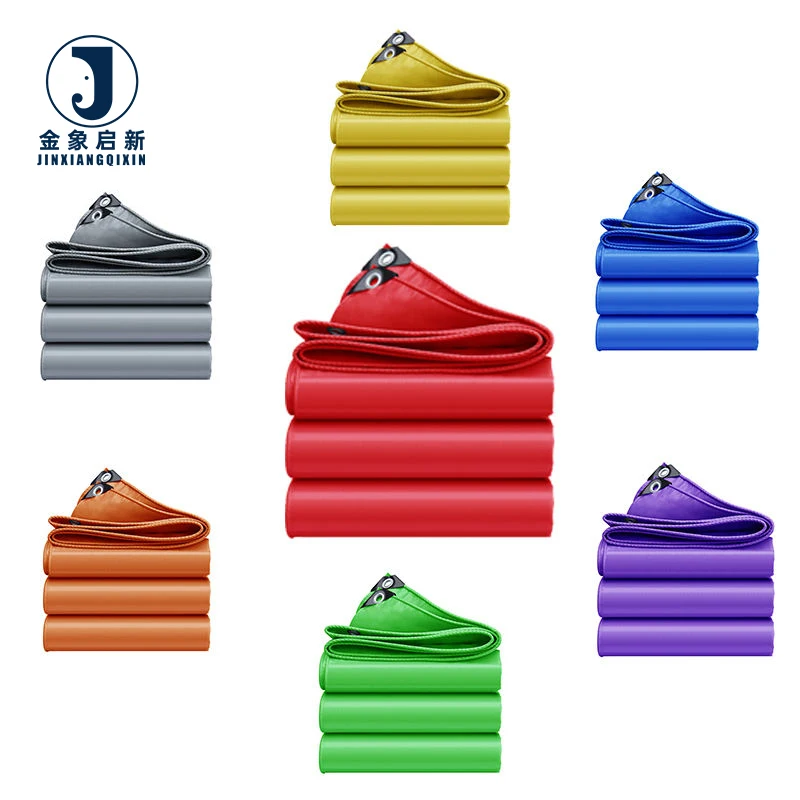
Precision Coating Control — every roll of PVC coated tarpaulin is verified against the quoted GSM and base fabric denier before dispatch, ensuring material specifiers receive the exact weight and construction specified.
Technical Specifications
| Parameter | Value |
|---|---|
| Product Type | PVC Coated Tarpaulin |
| Coating Material | PVC (100% PES dipping coating process) |
| Base Fabric Construction | Knitting and plain weave available |
| Knitting Density (Medium-duty) | 500D |
| Weight (Medium-duty) | 400-500 g/m² |
| Thickness (Medium-duty) | 0.35-0.45 mm |
| Tensile Strength (Medium-duty) | Warp 1500-2000 / Weft 1200-1800 N/5cm |
| Knitting Density (Heavy-duty) | 1000D |
| Weight (Heavy-duty) | 700-1000 g/m² |
| Thickness (Heavy-duty) | 0.70-1.0 mm |
| Tensile Strength (Heavy-duty) | Warp 2000-2500 / Weft 1800-2200 N/5cm |
| Knitting Density (Super Heavy-duty) | 500D-2000D |
| Weight (Super Heavy-duty) | 1100-1500 g/m² |
| Thickness (Super Heavy-duty) | 1.2-1.5 mm |
| Tensile Strength (Super Heavy-duty) | Warp 2500-3000 / Weft 2200-2800 N/5cm |
| Roll Width | 6ft, 8ft, 10ft, 12ft or 2m, 4m, 6m |
| Roll Length | 100 yards, 100 meters, or custom |
| Edge Reinforcement | All four edges reinforced with PP rope in hem |
| Eyelets | Galvanized, every 3ft or 1 meter interval |
| Corners | Reinforced plastic corners |
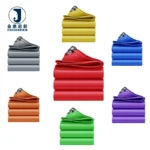
| Color Options | Blue, Blue/Orange, Green, Grey, Black, Clear, Grey/Green, Orange, or custom |
| UV Treatment | Available (test basis not stated) |
| Waterproof | Yes |
| Anti-Mildew | Yes |
| Certification | ISO, CE |
Application Suitability
| Application | Exposure & Requirement |
|---|---|
| Truck side curtain fabric | Constant flexing at load points, road debris abrasion, sustained UV exposure, weld seam integrity under dynamic tension |
| Flatbed and heavy truck tarpaulin | High tensile demand across wide spans, tie-down point stress, wind flap fatigue, weather sealing over multi-day transit |
| Tent and awning roll stock | Fabricator-grade consistency across rolls, heat weld compatibility, colour batch matching for large event structures |
| Tensioned membrane structure | Long-term tensile stability, coating adhesion under sustained load, minimal creep under architectural pre-stress |
| Industrial pipe canopy and protective cover | Abrasion from contact with steelwork, chemical splash resistance, UV stability for extended outdoor siting |
| Lumber, steel and coil tarps | Puncture resistance from sharp edges, load shifting stress, repeated deployment and folding cycles |
Why GSM Alone Does Not Tell You How Strong the PVC Coated Tarpaulin Is
GSM combines base fabric denier and coating weight — two independent variables that determine tensile and tear performance differently.
Technical buyers reviewing PVC coated tarpaulin quotations often see a single GSM number and assume higher weight equals stronger fabric. In practice, a 700 g/m² roll built on 1000D base yarn delivers substantially higher warp tensile strength than a roll reaching the same GSM by adding coating weight to a 500D substrate. The base fabric carries the structural load; the coating provides environmental protection. When these two are not specified independently, the material that arrives may meet the quoted GSM while underperforming on the tensile values your structural calculations require [NEED_CITE: tensile and tear test methods for coated fabrics per ISO 1421]. I have seen heavy-grade coated rolls fail at the weld line because the coating was thick but the base yarn was thin — the weld melted through the PVC but had insufficient yarn to grip.
Base Fabric Denier and the Structural Spine of PVC Coated Fabric
The polyester base fabric is the load-bearing element in any PVC coated tarpaulin. Across the three duty tiers, knitting density ranges from 500D for medium-duty applications up to 500D-2000D for super heavy-duty specifications. Higher denier yarns in the warp direction — where the primary tensile load falls during tie-down and wind loading — deliver the strength values listed in the warp/weft data above. Material specifiers should match denier to the mechanical demand of the end use, not simply to the target GSM.
Coating Weight, Adhesion and Weld Behaviour at Flex Points
The 100% PES dipping coating process encapsulates each yarn in PVC rather than laying a surface film, which influences how the fabric behaves during heat welding. Dipping coating allows PVC to penetrate the yarn interstices, creating mechanical adhesion between coating and substrate. When fabricators weld seams on truck side curtains or tensioned structures, the weld zone must transfer load through both the coating and the base yarn — if coating adhesion is insufficient, the weld fails at the peel point before the base fabric reaches its tensile limit. Specifying coating weight independently from base fabric weight allows you to verify that the adhesion performance matches your fabrication method [NEED_CITE: weld peel strength testing for PVC coated polyester fabrics].
Decoding the Thickness-to-GSM Relationship Across Duty Grades
Thickness in PVC coated fabric is driven primarily by coating weight, not base fabric density. The medium-duty tier at 0.35-0.45 mm and 400-500 g/m² suits applications where flexibility and low roll weight matter — awning fabric, temporary covers and lightweight truck tarps. The heavy-duty tier at 0.70-1.0 mm and 700-1000 g/m² adds coating mass for improved abrasion and puncture resistance, appropriate for flatbed covers and industrial canopy material. The super heavy-duty tier at 1.2-1.5 mm and 1100-1500 g/m² delivers maximum coating thickness for membrane structures and applications demanding long-term weathering resistance. Selecting the correct tier means balancing flexibility against protection.
The Hidden Cost of Specifying on Price Per Kilogram Rather Than Construction
When PVC coated tarpaulin is purchased on a price-per-kilogram basis, suppliers have an incentive to reach the quoted GSM by adding cheap filler to the coating rather than investing in base fabric denier. The result is a roll that passes the weight check but tears easily along the weft because the underlying yarn structure is underbuilt. In fabricated products such as truck side curtains, this failure typically appears as seam splitting at flex points — the weld holds, but the fabric around it lets go. Batch-to-batch inconsistency in coating formulation can also produce visible colour variation when rolls are installed side by side, requiring costly replacement and installation rework [NEED_CITE: coating weight verification and batch consistency protocols for PVC tarpaulin].
Why Technical Buyers Source PVC Coated Fabric Here
Three full production lines with 36 sets of professional equipment support volume runs of PVC coated tarpaulin with consistent coating weight across every roll in the order. A dedicated 10-person R&D team handles material selection, sample formulation and custom denier-to-GSM mapping, with samples developed within days for evaluation. The dipping coating process is controlled at every stage, with QA inspection points verifying coating adhesion and base fabric construction before the roll proceeds to winding. Pre-shipment inspection covers 100% of rolls, checking GSM, colour consistency and edge finishing against the confirmed specification. This level of process control exists because the facility has focused exclusively on coated fabric production for nearly three decades.
Documentation & Verification
- Material specification sheet stating exact GSM, base fabric denier, coating method and colour reference per roll
- UV treatment test report provided where applicable — confirm the standard required for your market
- Pre-shipment inspection record verifying GSM and coating weight against the confirmed quotation values
- ISO and CE certificates available for PVC coated tarpaulin orders requiring compliance documentation
- Roll packing list with individual roll weights and dimensions for receiving verification
- Certificate of origin and customs documentation provided for export shipments
Fabrication, Handling & Storage
- Heat welding temperature should match the PVC coating thickness — heavier 1100-1500 g/m² grades require higher dwell time to penetrate the coating and reach the base yarn
- Galvanized eyelets spaced every 3ft or 1 meter distribute tie-down loads across the PP rope reinforced hem, reducing point stress on the base fabric
- Store rolls vertically on their cores to prevent flat-spotting and permanent creasing in the 0.70-1.0 mm heavy-duty grades
- Unfold rolls at ambient temperature — cold PVC coating becomes brittle and may crack at the fold line during winter handling
- Use PVC-compatible cleaners only; solvent-based products can degrade the coating surface and compromise waterproof integrity
- When cutting 2m to 6m wide rolls for custom panels, plan the nesting layout to minimise offcut waste and reduce the number of welded seams in the finished product
What to Include in Your PVC Coated Tarpaulin Inquiry
To receive an accurate specification and quotation, provide the end-use application and the mechanical or environmental demands it places on the fabric. State the target GSM and whether your market requires a specific UV treatment standard or fire classification for site compliance. Confirm the roll width and length you need, the colour reference or custom shade, and whether you require finished panels with eyelets or roll stock only for your own fabrication line. If batch colour consistency is critical for your installation, note this so that pre-shipment samples can be arranged.
Frequently Asked Questions
Q: How do GSM, base fabric denier and tensile strength relate in PVC coated tarpaulin?
A: GSM is the combined weight of the base fabric and the PVC coating. Base fabric denier — 500D, 1000D or up to 2000D — determines the structural tensile capacity, while coating weight adds thickness and environmental protection. Two rolls at the same GSM can have very different tensile strengths depending on how that weight is distributed between yarn and coating.
Q: How can I verify that UV treatment is real and not just a claim?
A: Request a test report that names the specific standard used, including exposure duration and retention of tensile strength after testing. UV treatment is available across all duty grades — confirm the test basis required for your market and climate zone before committing to a production run.
Q: What is the difference between knitting and plain weave base construction?
A: Knitting produces a more flexible fabric suited to applications requiring repeated folding and deployment, such as truck tarpaulin covers. Plain weave delivers higher dimensional stability and is preferred for tensioned membrane structures where minimal stretch under sustained load is required. The 10-person R&D team can advise on the best construction for your application.
Q: Why do welded seams fail before the PVC coated fabric itself?
A: Seam failure occurs when the coating adhesion between PVC and base yarn is insufficient to transfer load through the weld zone. The dipping coating process penetrates the yarn structure to improve mechanical bonding. Specifying both coating weight and base fabric denier ensures the weld zone has adequate yarn engagement to match the fabric tensile capacity.
Q: Can colour consistency be maintained across multiple rolls in one order?
A: Colour consistency across rolls is controlled through batch formulation and in-process QA at each production stage. Pre-shipment inspection checks colour against the confirmed reference. For installations where rolls will be visible side by side, request a pre-shipment colour sample for approval before the full order ships.