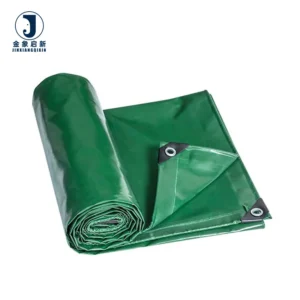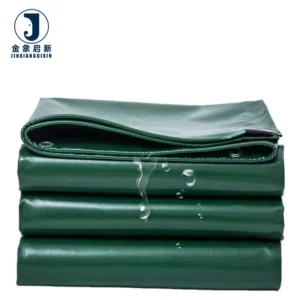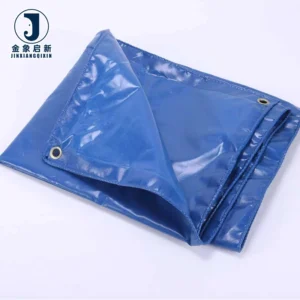
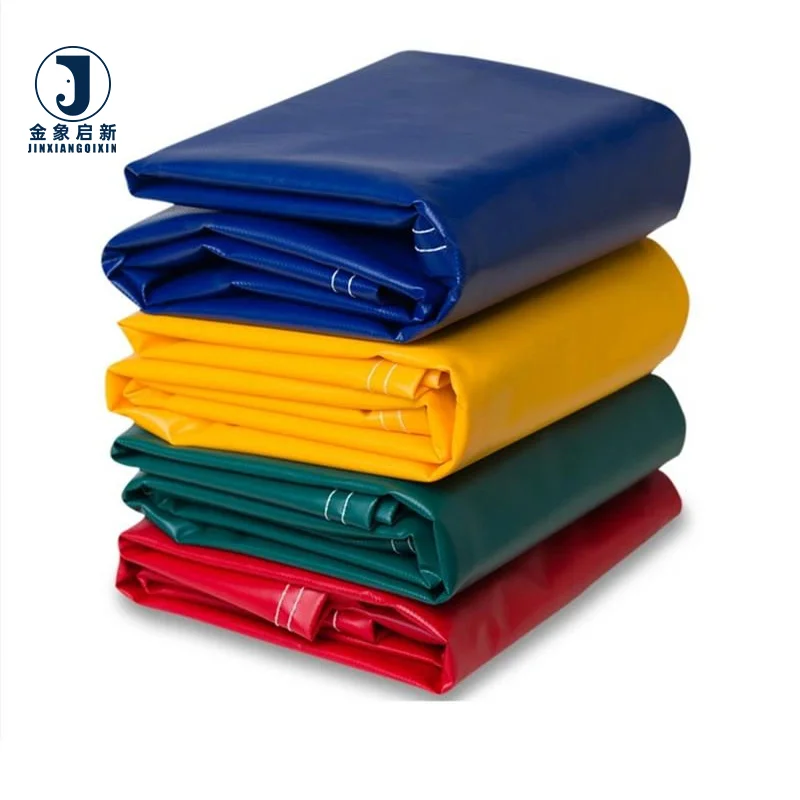
Process-Controlled Coating — Every roll of this technical grade knife coated PVC fabric leaves the line with a documented specification sheet stating base yarn denier, coating weight and measured GSM, so technical buyers can validate material composition on arrival rather than relying on quotation claims alone.
Technical Specifications
| Parameter | Value |
|---|---|
| Product Type | PVC Coated Tarpaulin Fabric |
| Coating Material | PVC |
| Base Fabric Denier (Medium) | 500D |
| Base Fabric Denier (Heavy-duty) | 1000D |
| Base Fabric Denier (Super Heavy) | 500D–2000D |
| Total Thickness (Medium) | 0.35–0.45 mm |
| Total Thickness (Heavy-duty) | 0.70–1.0 mm |
| Total Thickness (Super Heavy) | 1.2–1.5 mm |
| Weight (Medium) | 400–500 g/m² |
| Weight (Heavy-duty) | 700–1000 g/m² |
| Weight (Super Heavy) | 1100–1500 g/m² |
| Tensile Strength – Warp (Medium) | 1500–2000 N/5cm |
| Tensile Strength – Weft (Medium) | 1200–1800 N/5cm |
| Tensile Strength – Warp (Heavy-duty) | 2000–2500 N/5cm |
| Tensile Strength – Weft (Heavy-duty) | 1800–2200 N/5cm |
| Tensile Strength – Warp (Super Heavy) | 2500–3000 N/5cm |
| Tensile Strength – Weft (Super Heavy) | 2200–2800 N/5cm |
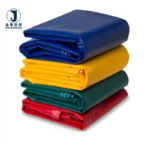
| Color Options | Blue, Blue/Orange, Green, Grey, Black, Clear, Grey/Green, Orange, custom |
| UV Treatment | Available (test basis not stated — request report) |
| Flame Retardant | Available in flame retardant grades — confirm the grade required for your market |
| Key Features | Waterproof, tear resistant, mildew proof, anti-aging, washable |
| Certification | ISO, CE |
Application Suitability
| Application | Exposure & Requirement |
|---|---|
| Truck side curtain and trailer cover | Constant flexing at load points, road debris abrasion, sustained UV and rain exposure |
| Tensioned membrane and inflatable structure | High tensile load under wind uplift, welded seam integrity, long-term weathering |
| Industrial pipe canopy and equipment enclosure | Chemical splash contact, thermal cycling, puncture risk from sharp edges |
| Tent and awning fabric | Repeated fold and unfold cycles, UV degradation, water ingress at stitch lines |
| Outdoor storage and construction site cover | Wind-driven rain, soil contact, mechanical abrasion from bulk material loading |
Why PVC Coated Tarpaulin Fabric GSM Alone Does Not Predict Field Performance
Coating weight and base fabric denier together determine how the material behaves under load — neither tells the full story in isolation.
Technical buyers frequently receive PVC coated tarpaulin fabric with a GSM figure on the quotation that does not match the roll arriving at the dock. The discrepancy often comes from a lighter base fabric being compensated with additional coating, which inflates weight without adding tensile or tear resistance. A 700 g/m² roll built on 500D yarn behaves very differently from the same GSM built on 1000D yarn when a truck side curtain flexes through thousands of load cycles. Specifying by GSM without requesting the denier and weave construction leaves the most critical performance variables unverified [NEED_CITE: tensile and tear test methods for coated fabrics per ISO 1421].
How Base Yarn Construction Governs Mechanical Behaviour
The base fabric is the structural skeleton of any PVC coated tarpaulin fabric. Denier indicates the thickness of individual yarns, and a move from 500D to 1000D substantially raises the force required to initiate a tear. Warp and weft density — the number of yarns per centimetre in each direction — then determines how that tear propagates once started. A tightly woven 1000D base resists tear spread far more effectively than a loosely woven fabric of the same denier, which is why tensile data across both axes must be reviewed together rather than comparing a single number.
Coating Thickness, Adhesion and Long-Term Durability
The PVC coating layer provides waterproofing, abrasion resistance and chemical protection, but its contribution depends on adhesion to the base fabric. Knife coating pushes PVC paste into the yarn interstices under controlled pressure, creating a mechanical bond that resists delamination when the material is flexed or welded. Coating thickness from 0.35 mm up to 1.5 mm covers the range from medium-duty covers to super heavy structural membranes. Thicker coatings add abrasion life and improve weld pool formation during hot-air joining, yet they also increase roll weight and handling effort on site [NEED_CITE: coating adhesion and peel strength test standards for technical textiles].
Reading the Specification Sheet Against Project Requirements
Three parameters require close comparison when selecting a grade: denier versus expected tear load, GSM versus handling constraints, and tensile values versus the peak forces the installed fabric will experience. A tensioned canopy in a coastal wind zone demands high warp tensile values and a super heavy grade, while a farmer’s market stall cover prioritises lighter weight for daily setup. Mapping these variables to the application prevents both over-specifying — which adds unnecessary cost and weight — and under-specifying, which leads to premature failure.
The Hidden Cost of Specifying on Price Per Kilogram
Selecting PVC coated tarpaulin fabric on a cost-per-kilogram basis without verifying construction invites a specific failure pattern: the supplier meets the target GSM by using a lower-denier base and a thicker, softer coating. The roll feels heavy and passes a hand check, but under dynamic loading the weaker base fabric allows tears to propagate rapidly, and the excess coating can delaminate at flex points. Welded seams may fail before the fabric body because the coating layer is too thick relative to the yarn structure. The result is a warranty claim that neither party can resolve because the original purchase order referenced only GSM [NEED_CITE: common failure modes in coated technical fabrics under cyclic loading].
Why Technical Buyers Source This PVC Coated Fabric Here
Three full production lines and 36 sets of professional coating equipment support consistent output across medium, heavy-duty and super heavy grades without batch bottlenecking. A dedicated 10-person R&D team handles material selection, custom colour matching and sample development within days, letting fabricators validate weld parameters and drape behaviour before committing to a production run. QA inspection runs at every coating and lamination stage, with 100% pre-shipment verification of GSM and thickness roll by roll. Nearly 30 years of focused coated-fabric production means the process variables — paste viscosity, oven temperature, knife gap — are controlled from experience rather than adjusted by trial and error.
Documentation & Verification
- Material specification sheet stating exact GSM, base denier, weave count and coating weight per roll
- Pre-shipment inspection record with measured thickness and weight against quoted values
- Test reports for UV and flame retardant grades supplied when applicable to the selected variant
- ISO and CE certificates included with customs and export documentation
- Certificate of origin and roll packing list for container load reconciliation
Fabrication, Handling & Storage
- Hot-air welding temperature must match coating thickness — heavier grades above 1.0 mm need higher air temperature and slower travel speed
- Store rolls horizontally on racking to prevent flat-spot deformation on the coating surface
- Eyelet and hem reinforcement should distribute load across multiple yarn courses, not just the coating layer
- Unroll super heavy grades with mechanical assistance to avoid creasing the 1.2–1.5 mm coating
- Clean with mild detergent only; solvent-based cleaners may degrade the PVC plasticiser in the coating
What to Include in Your Enquiry
Provide the application scenario, expected mechanical loads and environmental exposure so we can recommend the correct denier, GSM and coating thickness. State your target market’s fire classification or compliance requirements if flame retardant grades are needed. Specify required roll width, colour references and whether you need plain stock or custom-printed branding.
Frequently Asked Questions
Q: How do I verify the quoted GSM against the delivered PVC coated tarpaulin fabric?
A: Every shipment includes a pre-shipment inspection record with roll-by-roll weight and thickness measurements. On arrival, you can cut a measured sample from the roll edge and weigh it on a calibrated scale. The base denier and weave density stated on the material specification sheet give you a second cross-check, because a different base construction would produce a different hand feel and stiffness even at the same GSM.
Q: What UV test documentation is available for outdoor applications?
A: UV treatment is available across the range, but the test basis varies by grade. Before confirming your order, request the specific UV exposure test report for the grade you are selecting. The report will state the test method, exposure duration and retained tensile percentage, letting you judge suitability for your climate and expected service conditions.
Q: How does coating thickness affect hot-air welding of this fabric?
A: Thicker coatings above 1.0 mm require higher hot-air temperature and slower travel speed to fully melt the PVC layer at the seam. Medium grades in the 0.35–0.45 mm range weld quickly but need careful heat control to avoid burning through the thinner coating. We supply sample pieces so fabricators can dial in weld parameters before cutting production panels.
Q: Can colour consistency be maintained across multiple rolls in one order?
A: Colour matching is controlled at the coating paste mixing stage with reference to a master colour standard. All rolls in a single production run use the same paste batch, and QA checks each roll against the reference under controlled lighting. If your project spans multiple orders, request a retained colour swatch from the first batch to align subsequent runs.
Q: Which flame retardant grades are available and how do I specify them?
A: Flame retardant PVC coated tarpaulin fabric is available in several grades to match different regional fire codes. State the classification your project requires — for example, the building material class demanded by your local authority — and we will confirm which grade meets that standard, supported by the corresponding test report before order confirmation.