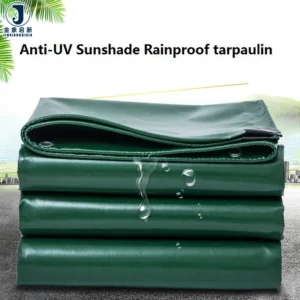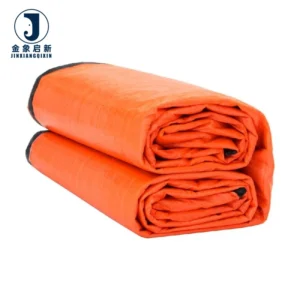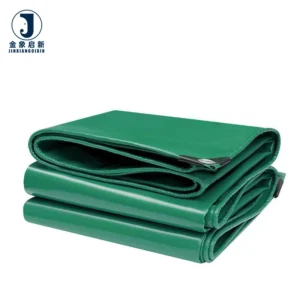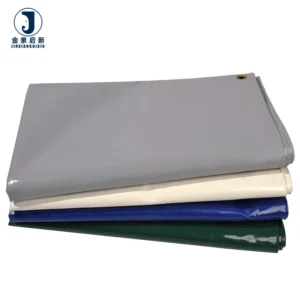
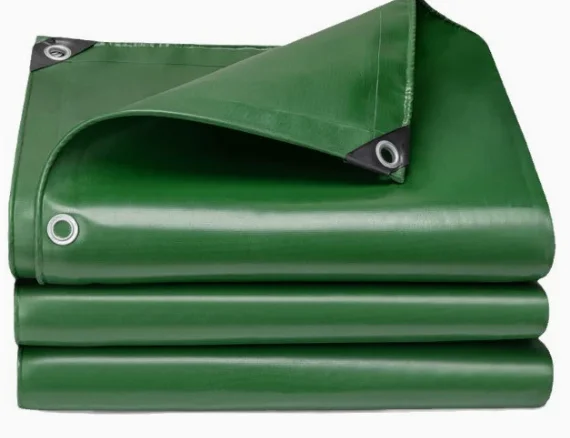
Process Control — nearly 30 years focused on coated fabric gives us direct command over coating weight, adhesion, and base weave consistency on every roll of PVC coated fabric we produce.
Technical Specifications
| Parameter | Value |
|---|---|
| Product Type | PVC Coated Fabric |
| Weight | At least 450 grams (source value — verify against manufacturer catalog) |
| Coating Material | PVC |
| Base Fabric | Woven fabric |
| Waterproof | Yes |
| Finish | High-strength vinyl |
| Standards | ISO, CE |
Application Suitability
| Application | Exposure & Requirement |
|---|---|
| Vehicle and equipment covers | Rain, snow, road debris, UV exposure, repeated handling and folding at tie-down points |
| Outdoor structure protection | Sustained weather exposure, wind load, pooling water, long-term dimensional stability |
| Industrial site and asset covers | Puncture risk from sharp edges, abrasion during installation, chemical dust, tear propagation |
What 450 GSM Actually Means When the Roll Arrives at Your Warehouse
A quoted weight figure only protects you if it is verified roll-by-roll before the container leaves the factory.
Buyers regularly specify a PVC Coated Fabric 450 gsm and receive material that measures lighter on arrival. The shortfall is rarely dramatic enough to trigger a rejection at first glance, but it shows up as earlier-than-expected tearing at stress points, faster degradation under sun exposure, and weld seams that separate under load. When the base fabric denier is lower than expected or the PVC coating is thinner on one side, the total weight drops — and so does the fabric’s ability to resist puncture and abrasion [NEED_CITE: tensile and tear test methods for coated fabrics per ISO 1421]. The problem compounds when multiple rolls from the same order vary in weight, making it impossible to set consistent welding parameters on the production floor.
How Base Fabric Denier and Weave Density Drive Real-World Strength
The woven base fabric is what carries the mechanical load in any PVC coated fabric. Yarn denier and warp-and-weft density determine how the material behaves when a point load hits it — a sharp corner on a pallet, a tie-down strap cutting into a truck cover. Higher denier yarns resist individual breakage, while tighter weave spacing limits how far a tear can propagate once initiated. The PVC coating protects the base from moisture and abrasion, but it does not compensate for a loosely woven substrate. A 450 gsm specification built on a dense, high-denier base will outperform a heavier-sounding alternative that relies mostly on coating thickness for its weight.
Coating Method and Its Effect on Seam Integrity
Knife coating applies PVC in controlled layers directly onto the woven base, forcing the compound into the interstices of the weave. This creates a mechanical bond between coating and yarn that resists delamination during heat welding and flexing. Calendered coatings sit more on the surface, which can be cost-effective but produces a weaker bond line. For applications where the fabric is heat-welded into panels or shaped covers, the coating method determines whether the weld holds longer than the surrounding material — or whether it peels away under the first heavy load [NEED_CITE: weld seam peel strength testing for coated technical textiles].
Reading the Numbers Behind a 450 GSM Fabric
The stated weight of a coated fabric is the sum of base fabric mass and coating mass. Two fabrics can both weigh 450 gsm yet perform very differently: one might use a heavier base with a thinner coat, giving high tensile strength but less surface protection, while the other uses a lighter base with thicker PVC for better waterproofing but lower tear resistance. For PVC Coated Fabric 450 gsm in industrial and outdoor covering roles, the balance between these two components dictates how the material handles folding, welding, and long-term weather exposure. Base weave density also influences how cleanly the fabric cuts and how well it holds eyelet installations. The GSM figure alone is a starting point — the material specification sheet should break out base fabric denier, weave count, and coating weight separately so buyers can compare like with like.
The Hidden Cost of Specifying Weight Without Verifying the Full Build
When a purchasing decision rests on GSM alone, the consequences appear months later in the field. A truck cover that tears along a weld line was not necessarily the wrong weight — it may have had the wrong coating-to-base ratio for the welding process used. An equipment cover that develops pinholes after one season may have had insufficient coating thickness on the weather-exposed side. Roll-to-roll inconsistency within a single shipment forces fabricators to adjust welding temperatures and pressures for each roll, slowing production and generating waste from failed seams [NEED_CITE: common causes of coated fabric weld failures in tarpaulin fabrication]. These problems trace back to incomplete specifications at the quoting stage.
Why Procurement Teams Source This Material Here
Deep process control over coating weight and base fabric selection means the 450 gsm PVC coated fabric leaving our facility matches the specification sheet on every roll. Three full production lines and 36 sets of professional equipment support volume orders without compressing lead times at the expense of coating consistency. A 10-person R&D team handles custom width, colour matching, and surface treatment development, producing samples within days rather than weeks. Dedicated QA and QC at every production stage — including 100% inspection before shipment — catches weight deviation, coating defects, and colour variation before they reach the container. Nearly 30 years of continuous coated fabric production has refined these controls through real production cycles, not theoretical protocols.
Documentation & Verification
- Material specification sheet stating GSM, base fabric denier, coating type, and colour reference
- Pre-shipment inspection record with roll-by-roll weight verification against the stated 450 gsm
- Test reports for UV and flame-retardant grades where applicable — confirm the grade required for your market
- ISO and CE certificates available on request for compliance submissions
- Roll packing list with individual roll numbers and net weights for receiving checks
Fabrication, Handling & Storage
- Heat welding temperatures should be calibrated to the knife-coated PVC surface to avoid coating burn-through
- Store rolls horizontally on pallets to prevent permanent creasing in the woven base fabric layer
- Allow cold-stored rolls to reach ambient temperature before unrolling to prevent coating crack damage
- Use PVC-compatible cleaners on the high-strength vinyl finish to avoid surface degradation over time
- Cut patterns should account for the fabric’s dimensional stability to minimise waste at selvage edges
- Reinforce eyelet zones with additional PVC patches to distribute tie-down loads across the woven base
What We Need to Quote Your Project Accurately
Provide the application type, expected exposure conditions, and the dimensions or roll quantities you need. If your market requires specific fire safety or UV resistance grades, state the standard your end customer expects so we can confirm whether the available treatment matches [NEED_CITE: regional fire classification standards for coated fabric in building and transport]. Let us know if you need custom width, colour, or surface printing, and whether you require finished panels or roll stock only. Sample approval before bulk production is standard procedure.
Frequently Asked Questions
Q: How do I verify the 450 gsm weight when the rolls arrive?
A: Weigh a measured sample from each roll using a calibrated scale and compare against the specification sheet. Our pre-shipment inspection records include roll-by-roll weight data. If your receiving process requires independent verification, request third-party testing to DIN or ISO methods before the container is sealed.
Q: What base fabric construction sits behind the 450 gsm total weight?
A: The total GSM includes both the woven base fabric and the PVC coating. Request the material specification sheet to see base denier and weave density broken out separately. These values determine tensile and tear performance more than total weight alone.
Q: How does the PVC coating method affect waterproof performance?
A: Knife coating forces PVC into the weave interstices, creating a continuous barrier with strong mechanical adhesion. This produces reliable waterproof integrity that withstands flexing and folding. The coating weight and base weave density together determine how the material performs under sustained water exposure.
Q: What UV treatment options are available for extended outdoor use?
A: Anti-UV treatments can be incorporated during coating, but the specific grade and test basis must match your market requirements. Confirm the UV resistance standard your application needs and request the corresponding test report before placing the production order.
Q: Why do weld seams sometimes fail before the fabric itself?
A: Weld failure often results from a mismatch between the welding parameters and the coating formulation. Knife-coated PVC bonds well when heat and pressure are calibrated correctly. We provide welding guidance based on our coating specification to help fabricators achieve seam strength that matches or exceeds the base fabric strength.