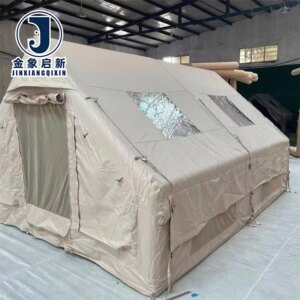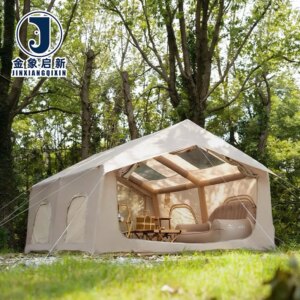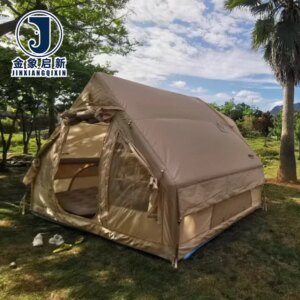
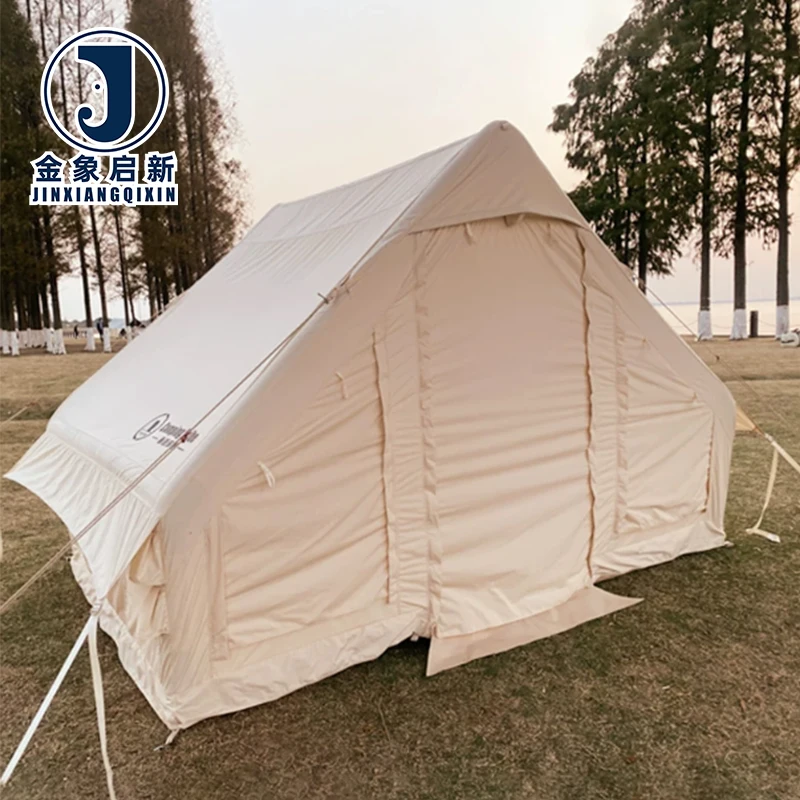
Coated Fabric Expertise — Nearly 30 years of PVC tarpaulin production with 3 full production lines delivering knife-coated rolls for inflatable tent structures requiring consistent air retention and seam integrity under inflation pressure.
Technical Specifications
| Parameter | Value |
|---|---|
| Product Type | Inflatable Tent |
| Core Material | PVC Tarpaulin |
| Product Forms | Inflatable Camping Tent |
| Capacity | 2-8 Person |
| Key Performance | Waterproof, UV-Resistant (test basis not stated), Tear-Resistant |
| Construction | Single-layer |
| Opening Mechanism | Quick Automatic Opening |
| Season Rating | 4-Season |
| Customization Service | OEM & ODM (sample customization, pattern printing, size adjustments, material thickness modifications) |
| Standards | ISO9001, ISO14001, ISO45001, CE |
Application Suitability
| Application | Exposure & Requirement |
|---|---|
| Commercial camping grounds | Rapid-deployment inflatable shelters requiring puncture resistance, repeated inflation cycles, and sustained outdoor exposure |
| Outdoor exhibition and event organizers | Portable tent structures subjected to wind loads, UV exposure, and frequent setup/teardown handling |
| Emergency response scenarios | Temporary inflatable shelters deployed in variable weather requiring waterproof performance and quick automatic opening |
| Industrial site accommodation | Mobile commercial spaces requiring 4-season structural integrity across temperature fluctuations |
| Temporary event shelters | Inflatable structures demanding tear-resistant fabric with reliable welded seam performance under internal air pressure |
Why Base Fabric Denier Matters More Than GSM for Inflatable Structures
The structural integrity of inflatable tent tubes depends on base fabric denier and weave density, not coating weight alone.
When sourcing PVC inflatable tent fabric material supplier, technical buyers often focus on GSM as the primary indicator of fabric strength. But for inflatable camping tents, the internal air pressure creates constant stress on welded seams and tube junctions. A heavy coating applied to a low-denier base fabric may meet the stated GSM while lacking the tensile strength to resist tube expansion under pressure. The base fabric’s warp and weft density determines how load distributes across the material when inflation forces concentrate at bend points and connection zones. [NEED_CITE: tensile and tear test methods for coated fabrics per ISO 1421]
Coating Adhesion and Weld Performance Under Inflation Pressure
Inflatable tent structures place unique demands on PVC tarpaulin because the material must maintain airtight seals at welded seams while withstanding repeated inflation and deflation cycles. Knife coating delivers controlled coating weight and strong adhesion to the base fabric, which directly affects how well heat-welded seams hold under internal pressure. When coating adhesion is weak, the material delaminates at stress concentrations before the base fabric reaches its tensile limit.
UV-Resistant Treatment Verification for Extended Outdoor Deployment
Outdoor inflatable camping tents face continuous solar exposure that degrades untreated PVC over time, causing surface chalking, loss of flexibility, and eventual cracking at fold lines. UV-resistant treatment is available in this PVC inflatable tent fabric material supplier range — confirm the specific UV test standard required for your target market and request documentation before committing to bulk orders. Commercial camping grounds and event organizers deploying structures for multi-week installations need verified treatment data rather than general claims. [NEED_CITE: UV aging test methods for PVC coated fabrics]
How Coating Method Determines Air Retention and Seam Reliability
The relationship between coating method, GSM, and air retention defines whether an inflatable tent holds pressure through a full deployment cycle. Knife coating applies PVC paste directly onto the base fabric under controlled tension, producing uniform coating thickness that prevents air leakage through pinholes or thin spots. The coating weight affects both flexibility and puncture resistance — heavier grades resist ground contact damage but reduce the fabric’s ability to fold compactly for transport. Base fabric denier and weave pattern work together with coating weight to determine overall tear propagation resistance, which matters when a puncture occurs under inflation pressure. The surface finish — whether glossy or matte — influences cleaning ease and whether printed branding adheres reliably for commercial branding applications.
The Hidden Cost of Specifying Without Verifying Batch Consistency
Color variation between rolls in the same order becomes visible when multiple inflatable tents are installed side by side at a commercial camping ground or exhibition site. [NEED_CITE: batch-to-batch colour consistency standards in coated fabric production] When coating weight varies roll to roll within a single shipment, inflation behavior becomes unpredictable — some units may require higher air pressure to achieve full structural rigidity while others reach operating pressure faster. Welded seam failures that occur before the fabric itself degrades typically trace back to inconsistent coating thickness at the weld zone, where heat penetration varies across the material surface.
Why Procurement Verification Matters Here
Three full production lines and 36 sets of professional processing equipment support roll-to-roll consistency for PVC inflatable tent fabric orders. The 10-person R&D team handles material thickness modifications, pattern printing specifications, and sample development before bulk production begins. Dedicated QA and QC staff conduct full-process quality inspection with coating weight verification at each production stage. Pre-shipment inspection records document actual GSM values measured against the specification sheet for every roll. ISO9001, ISO14001, ISO45001, and CE certification documentation accompanies each shipment for compliance verification in your destination market.
Documentation & Verification
- Material specification sheet stating GSM, base fabric denier, coating composition, and color reference per order
- Test reports for UV-resistant treatment and waterproof performance available upon request with stated test basis
- ISO9001, ISO14001, ISO45001, and CE certificates provided for market compliance requirements
- Pre-shipment inspection record with actual coating weight verification against stated specifications
- Roll packing list with batch identification for traceability across multi-roll orders
- Certificate of origin and customs documentation support for international shipments
Fabrication, Handling & Storage
- Heat-welding parameters must account for coating thickness to ensure seam integrity under inflation pressure
- Store rolls vertically on pallets to prevent permanent creasing that weakens the PVC tarpaulin coating layer
- Avoid dragging material across rough surfaces during fabrication to protect the coated surface finish
- Allow cold-stored rolls to reach ambient temperature before unrolling to prevent cracking at low temperatures
- Use compatible PVC adhesive for field repairs on punctures to maintain air retention in inflatable structures
- Plan cutting layout to maximize utilization and minimize waste from the single-layer PVC tarpaulin construction
What We Need to Move Your Inquiry Forward
Provide your target application and deployment environment so we can recommend appropriate material thickness and treatment specifications. Specify required fabric width, annual volume, and whether you need rolls or finished cut-to-size panels for your inflatable tent production. Include any color requirements, pattern printing needs, and the compliance standards your destination market requires for UV resistance or fire classification.
Frequently Asked Questions
Q: How can I verify UV-resistance claims with test data before placing bulk orders?
A: Request specific UV test reports that document the testing standard, exposure duration, and measured retention of physical properties. We provide test documentation upon request — confirm which UV standard your market requires so we supply relevant data. For PVC inflatable tent fabric deployed in high-solar environments, verified treatment data prevents premature degradation failures.
Q: What is the OEM/ODM customization process from sample to production?
A: Submit your requirements for material thickness, pattern printing, size adjustments, and color specifications. Our R&D team develops samples within days for your approval before bulk production begins. Once you confirm the sample meets your inflatable tent specifications, we proceed with production under full-process quality inspection with dedicated QA and QC oversight.
Q: How do you ensure color consistency across multiple rolls in one order?
A: Each production batch follows controlled coating and color-matching procedures with verification at multiple stages. Pre-shipment inspection includes color comparison against approved references before dispatch. Roll packing lists document batch identification so you can trace material back to specific production runs if questions arise during your inflatable tent fabrication.
Q: What documentation accompanies each shipment for compliance verification?
A: Every shipment includes material specification sheets, pre-shipment inspection records with actual coating weight measurements, ISO and CE certificates, roll packing lists with batch numbers, and certificates of origin. Additional test reports for UV-resistant treatment or other performance properties are provided based on your stated market requirements.
Q: What material thickness options are available for inflatable tent frame tubes versus outer shells?
A: Material thickness modifications are available through our OEM and ODM customization service. Frame tubes typically require heavier grades for puncture resistance and air retention under inflation pressure, while outer shells may prioritize lighter weight for portability. Provide your structural requirements so we recommend appropriate specifications for each inflatable tent component.