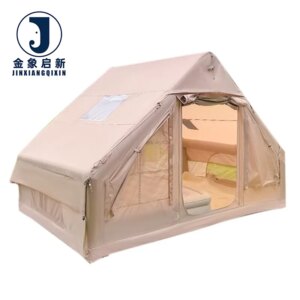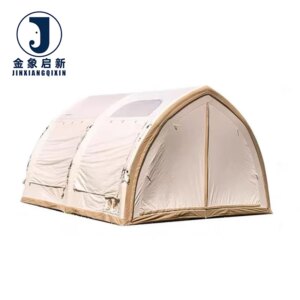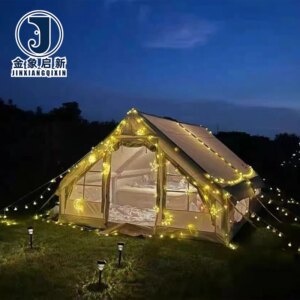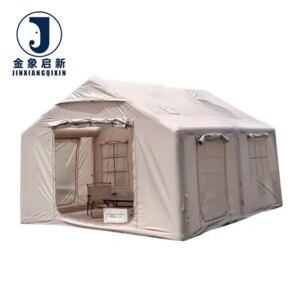
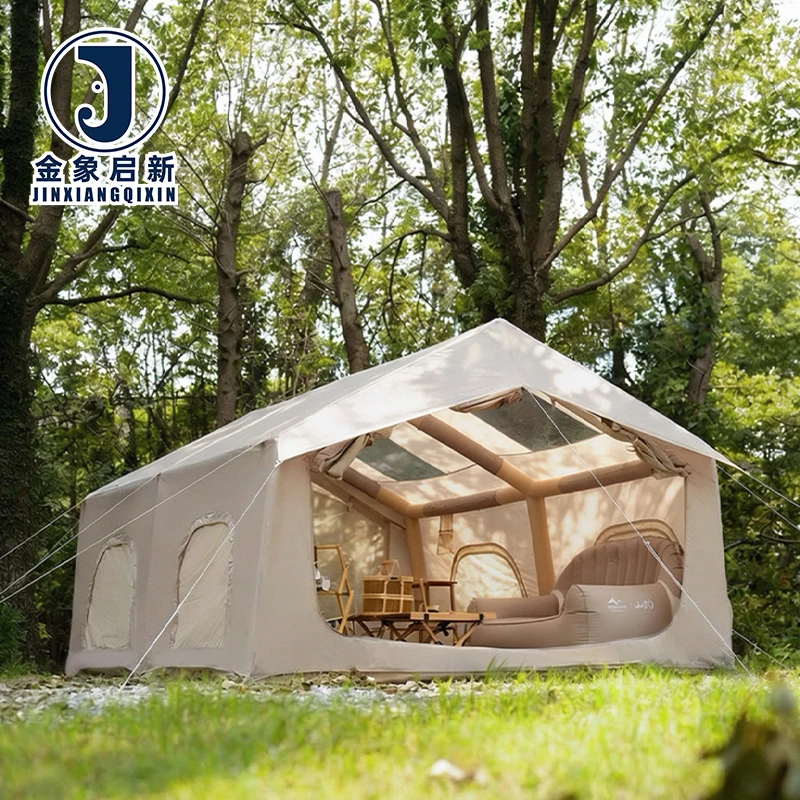
Coating Control Expertise — nearly three decades focused on PVC coated fabric with process control over coating weight and adhesion, applied here to inflatable tent fabric for consistent seam and weld integrity.
Technical Specifications
| Parameter | Value |
|---|---|
| Product Type | Inflatable Tent |
| Core Material | PVC Tarpaulin |
| Product Forms | Single Layer Inflatable Tent |
| Waterproof | Confirmed |
| UV-Resistant | Available — test basis to be confirmed per project |
| Tear-Resistant | Confirmed |
| Fire-Retardant | Available in fire-retardant grades — confirm the grade required for your market |
| Anti-Static | Available — standard to be confirmed per project specification |
| Customization | Sample customization, pattern printing, OEM & ODM services |
| Production Lines | 3 full production lines |
| Processing Equipment | 36 sets of professional processing equipment |
| R&D Team | 10 technicians |
| Standards | ISO9001, ISO14001, ISO45001, CE |
Application Suitability
| Application | Exposure & Requirement |
|---|---|
| Emergency response command centers at construction sites | Repeated inflation cycles, rapid deployment stress, outdoor weather exposure |
| Temporary storage facilities for disaster relief supplies | Waterproof integrity, wind load, long-term UV exposure |
| Equipment maintenance shelters in remote locations | Abrasion from ground contact, thermal fluctuation, field repairability |
| Rapid deployment field stations for infrastructure inspection teams | Cyclic pressurization, transport folding, frequent setup and teardown |
| Membrane and inflatable structure fabrication | Weld seam integrity under inflation pressure, batch colour consistency across rolls |
Why Welds Fail Before the Fabric Does on Inflatable Structures
When inflatable tent fabric is specified by GSM alone, buyers often discover that the weakest point is not the coated fabric itself but the welded seam — the joint that flexes most during inflation and deflation cycles. Seam integrity depends on coating formulation and weld compatibility, not just base fabric weight. I have seen coated rolls where the weld line delaminated after repeated pressurization cycles while the surrounding material remained intact. This typically traces back to a mismatch between the PVC coating plasticiser content and the hot-air welding temperature profile used during fabrication [NEED_CITE: tensile and tear test methods for coated fabrics per ISO 1421]. The result is a structure that loses air pressure at the seam long before the fabric shows any sign of degradation, leaving an emergency shelter or industrial enclosure unfit for service.
Coating Formulation and Weld Behaviour Under Inflation Stress
The PVC coating on inflatable tent fabric must bond to the base fabric strongly enough to resist delamination during cyclic pressurization. Knife coating builds a defined coating layer on the substrate, control* weave. When the plasticiser ratio and curing temperature are held within a narrow window, the resulting surface responds predictably to hot-air or high-frequency welding. This consistency is what allows fabricators to set weld parameters once and hold them across an entire production run.
Single-Layer Construction and Air Retention Demands
A single-layer inflatable tent relies entirely on the coated fabric for both structure and air retention. Unlike double-wall systems where an inner bladder carries the pressure load, every square metre of custom inflatable structure PVC fabric in a single-layer design must resist stretching and micro-porosity under continuous inflation. The base fabric denier and weave density work together with the coating to prevent air migration through the material. Any inconsistency in coating thickness across the roll width introduces points where air loss concentrates, forcing the inflation system to work harder and shortening the service interval between maintenance checks.
Reading the Material Data Beyond GSM
Total GSM tells you the combined weight of base fabric and coating, but it does not reveal how that weight is distributed. A heavier coating over a lighter base fabric may show the same GSM as a lighter coating over a denser weave, yet their tear propagation resistance and weld peel strength differ significantly [NEED_CITE: relationship between base fabric denier and tear strength in PVC coated textiles]. For inflatable structures, the base fabric must resist tear initiation at stress points — valve cutouts, corners, and panel junctions — while the coating must maintain adhesion through hundreds of inflation cycles. Specifying both the base fabric construction and the coating weight separately gives a far more accurate picture of how the inflatable tent fabric manufacturer built the material than a single GSM figure.
What Happens When Specifications Are Selected on Price Alone
Buyers who approve inflatable tent fabric based on the lowest quoted GSM often face consequences that surface only after the structure is deployed. Coating weight that falls short of the stated specification reduces air retention and allows moisture ingress at the base fabric interface. Fire-retardant treatment claimed without a supporting test report becomes a compliance failure when the site safety auditor asks for documentation [NEED_CITE: DIN 4102 fire classification for building materials]. Colour variation between rolls in the same shipment becomes visible once panels are welded side by side on the finished structure, forcing either acceptance of an inconsistent appearance or a costly rework. Weld seams that separate under the first inflation cycle trace back to coating formulation that was not matched to the fabrication method.
Why Fabrication Teams Source This Fabric Here
Three full production lines and 36 sets of processing equipment mean that PVC inflatable tent fabric orders move through coating, curing, and inspection without queuing behind unrelated product runs. The 10-person R&D team handles material selection and sample development in-house, so a change in fire-retardant grade or coating weight is validated on a sample roll before the full order enters production. Dedicated QA/QC inspection at every stage catches coating weight drift and colour deviation before they reach the dispatch bay. Samples for custom width, colour, or pattern printing are developed within days, allowing fabricators to confirm weld parameters and visual appearance before committing to bulk volume.
Documentation & Verification
- Material specification sheet stating base fabric denier, coating weight, and total GSM for the inflatable grade supplied
- Fire-retardant and anti-static test reports matched to the production batch where project compliance requires certification
- ISO and CE documentation traceable to the coating batch for procurement audit trails
- Pre-shipment inspection record confirming coating weight and colour consistency roll by roll
- Roll packing list with gross and net weights for container loading verification
Fabrication, Handling & Storage
- Set hot-air weld temperature to match the PVC coating plasticiser content — confirm with a test strip from the roll end before full-panel welding
- Store rolls horizontally on padded racks to prevent permanent creasing in the coated surface that transfers to the finished inflatable structure
- Allow cold-stored rolls to reach workshop temperature before unrolling to avoid coating micro-cracking at low flexibility
- Use mild detergent and soft cloth for field cleaning — abrasive solvents degrade the PVC coating surface and reduce UV protection
- Plan panel cutting layout to place weld seams away from high-stress inflation points such as valve cutouts and corners
- Repair minor field punctures with compatible PVC adhesive patches applied to a clean, dry coated surface
What to Include with Your Enquiry
To move quickly to sample and quotation, provide the intended application and the inflation pressure range the structure will operate under. Confirm whether your project requires fire-retardant or anti-static certification and which test standard applies in your market. State the roll width, colour, and any pattern printing needed so the R&D team can prepare a sample that reflects your production specification.
Frequently Asked Questions
Q: How is the PVC coating weight and adhesion validated for inflatable structure applications?
A: Coating weight is measured per roll against the stated specification before dispatch. Adhesion is assessed through peel testing that separates the PVC layer from the base fabric under controlled force, confirming the bond strength is sufficient for repeated inflation and deflation cycles without delamination.
Q: What fire-retardant grades are available and which test standards apply for inflatable tent fabric?
A: Fire-retardant treatment is available in multiple grades depending on the destination market. The applicable test standard varies by region and project specification. Provide your compliance requirement at enquiry stage so the correct grade is formulated and a matching test report is supplied with the shipment.
Q: How are welded seams tested to ensure they outlast the base fabric under inflation cycles?
A: Welded seam samples undergo peel and shear testing to verify that the joint strength meets or exceeds the base fabric tear resistance. Hot-air weld parameters are matched to the coating formulation of the specific batch, and the test confirms the seam will hold through cyclic pressurization without separating.
Q: What customisation options exist for width, colour and pattern printing on inflatable structure fabric?
A: Rolls are available in custom widths and colours with pattern printing for branding or identification. The R&D team develops a sample roll to confirm colour accuracy and print adhesion on the PVC surface before bulk production, ensuring consistency across the full order quantity.
Q: How is batch-to-batch colour consistency controlled across rolls for large membrane projects?
A: Colour is matched against a reference standard under controlled lighting at the coating stage. Every roll in the batch is inspected side by side before dispatch, and any roll showing visible deviation is held for review. The pre-shipment inspection record documents colour verification roll by roll.