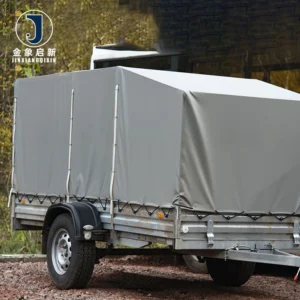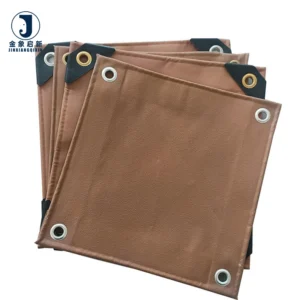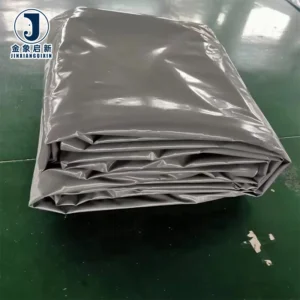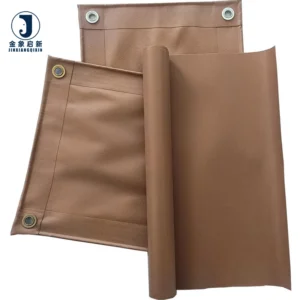
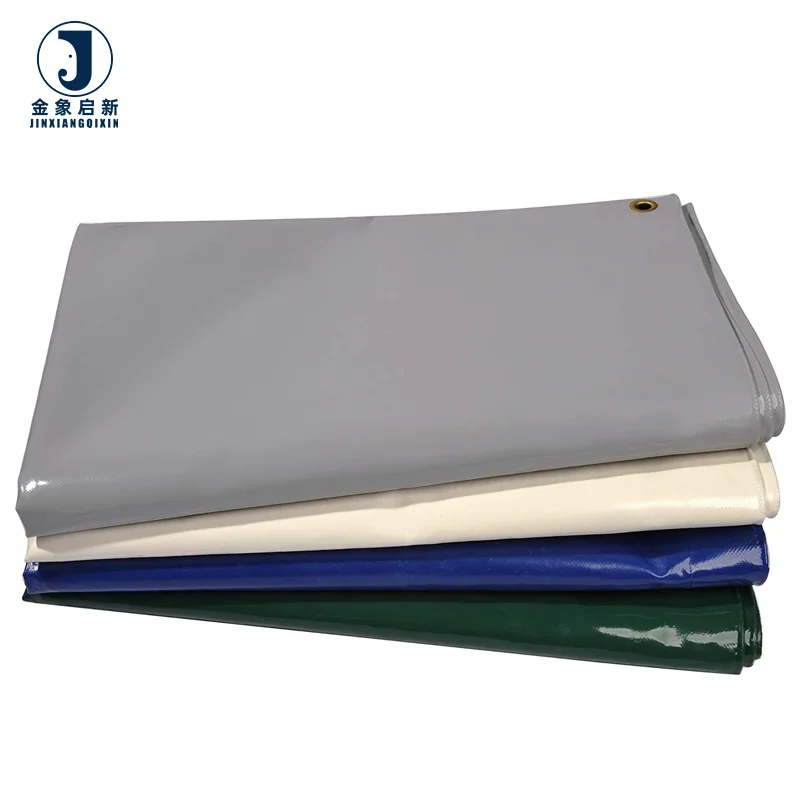
Coating Weight Control — Three dedicated production lines maintain strict GSM tolerance on every roll of PVC coated polyester tarpaulin, verified against the material specification sheet before dispatch.
Technical Specifications
| Parameter | Value |
|---|---|
| Product Type | PVC Coated Tarpaulin |
| Base Fabric Denier Options | 500D×840D / 500D×1000D / 1000D×1000D / 1000D×1300D / 1300D×1300D / 1000D×2000D |
| Weight Range | 350 / 400 / 420 / 500 / 600 / 650 / 750 / 900 GSM (product family — confirm required grade) |
| Total Thickness | 0.29 mm (400 GSM) / 0.32 mm (420 GSM) / 0.38 mm (500 GSM) / 0.44 mm (600 GSM) / 0.46 mm (650 GSM) / 0.55 mm (750 GSM) / 0.65 mm (900 GSM) |
| Mesh Count | 30×19 (350–500 GSM range) / 20×20 (600–750 GSM range) / 30×15 (900 GSM) |
| Tensile Strength — Warp/Weft (N) | 1650/1600 (350) / 1800/1700 (400) / 1850/1750 (420) / 2050/1900 (500) / 2500/2200 (600) / 2550/2250 (650) / 2750/2850 (750) / 3900/3500 (900) (test basis not stated) |
| Coating Material | PVC (double-sided coating on woven polyester base fabric) |
| Flame Retardant Grade | Available in flame retardant grades — confirm the grade required for your market (grade not stated) |
| UV Treatment | Anti-UV treatment available — request test report to confirm exposure duration (test basis not stated) |
| Waterproof Performance | Fully waterproof, double-sided PVC coating seals the base fabric |
| Surface Finish | Leather-like texture, smooth and soft surface |
| Color | Gray |
| Edge Finishing | 5 mm thick rope without splicing; high-temperature heat-sealed seamless edge wrapping |
| Eyelets | 3 cm enlarged aluminum alloy buttonhole |
| Corner Reinforcement | Reinforced corners on all sides |
| Repair Method | Repairable by hot air welding |
| Key Features | Water resistant, waterproof, flame retardant grade customizable, anti-UV treated |
Application Suitability
| Application | Exposure & Requirement |
|---|---|
| Truck and trailer side curtains | Constant flexing at load points, road debris abrasion, weather exposure, UV degradation |
| Awning and canopy structures | Continuous UV exposure, wind-driven rain, tension at anchor points |
| Tent and event structures | Flame retardant compliance required by local authority, UV and water ingress prevention |
| Pergola rain covers | Permanent outdoor installation, pooling water, UV and thermal cycling |
| Machine and wood pile covers | Abrasion from contact surfaces, moisture ingress, wind uplift |
| Balcony and window rainproof cloth | UV and weather cycling, moderate wind load, aesthetic appearance over time |
| Groundsheet and canopy | Puncture from ground contact, standing water, fold-line fatigue |
Why Stated GSM Alone Cannot Predict Fabric Failure
GSM without the corresponding base fabric denier and mesh count is an incomplete specification. A PVC coated tarpaulin quoted at a given weight may achieve that mass through heavier coating rather than a stronger base fabric, producing a material that tests correctly on a scale but tears under load.
Technical buyers evaluating PVC Coated Tarpaulin GSM coating weight tensile tear strength need to cross-reference the base yarn count, the weave density, and the tensile values in both warp and weft directions. A 650 GSM fabric on a 1000D×1300D base behaves fundamentally differently from a 650 GSM fabric achieved through coating weight alone. Without this cross-reference, the specification sheet is misleading and the material is likely to underperform at the flex points where truck loads shift or where tent fabric meets the frame [NEED_CITE: tensile and tear test methods for coated fabrics per ISO 1421].
Base Fabric Denier and Tensile Performance
The range spans six denier constructions from 500D×840D up to 1000D×2000D, each paired with a specific GSM grade. Warp tensile values climb from 1650 N at the lightest construction to 3900 N at the heaviest. For fabricators cutting custom truck side curtains, selecting the correct denier matters more than selecting the highest GSM — the base yarn thickness determines how the material behaves at the weld seam where panels join.
Coating Weight, Thickness, and Seam Weldability
PVC Coated Tarpaulin GSM coating weight tensile tear strength data shows thickness ranging from 0.29 mm to 0.65 mm across the grade ladder. Heavier coating adds abrasion resistance but changes the heat input required for hot air welding. Fabricators running automated welding equipment must adjust temperature and speed settings for each GSM grade — a parameter set that works at 420 GSM will burn through a 900 GSM panel or leave the seam cold and brittle.
Double-Sided PVC Coating on Woven Polyester
Unlike single-layer PE woven tarpaulin, this construction encases a woven polyester scrim between two PVC coating layers. The double-sided coating approach provides PVC-to-PVC contact at every weld point, producing seams that match the base fabric in strength rather than becoming the failure line. [NEED_CITE: coating adhesion and peel strength standards for PVC coated polyester fabrics]
Reading the Specification Sheet Correctly
Mesh count shifts from 30×19 in the lighter grades to 20×20 in the 600–750 GSM range, and then to 30×15 at 900 GSM. This is not arbitrary — higher mesh count with finer yarns produces a fabric that is more flexible and easier to fold, while lower mesh count with heavier yarns resists puncture and abrasion at contact points. The total thickness at each GSM grade correlates directly to the coating mass applied per square metre. When comparing two suppliers quoting the same GSM, the one with a higher denier base and lower mesh count is carrying more of that weight in yarn rather than coating, which typically produces better long-term tear resistance. Temperature boundaries are also relevant: the material remains flexible down to a brittle temperature of ≤ -50°C to -60°C and begins softening at ≥ 80°C, setting the operational envelope for cold-climate storage and hot-climate installation.
The Cost of Ordering on Weight Without Denier
When a PVC coated tarpaulin is selected on GSM alone, the typical failure pattern appears at the welded seams within the first year of service. The coating carries the weight specification, but the base fabric lacks the yarn count to resist tear propagation. The result is a truck cover that passes the scale test in the warehouse but splits along the weld line when the trailer flexes during transit. Batch colour inconsistency is a secondary risk when multiple rolls are sourced for the same installation — a visible colour shift between adjacent panels forces the fabricator to reject the entire run. [NEED_CITE: coated fabric seam failure modes and field inspection data]
Why Procurement Teams Specify Here
Ten-person R&D capability supports material selection, sample development, and custom width or colour runs with samples produced within days for evaluation before committing to roll volume. Three full production lines and 36 sets of professional equipment provide the capacity for bulk orders without sacrificing the GSM tolerance and coating adhesion that define product quality. Dedicated QA and QC inspection at every production stage, with 100 percent pre-shipment verification, ensures that the roll arriving at your facility matches the specification sheet in weight, denier, and colour. Coating process control built over nearly 30 years of focused production on PVC coated fabrics translates into consistent coating-to-base-fabric adhesion across every roll in a batch.
Documentation & Verification
- Material specification sheet stating exact GSM, base fabric denier, mesh count, and coating weight per roll
- Test report for UV resistance and flame retardant grade supplied with shipment documentation
- Pre-shipment inspection record verifying roll weight matches the quoted grade before dispatch
- ISO and CE certificates available with shipment documentation
- Roll packing list with colour reference and batch number for traceability
Fabrication, Handling & Storage
- Hot air welding temperature and speed must be adjusted per GSM grade — test on offcuts from the same roll before running production seams on 420 GSM or 900 GSM panels
- Aluminum alloy eyelets at 3 cm spacing distribute tie-down load; reinforced corners prevent tear-out at high-stress anchor points
- Store rolls upright on pallets in dry, shaded conditions to prevent flat-spotting and surface marking on the leather-like PVC finish
- Unroll and allow material to relax at ambient temperature before cutting, especially after cold-weather transport below freezing
- Clean with mild detergent and soft brush; avoid solvent-based cleaners that may attack the PVC coating surface
Requesting a Specification Match
Provide the end-use application, the exposure conditions the material will face, and the specific GSM grade or denier construction you are evaluating. If your target market requires a particular flame retardant classification, state the standard reference so the correct grade can be confirmed before sampling. Indicate whether you require roll stock or finished cut panels, the target roll width, and whether colour consistency across multiple rolls is critical to your installation.
Frequently Asked Questions
Q: How can I verify the GSM of the PVC coated tarpaulin when the rolls arrive?
A: Cut a measured sample of known area from each roll, weigh it on a calibrated scale, and calculate grams per square metre. Compare the result against the material specification sheet supplied with the shipment. If the measured GSM is below the quoted grade, flag it with the pre-shipment inspection record before releasing the material into production.
Q: Which flame retardant standard should I specify for my market?
A: Common classifications include DIN 4102 (B1), NFPA 701, and M2 depending on your jurisdiction. Confirm the exact standard your local authority requires before placing the order. The supplier can then match the flame retardant grade and supply the corresponding test report with the shipment documentation.
Q: How does base fabric denier affect welding performance?
A: Higher denier yarns such as 1000D or 1300D require more heat input and slower weld speeds to achieve full coating fusion at the seam. Lower denier constructions like 500D×840D weld faster but need careful temperature control to avoid burning through the thinner coating. Always run test welds on offcuts before production.
Q: What is the difference between PVC coated polyester and PE woven tarpaulin?
A: PVC coated polyester uses a woven scrim fully encapsulated between two PVC layers, producing PVC-to-PVC contact at every weld seam. PE woven tarpaulin is a single-layer laminated film with different tear characteristics and limited seam weldability. The PVC construction supports longer service in demanding outdoor applications.
Q: How do I ensure colour consistency when ordering multiple rolls?
A: Specify the colour reference and request that all rolls for your order come from the same production batch. The pre-shipment inspection record includes the batch number and colour reference. When multiple batches are unavoidable, request a colour swatch from each batch before dispatch for visual comparison.