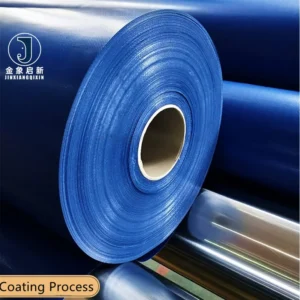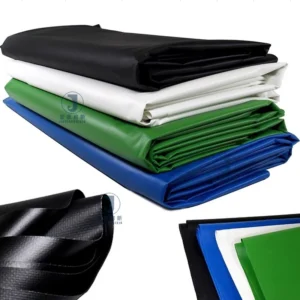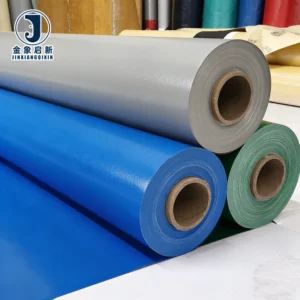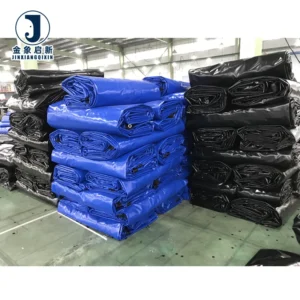
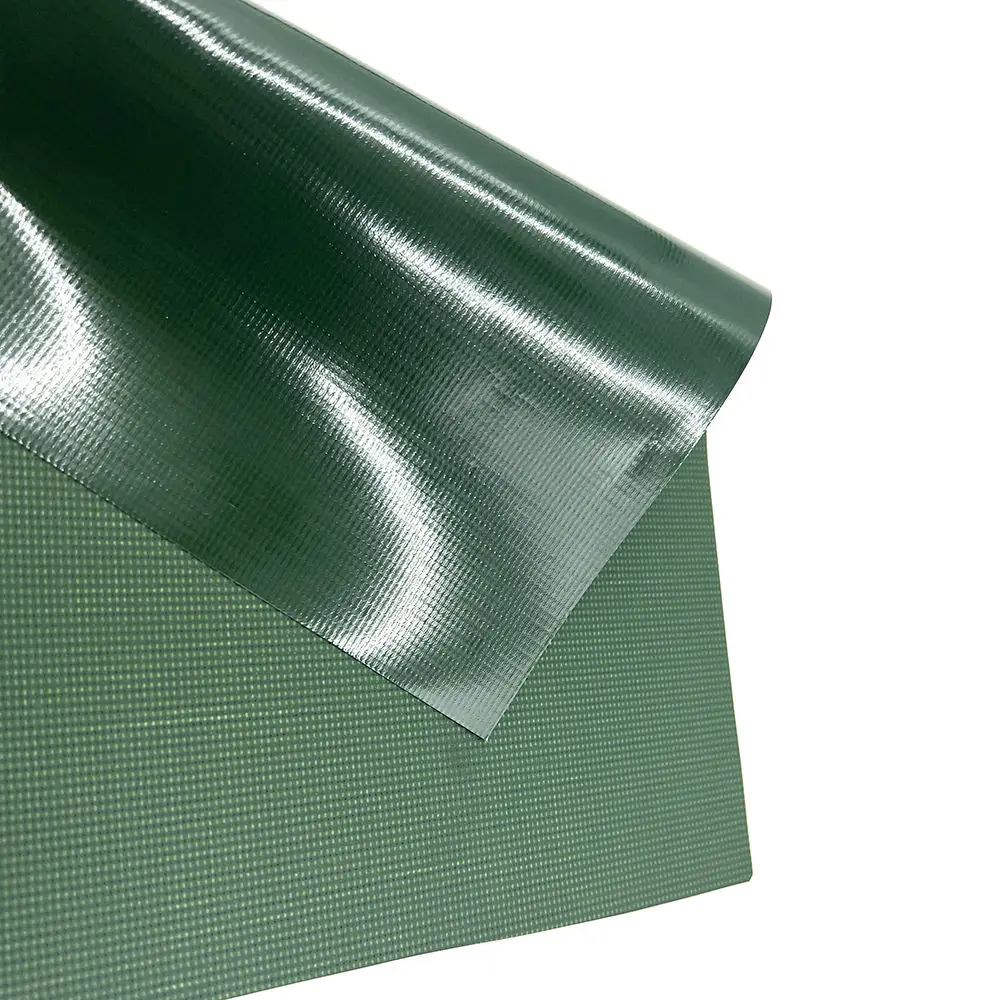
Precision Coating Control — Knife coated PVC tarpaulin with traceable GSM and adhesion quality verified at every production stage, ensuring batch consistency across full container loads.
Technical Specifications
| Parameter | Value |
|---|---|
| Product Type | PVC Coated Tarpaulin Roll |
| Coating Method | Knife Coated |
| Coating Material | PVC |
| Color Options | Green (custom colors available) |
| Welding Compatibility | HF Welding, Hot Air Welding, Sewing |
| Flame Retardant | Available in multiple grades — confirm grade required for your market |
| UV Treatment | Available — test basis verifiable upon request |
| Temperature Resistance | High and low temperature formulations available |
| Key Features | Waterproof, Anti-Mildew, Antibacterial, Oil & Stain Resistant, Acid & Alkali Resistant, Anti-Oxidation, Self-Cleaning Surface |
| Flexibility | Highly flexible, resistant to cracking under repeated folding |
Application Suitability
| Application | Exposure & Requirement |
|---|---|
| Tensile & Membrane Structures | Long-term UV exposure, structural tension loads, weather cycling, architectural aesthetics |
| Stadium & Airport Roofs | Large span tension, wind uplift, fire safety compliance, public occupancy codes |
| Truck & Trailer Covers | Road abrasion, constant flexing at load points, weather and chemical splash exposure |
| Portable Storage Structures | Temporary deployment, repeated folding and unfolding, ground contact moisture |
| Shade Systems | Continuous solar radiation, thermal expansion, color fastness requirements |
Why Coating Adhesion Matters More Than Stated GSM
A 650 GSM quotation means nothing if the PVC layer delaminates from the base fabric at the first flex point.
Technical buyers often receive PVC knife coated tarpaulin roll material properties sheets showing target GSM, only to find coating weight varies significantly across the roll width. When adhesion fails, the coating peels away from the polyester base, leaving bare fabric exposed to moisture and UV degradation. This failure mode appears first at welded seams and high-stress fold lines — precisely where the material needs integrity most. [NEED_CITE: coating adhesion test methods for PVC coated fabrics per ISO 2411]
Knife Coating Process and Coating Weight Uniformity
The knife coated manufacturing method applies liquid PVC directly onto the moving base fabric under controlled blade gap and tension. This direct application produces consistent coating weight across the full roll width, unlike laminated constructions where adhesive layers introduce variable bond strength. For PVC knife coated tarpaulin roll material properties, the knife coating process delivers superior peel strength between coating and substrate — critical for applications involving repeated folding, welding, and mechanical stress.
Base Fabric Construction and Structural Performance
The polyester base fabric denier and weave density determine how loads distribute through the material structure. Higher denier yarns resist individual fiber breakage under point loads, while tighter weave patterns limit tear propagation once a cut initiates. The relationship between PVC knife coated tarpaulin roll material properties and actual field performance depends on this base fabric engineering — not coating thickness alone. [NEED_CITE: tensile and tear test methods for coated fabrics per ISO 1421]
Interpreting Specification Data for Procurement Decisions
GSM combines base fabric weight and coating weight into a single number, but two materials with identical GSM can perform very differently. A fabric with heavier base yarns and thinner coating will show higher tensile strength but reduced surface abrasion resistance compared to one with lighter base and thicker coating. Understanding this balance helps specify PVC knife coated tarpaulin roll material properties matched to actual application demands — whether that prioritizes structural tension capacity or surface durability against environmental exposure.
Welding Behavior and Seam Integrity
Knife coated PVC fabric responds differently to HF welding, hot air welding, and sewing depending on coating formulation and thickness. HF welding requires specific plasticizer content to achieve molecular fusion at the seam; hot air welding depends on surface melting characteristics; sewing creates mechanical holes that require sealing against water ingress. Fabricators must match welding method to the specific PVC knife coated tarpaulin roll material properties — incorrect parameters cause seam failure before fabric failure, especially at load-bearing junctions.
The Hidden Cost of Specification Mismatch
When flame retardant grade does not match local building codes, entire membrane structure installations fail inspection and require complete replacement — not just the affected sections. Color variation between rolls in the same shipment becomes visible once panels are installed side by side on stadium roofs or shade structures, forcing selective replacement that disrupts project timelines. Welding parameters calibrated for one coating formulation produce weak seams on another, causing field failures that appear months after installation. [NEED_CITE: fire safety standards for tensile membrane structures in public assembly occupancies] These specification mismatches cost far more than the initial material price difference.
Why Source Knife Coated PVC Here
Three dedicated production lines with 36 equipment sets maintain consistent output quality across large-volume orders, preventing the batch variation that plagues multi-purpose coating facilities. The 10-person R&D team develops custom formulations and color matches within days, not weeks — critical when project timelines compress. Every roll undergoes 100% inspection against the material specification sheet before shipment, catching GSM deviations and coating defects that would otherwise reach your fabrication floor. Sample development for custom width, treatment, or color requirements happens rapidly, allowing specification validation before committing to full production runs. ISO and CE certification documentation accompanies each shipment, supporting compliance requirements in North American, European, and Asian markets.
Documentation & Verification
- Material specification sheet stating exact GSM, base fabric denier, weave pattern, and coating weight breakdown
- Flame retardant test reports citing applicable standard (M2, B1, NFPA 701, DIN 4102) — verify grade matches your jurisdiction
- UV resistance test data showing exposure duration and retention percentage — request test basis before specifying
- Pre-shipment inspection record confirming roll-by-roll GSM verification and visual defect screening
- Certificate of origin and customs documentation for international shipment clearance
Fabrication, Handling & Storage
- HF welding parameters depend on PVC plasticizer content — request recommended temperature and dwell time settings for this knife coated formulation
- Hot air welding requires clean, dry surfaces — store rolls flat in climate-controlled environment to prevent moisture absorption before fabrication
- Sewing creates needle holes that compromise waterproofing — specify seam sealing tape compatible with PVC coating chemistry
- Roll storage on edge prevents permanent creasing — avoid stacking heavy objects on horizontal rolls that cause flat-spot deformation
- Self-cleaning surface treatment affects adhesive compatibility — test bonding agents for graphics application before full production
- Cold temperature handling increases brittleness — allow rolls to acclimate to workshop temperature before unrolling and cutting
Specification Requirements for Quotation
Provide your application type and primary exposure conditions — whether this PVC knife coated tarpaulin roll material will face structural tension loads, continuous UV radiation, or chemical splash environments. Specify your target market’s fire safety classification requirements and any third-party testing standards your project demands. Indicate required roll width, estimated annual volume, and whether you need custom color matching or standard green stock. Confirm whether you require raw roll stock or finished fabricated panels with welding and edge finishing. Request sample rolls for welding parameter validation and coating adhesion testing before placing production orders.
Frequently Asked Questions
Q: How do I verify actual GSM matches the quoted specification when rolls arrive?
A: Request pre-shipment inspection records showing roll-by-roll weight measurements. On receipt, cut standardized samples from multiple roll positions and weigh against calculated area to verify GSM. Coating weight can be separated from base fabric weight through solvent dissolution testing if coating-to-substrate ratio verification is required for your quality system.
Q: Which flame retardant grade applies to my market, and how is compliance demonstrated?
A: Building codes vary by jurisdiction — European projects often require M2 or B1 per DIN 4102, North American applications may specify NFPA 701, while other regions have local standards. Request test reports citing the specific standard applicable to your project location. Third-party laboratory certification provides independent verification beyond manufacturer self-declaration.
Q: What determines UV treatment effectiveness and expected service life?
A: UV resistance depends on stabilizer chemistry and concentration within the PVC formulation, not just surface treatment. Request test data showing exposure duration under accelerated weathering protocols and retained physical properties afterward. Actual outdoor service life varies with geographic solar intensity, installation angle, and environmental pollutants.
Q: How do I choose between HF welding, hot air welding, and sewing for this material?
A: HF welding produces strongest seams for structural applications but requires compatible plasticizer content. Hot air welding suits field repairs and complex geometries. Sewing offers fastest production but creates perforation points requiring sealing. Request welding parameter recommendations specific to this knife coated formulation and conduct peel strength testing before committing to production method.