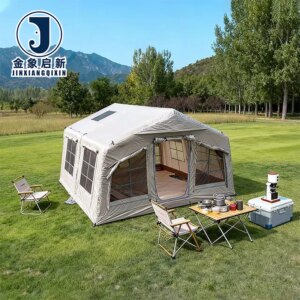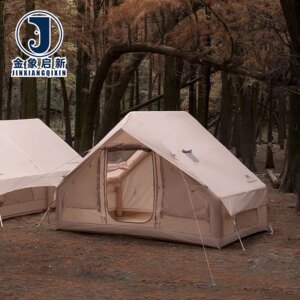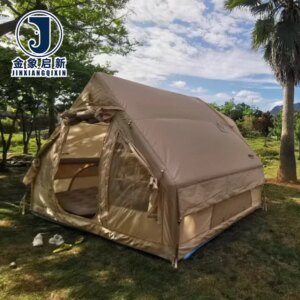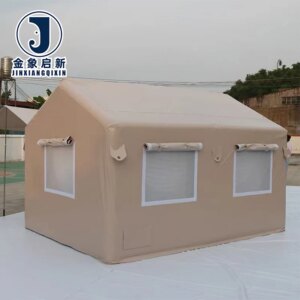
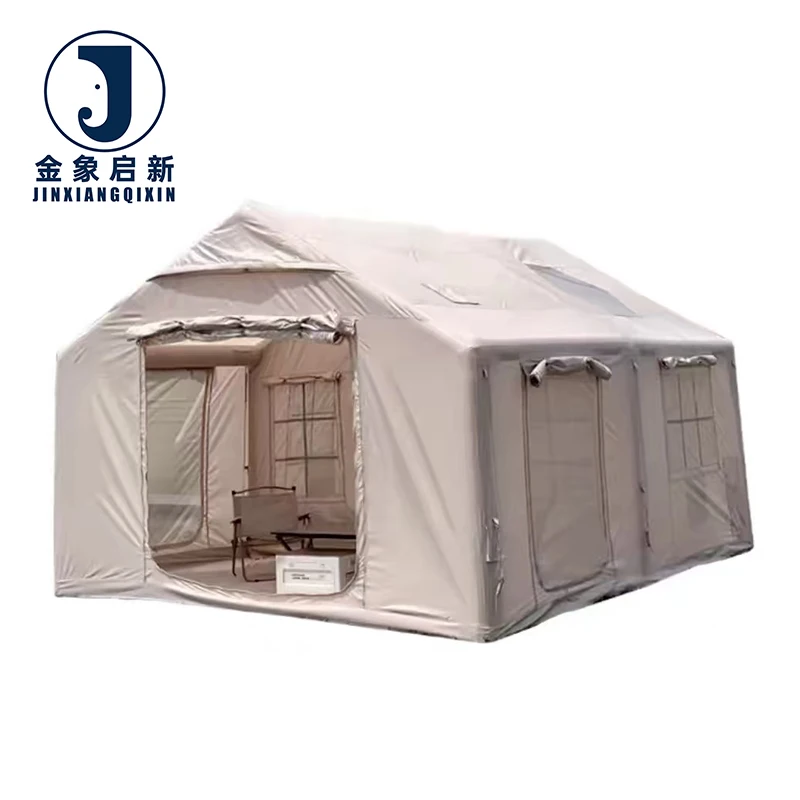
Deep Process Control Over Coating Weight — every batch of our PVC knife-coated inflatable tent fabric is verified against target GSM and adhesion specs before leaving the production line, ensuring structural reliability when rapid deployment matters most.
Technical Specifications
| Parameter | Value |
|---|---|
| Product Type | Inflatable Tent |
| Core Material | PVC tarpaulin (knife-coated fabric) |
| Capacity | 3–5 person |
| Design | Single Layer Construction, Extended Type, Four-Season Use |
| Key Performance | Waterproof, tear-resistant, quick automatic opening |
| UV Resistance | Available with UV-resistant treatment — confirm grade required for your market |
| Coating Method | Knife coated |
| Customization | OEM & ODM support |
| Standards | ISO 9001, ISO 14001, ISO 45001, CE |
Application Suitability
| Application | Exposure & Requirement |
|---|---|
| Post-disaster temporary site offices | Constant UV exposure, wind loading, rapid deployment needed within hours of arrival |
| Equipment storage shelters during infrastructure recovery | Heavy handling abrasion, moisture ingress risk, frequent relocation |
| Emergency command centers for large-scale industrial facilities | Continuous inflation pressure, temperature fluctuation, personnel traffic wear |
| Material staging and operational coordination shelters | Extended outdoor deployment, ground moisture contact, variable wind loads |
Why "UV-Resistant" on a Quotation Means Nothing Without Test Data
Every roll of PVC inflatable tent fabric we ship can be traced back to its specific coating formulation and treatment batch record.
Sourcing emergency shelters across industrial procurement channels often reveals the same gap: UV protection is claimed on the spec sheet, yet no test basis is provided when the buyer asks for verification. When an inflatable tent deployed at a disaster recovery site begins to chalk and embrittle within a single season, the failure is rarely the base fabric — it is the coating formulation that was never validated against a recognized exposure standard [NEED_CITE: tensile and tear test methods for coated fabrics per ISO 1421]. For technical buyers specifying shelters that must perform through four-season rotation cycles, requesting the test report before approving the production sample eliminates this risk entirely.
Knife-Coated Construction for Structural Integrity Under Inflation
The knife-coated method forces PVC paste directly into the interstices of the base fabric, creating a mechanical bond that resists delamination when the inflatable frame is pressurized and flexed repeatedly. This matters because an inflatable tent’s structural tubes undergo continuous micro-movement as wind loads shift, and a coating that separates from the substrate creates an immediate failure point. When sourcing an Inflatable Tent Fabric PVC Coated Manufacturer, buyers should confirm the coating method matches the inflation cycle demands of their deployment scenario.
Automatic Deployment Demands Predictable Material Behavior
An automatic inflatable tent relies on the fabric responding uniformly to air pressure — inconsistent coating weight across a single roll causes uneven expansion, leading to asymmetric tube geometry and structural weakness at the seam lines. Our production lines maintain coating uniformity through calibrated knife gap settings and in-line weight checks at every stage. This level of control is what separates field-reliable emergency shelters from units that perform adequately on the test bench but deform under actual site conditions [NEED_CITE: coating weight verification methods for PVC tarpaulin production].
Single-Layer Design Balances Portability and Thermal Load
The single-layer construction of this inflatable tent reduces packed weight and volume, which directly impacts how many units a logistics coordinator can stage at a disaster response depot. However, single-layer PVC tarpaulin must carry all weather protection in one pass — the knife-coated layer must deliver waterproofing, UV stability, and tear resistance simultaneously without the backup of a secondary membrane. This is where GSM and coating formulation intersect: a heavier coating on the same denier base fabric shifts the balance between structural rigidity and pack size, and the correct specification depends on whether the tent will be redeployed frequently or left standing for extended recovery operations.
The Hidden Cost of Specifying on Price Per Square Meter Alone
When procurement teams evaluate inflatable tent fabric on unit cost without cross-referencing coating weight and adhesion data, the consequence typically surfaces at the welded seam. A coating that was applied below the target GSM to hit a price point will often fail at the heat-welded joint before the body fabric shows any sign of wear — because there is simply not enough PVC material at the bond interface to sustain the peel strength the seam demands [NEED_CITE: peel strength failure modes in heat-welded PVC tarpaulin joints]. For emergency shelters deployed in high-wind recovery zones, a seam failure means the entire unit is decommissioned, and the replacement cost far exceeds the original saving on material.
Why Technical Buyers Source This Fabric Here
Our three full production lines and 36 sets of professional equipment support the batch volumes that emergency preparedness programs require, with capacity planning that holds lead times even during peak disaster-season demand. The 10-person R&D team handles material specification development and sample confirmation before any production run begins — this is not a catalog pick, but a specification built around your deployment environment. Dedicated QA and QC staff conduct in-process checks at coating, laminating, and finishing stages, with 100% pre-shipment inspection on every unit including inflation testing. Custom width, color matching, and OEM printing are supported without the extended minimums that delay time-sensitive emergency procurement programs.
Documentation & Verification
- Material specification sheet stating coating method, base fabric type, and treatment details for each batch
- Batch-specific quality inspection report with coating weight verification records
- Pre-shipment inflation test record and structural integrity verification for every unit
- ISO 9001, ISO 14001, ISO 45001, and CE certification documentation included with shipment
- Pre-production sample approval record signed off by the R&D team before manufacturing
- Certificate of origin and customs support documentation for cross-border emergency procurement
Fabrication, Handling & Storage
- Heat-weld parameters must be calibrated to the knife-coated PVC thickness to prevent seam delamination at inflation joints
- Store rolled fabric upright on pallets in a dry, shaded warehouse to prevent flat-spot deformation on the coating surface
- Avoid dragging knife-coated PVC rolls across unsealed concrete during workshop handling to protect the outer coating layer
- Field repairs on punctured inflatable tubes require compatible PVC adhesive and matching coating weight patch material
- Clean deployed tent surfaces with neutral pH detergent only — alkaline cleaners degrade the PVC topcoat over repeated wash cycles
Inquiry Guidance for Technical Procurement
Provide your deployment environment details including expected wind loading, temperature range, and anticipated standing duration so we can recommend the correct coating weight and treatment package. Specify whether you require finished tent units with inflation valves and seam welding, or roll stock for your own fabrication line. If your target market mandates specific fire classification or UV test standards, include the reference document in your initial inquiry so the correct formulation is selected during sampling.
Frequently Asked Questions
Q: What UV treatment verification is available for the inflatable tent fabric?
A: Our PVC tarpaulin can be produced with UV-resistant coating formulations, and we provide the test basis documentation upon request. Buyers should specify the exposure standard required by their market — such as accelerated weathering hours or outdoor exposure classification — so the R&D team can match the correct additive package during sample development and confirm performance before production begins.
Q: What OEM and ODM customization options are available for emergency tent orders?
A: We support custom dimensions, color matching, branding, and valve configuration through our OEM and ODM process. The 10-person R&D team develops a pre-production sample for your approval before full-scale manufacturing starts, ensuring the knife-coated fabric specification, seam construction, and inflation geometry all match your deployment requirements.
Q: What inflation and structural checks are performed before shipment?
A: Every inflatable tent unit undergoes full inflation testing and structural integrity verification during pre-shipment inspection. Our QA team checks tube geometry, seam strength at welded joints, and valve function before packing. The inspection record accompanies each shipment as part of the documentation package.
Q: How is batch-to-batch color and coating consistency controlled across large orders?
A: Our in-process QA system monitors coating weight and color reference at every production stage. Each roll is checked against the batch master sample, and any deviation outside tolerance is flagged before the material reaches the cutting or welding stage. This is critical when multiple tents are deployed side by side at a single site.
Q: What storage and field repair guidelines apply to this PVC inflatable tent fabric?
A: Store units in a cool, dry environment away from direct sunlight when not deployed. For field repairs on the knife-coated PVC surface, use compatible PVC patch material and adhesive matched to the coating weight. Avoid folding the inflatable tubes sharply at the same crease point repeatedly to prevent coating fatigue cracking over time.