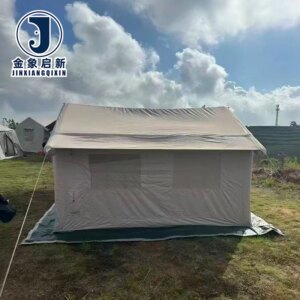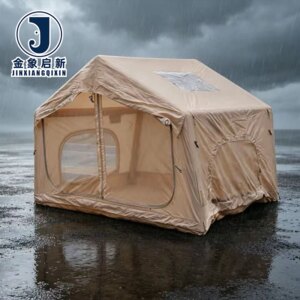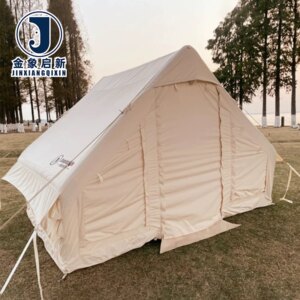
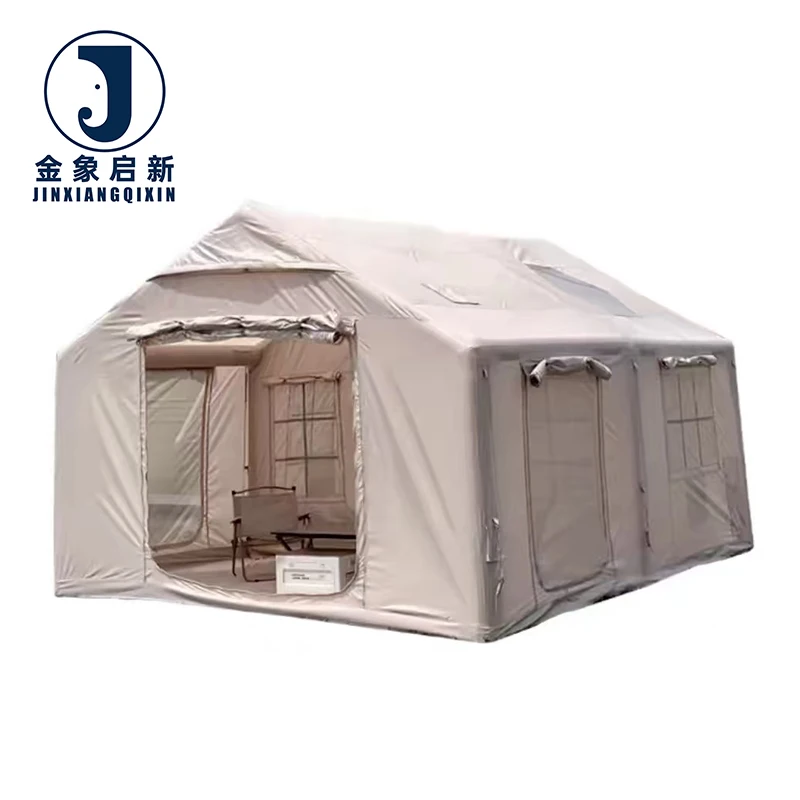
Material Process Control — Three full production lines with 36 sets of equipment manage coating weight and adhesion to ensure batch-to-batch consistency for PVC inflatable tent fabric orders.
Technical Specifications
| Parameter | Value |
|---|---|
| Product Type | Inflatable Tent |
| Core Material | PVC tarpaulin (PVC knife-coated fabric) |
| Capacity | 3-5 person |
| Design | Four-Season Use, Single Layer Construction, Extended Type |
| Key Performance | Waterproof, UV-resistant (test basis not stated in source), tear-resistant, quick automatic opening |
| Customization Service | OEM & ODM support |
| Quality Control System | Full-process quality inspection with dedicated QA&QC staff |
| Standards | ISO9001, ISO14001, ISO45001, CE |
Application Suitability
| Application | Exposure & Requirement |
|---|---|
| Temporary site offices during infrastructure recovery | Prolonged outdoor weather exposure, rapid deployment, structural stability for inflatable frames |
| Equipment storage shelters in post-disaster operations | Water ingress prevention, UV exposure over extended periods, abrasion from stored machinery |
| Emergency command centers for large-scale industrial facilities | High occupancy loads, frequent inflation and deflation cycles, thermal comfort in four-season conditions |
| Material staging and operational coordination | Heavy foot traffic, ground contact moisture, wind loading on extended-type structures |
Why UV Claims Without Test Data Put Procurement at Risk
Verified test reports separate marketing language from material reality.
When sourcing PVC inflatable emergency tent aftermarket supplier options, buyers frequently encounter UV resistance claims that lack supporting documentation. A supplier states the fabric is UV-resistant, but without a test report referencing a recognized standard, the buyer cannot verify how the material will perform after months of continuous sun exposure on a disaster recovery site. This gap between claim and evidence leads to field failures where the PVC surface chalks, becomes brittle, and cracks at the weld seams under seasonal temperature cycling [NEED_CITE: UV degradation test methods for PVC coated textiles]. Procurement teams then face emergency re-orders and compliance audit findings that could have been avoided with upfront documentation.
Coating Adhesion and Inflatable Structural Loads
PVC knife-coated fabric delivers the tensile and tear resistance necessary for inflatable tent structures that must hold internal air pressure across temperature variations. The coating method bonds PVC directly into the base fabric weave, creating a unified material rather than a laminated surface that can delaminate under repeated flex cycles. For inflatable tent fabric manufacturer requirements, this adhesion quality determines whether the shelter maintains structural integrity during inflation and deflation sequences over its service life.
Single Layer Construction for Rapid Deployment Balance
Single layer construction in this PVC inflatable emergency tent aftermarket supplier product balances durability against transport weight, allowing emergency response teams to deploy shelters without heavy logistics equipment. The extended type design provides sufficient interior volume for command operations while the single layer keeps packed dimensions manageable for air freight or rapid ground transport. This configuration suits scenarios where deployment speed matters more than thermal insulation layering.
Interpreting the Specification Sheet for Field Performance
The PVC knife-coated construction method directly influences how the fabric handles heat welding at seam junctions, which is where inflatable structures concentrate stress during pressurization. Knife coating produces a thicker, more uniform PVC layer compared to dip coating, supporting stronger weld bonds that resist peeling under internal air pressure [NEED_CITE: heat welding parameters for PVC coated fabrics per ISO 1421]. The four-season use designation indicates the material formulation maintains flexibility across seasonal temperature ranges without becoming brittle in cold conditions or overly soft in summer heat. Base fabric denier and weave density work together with coating weight to determine tear propagation resistance — a higher denier base with tight weave limits how far a puncture or cut will spread across the tent surface. The waterproof performance derives from the continuous PVC coating that seals the base fabric completely, preventing water penetration through the material body.
What Happens When Weld Parameters Miss the Material Specification
Welded seams on inflatable tents fail before the fabric body does when heat and pressure settings do not match the specific PVC coating formulation. A temperature too low produces incomplete fusion where the weld line peels under air pressure; too high degrades the PVC surface and weakens the bond. Buyers who switch suppliers without re-qualifying weld parameters against the new material specification often discover this mismatch during field inflation tests, resulting in shelter rejection at the worst possible moment [NEED_CITE: seam strength testing for inflatable structures]. Batch-to-batch coating consistency from the same manufacturer reduces this re-qualification burden.
Sourcing Confidence Through Documented Production Control
Dedicated QA and QC staff inspect every production stage rather than sampling only finished rolls, catching coating weight deviations before they reach the cutting table. The 10-person R&D team develops pre-production samples that confirm material behavior against your specific inflatable tent design before full-scale manufacturing begins. Three full production lines provide capacity to fulfill bulk orders within typical multi-week lead times without sacrificing inspection rigor. Full-process quality inspection includes pre-shipment inflation testing and structural integrity checks with documented inspection records for each order. ISO9001, ISO14001, ISO45001, and CE certifications ship with documentation, providing the compliance paper trail that industrial disaster response procurement requires.
Documentation & Verification
- Material specification sheet stating base fabric denier, PVC coating method, and color reference per batch
- UV-resistant test report documenting the standard and exposure conditions applied to the specific material grade
- Pre-shipment inflation test record confirming structural integrity and seam performance before dispatch
- ISO9001, ISO14001, ISO45001, and CE certificates included with shipment documentation package
- Batch traceability records linking each roll to its production run for quality management integration
Fabrication, Handling & Storage
- Heat welding temperature and dwell time must match the PVC knife-coated formulation to achieve full seam fusion
- Store rolls upright on pallets to prevent flat-spot deformation that affects inflatable panel cutting accuracy
- Avoid dragging single layer fabric across abrasive surfaces during layup to protect the PVC coating surface
- Clean with mild detergent only; solvent-based cleaners can soften the PVC coating and reduce weld adhesion
- Allow material to acclimate to ambient temperature before inflation in cold conditions to maintain flexibility
Moving From Inquiry to Production Sample
Specify your intended inflation pressure range and the seasonal temperature extremes your shelters will face so the material recommendation aligns with actual field loads. Confirm whether your market requires specific flame retardant or anti-static certifications beyond the standard ISO and CE documentation. Provide target dimensions and annual volume requirements to determine whether standard roll widths suit your cutting patterns or custom widths improve material utilization.
Frequently Asked Questions
Q: How is UV resistance verified and what test basis supports the claim?
A: UV resistance claims must be supported by test reports referencing recognized exposure standards. Request the specific test method and exposure duration applied to the material grade you are purchasing. Without documented test conditions, UV resistance remains an unverified marketing statement that cannot be validated against your expected field exposure timeline.
Q: What OEM/ODM customization options are available for inflatable tent dimensions and material thickness?
A: OEM and ODM services cover dimensional adjustments, material thickness selection, and performance specification alignment. The R&D team develops pre-production samples confirming your design requirements before manufacturing begins. Custom sizing and performance parameters are confirmed during the sample approval stage to ensure the final production run meets your exact specifications.
Q: How is batch-to-batch color consistency controlled across rolls for large orders?
A: Color consistency is managed through controlled pigment formulation and in-process inspection at the coating stage. Each batch references a color standard, and inspection records document conformance before rolls are released for shipment. Request the color reference documentation for your order to verify consistency across multiple rolls in large-volume purchases.
Q: What pre-shipment inspection and inflation testing is performed before dispatch?
A: Pre-shipment procedures include inflation testing to verify structural integrity and seam performance under air pressure. Dedicated QA and QC staff conduct full-process inspection with documented records accompanying each shipment. Inspection records confirm that the material meets specification requirements before the order leaves the production facility.
Q: How are custom sizes and minimum order quantities handled for inflatable tent fabric?
A: Custom sizes are accommodated through the OEM and ODM service framework with sample development preceding production. Minimum order quantities vary based on the customization scope and whether standard or custom roll widths are specified. Confirm your dimensional requirements and volume needs during the inquiry stage to receive accurate minimum quantity guidance.