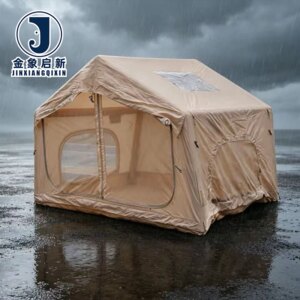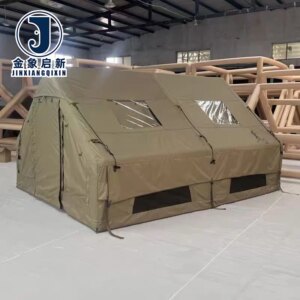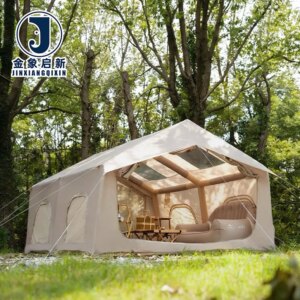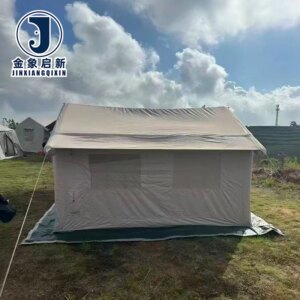
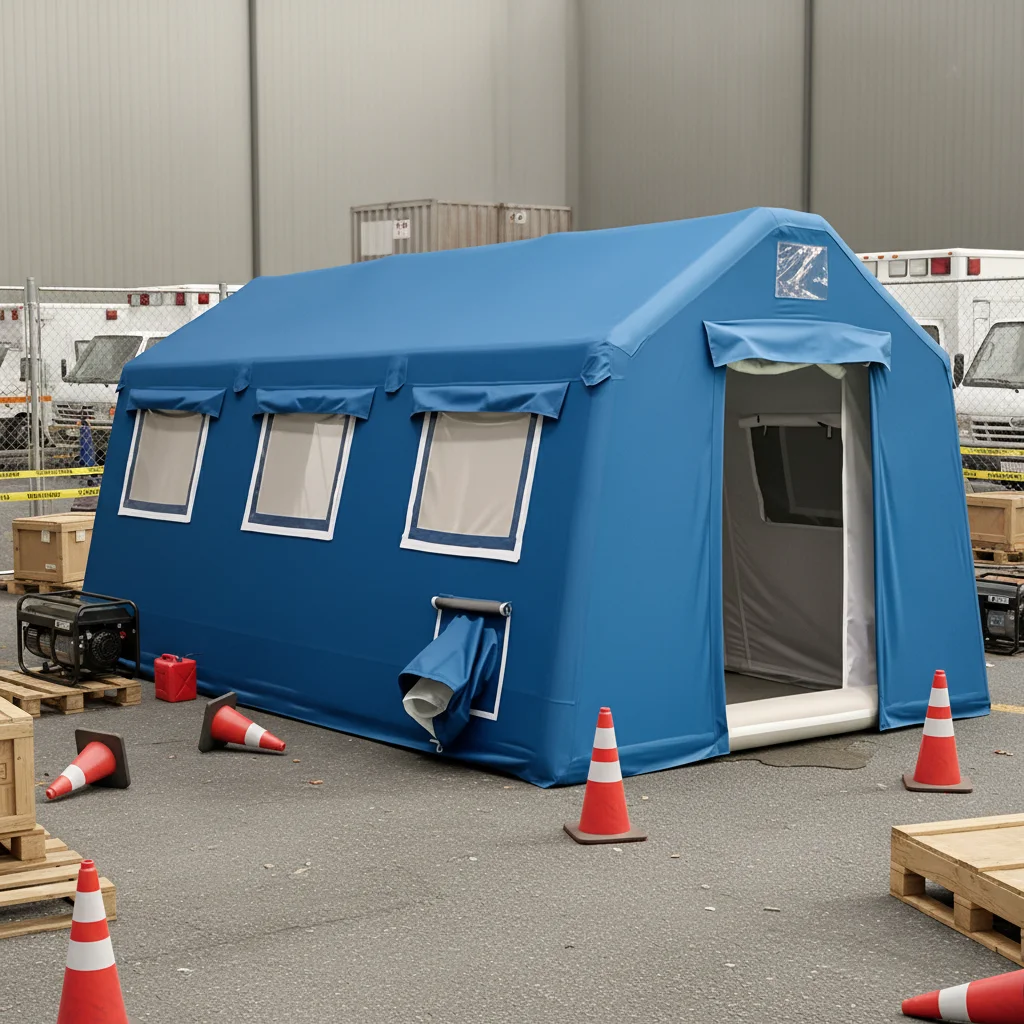
Deep Coating Control — PVC knife-coated inflatable tent fabric built on nearly 30 years of process mastery over adhesion and weight consistency, verified by 24-hour air retention testing on every unit.
Technical Specifications
| Parameter | Value |
|---|---|
| Product Type | Inflatable Tent |
| Core Material | PVC tarpaulin (knife-coated fabric) |
| Coating Material | PVC knife-coated fabric |
| Key Performance | Waterproof, tear-resistant |
| UV Resistance | Available in UV-resistant grades — confirm the grade required for your market (test basis not stated in source) |
| Flame Retardant | Available in flame retardant grades — confirm the grade required for your market (grade not stated in source) |
| Product Forms | Quick automatic opening, single layer construction, extended type |
| Customization | OEM & ODM customization, sample customization, pattern printing |
| Quality Testing | 24-hour air pressure retention, seam tensile testing, environmental simulation (temperature cycling, UV exposure) |
| Certifications | ISO9001, ISO14001, ISO45001, CE |
Application Suitability
| Application | Exposure & Requirement |
|---|---|
| Emergency response command centers | Rapid deployment under extreme weather, repeated inflation cycles, structural integrity under wind load |
| Temporary storage during disaster recovery | Prolonged outdoor exposure, waterproof integrity for sensitive equipment, resistance to ground abrasion |
| Mobile field operations bases | Four-season climate variation, UV degradation resistance, tear resistance from frequent setup and teardown |
| Infrastructure maintenance shelters | Extended outdoor deployment in diverse climates, wind load bearing, fire safety compliance on regulated sites |
Why "Waterproof and UV-Resistant" Means Nothing Without Test Documentation
A PVC inflatable tent fabric is only as reliable as the test report that ships with it.
Buyers sourcing custom inflatable shelter PVC material frequently receive quotation sheets listing waterproof and UV-resistant claims with no supporting evidence. When the shelter is deployed in monsoon conditions or high-altitude UV exposure, seam leakage and surface degradation appear within weeks. Without batch-level test documentation, there is no way to verify whether the coating weight, UV stabilizer concentration, or flame retardant grade actually match what was specified. [NEED_CITE: accelerated weathering test methods for PVC coated fabrics per ISO 4892]
Coating Adhesion and Structural Integrity Under Inflation Pressure
Inflatable tent fabric operates under constant internal air pressure, meaning the coating-to-base-fabric bond must withstand continuous tensile stress across the entire surface. PVC knife-coated fabric achieves this bond by forcing liquid PVC into the weave under blade pressure, creating mechanical interlock rather than simple surface lamination. This construction method directly affects how the material behaves during repeated inflation and deflation cycles — a critical factor for emergency shelters that may be deployed, collapsed, and redeployed multiple times during a single response operation. When specifying an Inflatable Tent Fabric manufacturer, the coating method is the single most important variable determining long-term structural reliability. [NEED_CITE: peel strength test methods for coated fabrics per ISO 2411]
Waterproof Seam Performance in Temporary Shelter Applications
Seam failure is the most common point of leakage in inflatable shelter structures, and the failure almost always occurs at the weld line rather than the base fabric. The knife-coating process produces a homogeneous PVC surface that responds predictably to hot-air welding parameters, provided the coating weight is consistent across the entire roll. Batch-to-batch variation in coating thickness creates inconsistent weld behavior — some sections bond fully while adjacent areas delaminate under pressure. Our 10-person R&D team develops weld parameter recommendations specific to each custom inflatable shelter PVC order, ensuring fabricators have the correct temperature and speed settings before production begins. [NEED_CITE: hot-air welding parameters for PVC coated fabrics]
Reading the Specification Sheet Beyond Marketing Claims
The relationship between base fabric denier, weave density, and total GSM determines how the inflatable tent fabric performs under real-world loads. A high GSM achieved through heavy coating on a low-denier base fabric will feel substantial but tear easily at stress concentrations — precisely where inflatable structures experience the most flex. Knife-coated construction allows the manufacturer to specify coating weight independently from base fabric selection, giving technical buyers the ability to match tensile requirements to the shelter’s engineering specifications. UV-resistant and flame-retardant treatments are chemical additions to the PVC compound that must be verified through standardized testing; claims without test references should be treated as unconfirmed until documentation arrives with the shipment.
The Hidden Cost of Underspecified Inflatable Shelter Fabric
When procurement teams select inflatable tent fabric based solely on quoted GSM without verifying actual delivered weight, the shelter may appear correct on arrival but fail prematurely under field conditions. Underspecified coating weight reduces the material’s ability to hold an airtight weld, leading to slow pressure loss that operators attribute to valve failure rather than fabric specification. Flame retardant grades that do not match local fire safety regulations result in shelter rejection at the deployment site, forcing emergency response teams to operate without cover while replacement material is sourced. [NEED_CITE: DIN 4102 fire classification for building materials]
Procurement Advantages for Technical Buyers
Three full production lines and 36 sets of processing equipment support consistent batch output for custom inflatable shelter PVC orders, reducing the risk of specification drift across large quantities. The 10-technician R&D team handles material selection, pattern printing specifications, and sample development, delivering production-grade samples within days for evaluation before full-scale commitment. Every unit undergoes 24-hour air pressure retention testing, seam tensile testing, and environmental simulation including temperature cycling and UV exposure before dispatch. Dedicated QA/QC staff conduct 100% inspection at every production stage, not random sampling. Batch inspection reports ship with every order, documenting actual test results against the specification sheet rather than generic compliance statements.
Documentation & Verification
- Material specification sheet stating base fabric denier, coating method, and GSM per batch
- UV and flame-retardant test reports included where applicable to your market requirements
- ISO9001, ISO14001, ISO45001, and CE certificates provided for regulatory compliance
- Pre-shipment inspection record with seam strength and 24-hour air retention results per unit
- Roll packing list and certificate of origin for customs clearance at destination
Fabrication, Handling & Storage
- Hot-air weld temperature and speed settings vary by PVC knife-coated fabric GSM — request parameters per batch
- Store rolls vertically on pallets to prevent creasing that weakens the coating bond at fold lines
- Allow cold-stored knife-coated fabric to reach ambient temperature before unrolling to avoid surface cracking
- Use PVC-compatible cleaners only; solvent-based products degrade the knife-coated surface finish
- Field repairs on PVC tarpaulin require matching coating compound and hot-air patch application
Requesting a Technical Proposal
Provide your target deployment climate, required fire safety grade for your market, and annual volume estimate so we can recommend the correct base fabric and coating specification. Specify whether you need roll stock for in-house fabrication or finished inflatable tent units with pattern printing and access configurations. Request a production-grade sample to validate weld parameters and seam performance before placing a full-scale order.
Frequently Asked Questions
Q: How are UV resistance and flame-retardant claims verified with test documentation?
A: Every batch of custom inflatable shelter PVC ships with test reports specific to the UV and flame-retardant grades specified on your order. We do not issue generic claims — if your market requires a particular fire classification, confirm the grade during consultation and the corresponding test report will be included in your shipment documentation.
Q: What customization options are available for size, color, and access configurations?
A: Our OEM and ODM customization covers dimensions, color matching, pattern printing, and access point engineering. The 10-person R&D team develops a production-grade sample for your approval before full-scale manufacturing begins, ensuring the finished inflatable tent meets your exact deployment requirements.
Q: How does the 24-hour air pressure retention test ensure inflation system reliability?
A: Each inflatable tent unit is inflated and monitored for 24 hours before shipment to verify that all weld lines, valve connections, and fabric surfaces maintain pressure within tolerance. Units that show any pressure drop are inspected and reworked, ensuring only fully verified shelters reach your site.
Q: What certification documents support regulatory compliance in destination markets?
A: We provide ISO9001, ISO14001, ISO45001, and CE certificates with every shipment. Additional documentation including certificate of origin and customs support materials are included to facilitate clearance in your destination country.
Q: How is batch-to-batch consistency maintained across customized inflatable shelter orders?
A: Three full production lines with dedicated QA/QC staff at every stage ensure coating weight, color, and treatment concentration remain consistent across rolls. Batch inspection reports document actual measured values against your specification sheet, not generic tolerance ranges.