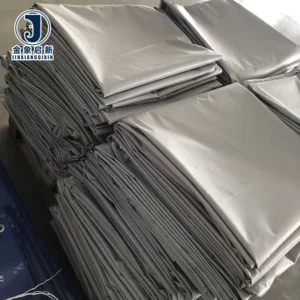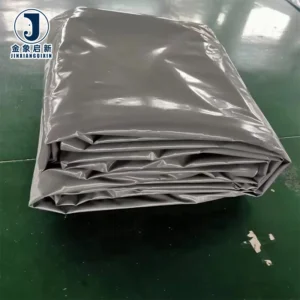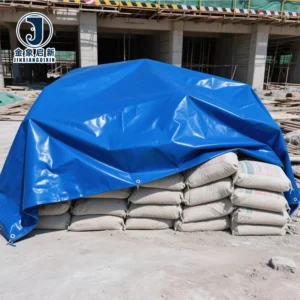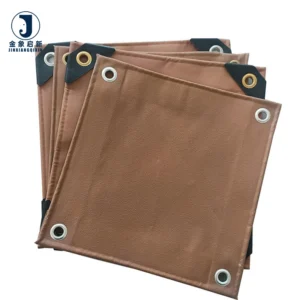
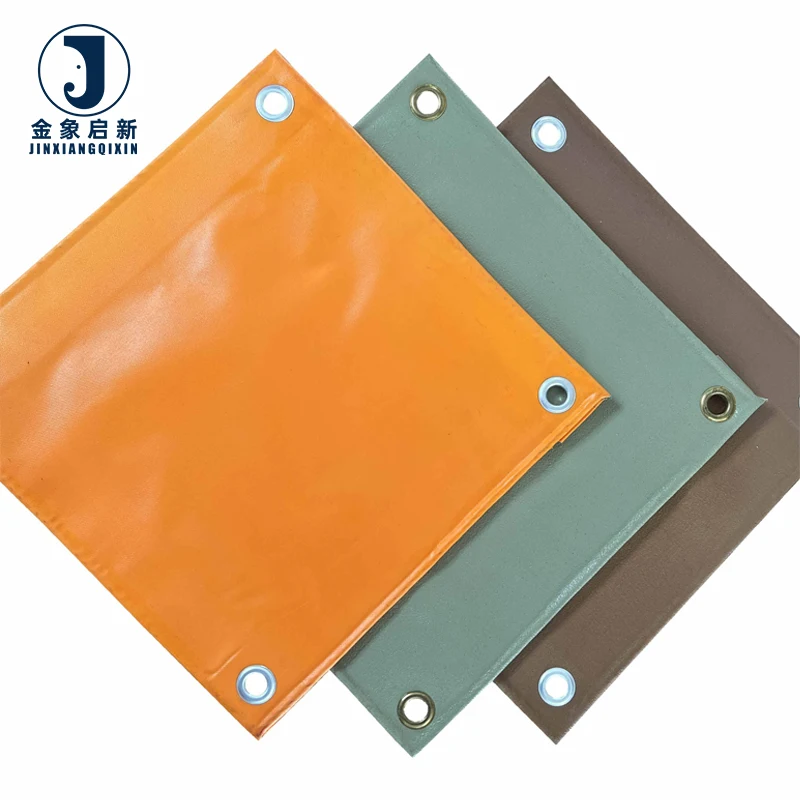
Coating process control — nearly 30 years of dedicated PVC coating experience ensures adhesion integrity and consistent GSM across every roll of Anti-Static Printable PVC Coated Tarpaulin leaving our facility.
Technical Specifications
| Parameter | Value |
|---|---|
| Product Type | PVC Coated Tarpaulin |
| Base Fabric | 100% high toughness polyester yarn |
| Coating Material | PVC |
| Coating Method | Lamination technology and hot melt coating technology |
| Weight (medium-duty) | 400–500 g/m² |
| Weight (heavy-duty) | 700–1000 g/m² |
| Weight (super heavy-duty) | 1100–1500 g/m² |
| Base Fabric Denier (medium-duty) | 500D |
| Base Fabric Denier (heavy-duty) | 1000D |
| Base Fabric Denier (super heavy-duty) | 500D–2000D |
| Total Thickness (medium-duty) | 0.35–0.45 mm |
| Total Thickness (heavy-duty) | 0.70–1.0 mm |
| Total Thickness (super heavy-duty) | 1.2–1.5 mm |
| Tensile Strength (medium-duty) | Longitude 1500–2000 / Latitude 1200–1800 N/5cm (test basis not stated) |
| Tensile Strength (heavy-duty) | Meridian 2000–2500 / Latitude 1800–2200 N/5cm (test basis not stated) |
| Tensile Strength (super heavy-duty) | Warp 2500–3000 / Weft 2200–2800 N/5cm (test basis not stated) |
| Cold Crack Resistance | -30°C (test standard not stated) |
| Anti-Static | Treatment applied (surface resistance or standard not stated) |
| Flame Retardant | Treatment available (grade not stated — confirm the grade required for your market) |
| Anti-Mildew | Mold proof treatment applied (test basis not stated) |
| UV Treatment | Applied (test basis not stated) |
| Waterproof | Yes |
| Printing Option | Printable — suitable for large-format exhibition booth and event backdrop |
| Color | Custom |
| Standards | ISO, CE |
Application Suitability
| Application | Exposure & Requirement |
|---|---|
| Exhibition booth and trade show backdrop | Indoor and semi-outdoor installation, frequent handling and transport, anti-static surface to resist dust adhesion, printable for full-colour large-format graphics |
| Event and conference stage backdrop | Wide-width coverage requiring roll-to-roll colour consistency, rapid installation and teardown, frame tensioning at edges |
| Inflatable and membrane structure fabric for temporary events | Air pressure loading, repeated inflation cycles, UV exposure during outdoor use, welded seam integrity under flex |
| Truck tarpaulin | Constant flexing at load points, road debris abrasion, UV and weather exposure, tie-down stress at edges |
| Tensioned structural fabric | Sustained tensile loading, wind flutter, long-term UV exposure, welded joint strength at anchor points |
Why Base Fabric Denier Matters More Than GSM Alone for Backdrop Tensile Performance
Tensile strength in PVC coated tarpaulin is governed by the polyester yarn denier and weave density — not by coating weight.
Buyers often specify a higher GSM expecting proportionally higher strength, only to find the material tears easily at frame attachment points during backdrop installation. The coating adds weight and surface protection, but the load-bearing skeleton is the base fabric underneath. A 500D polyester yarn coated to 450 g/m² will not match the tensile performance of a 1000D yarn at the same coating weight. For exhibition structures where the fabric is tensioned across aluminium frames, the warp and weft denier directly determine how much stress the material can carry before deformation or failure at the clamping rail [NEED_CITE: tensile and tear test methods for coated fabrics per ISO 1421].
How Hot Melt Coating Delivers the Adhesion That Backdrop Welding Depends On
The lamination and hot melt coating technology used in this Anti-Static Printable PVC Coated Tarpaulin bonds the PVC layer to the polyester base fabric under heat and pressure. This produces a coating-to-yarn adhesion level that directly affects how well heat-welded seams hold during installation and teardown. When adhesion is weak, the coating delaminates at the weld line before the fabric itself reaches its tensile limit — a failure mode commonly seen in exhibition booths that are assembled and dismantled repeatedly across multiple events.
Printable Surface and Anti-Static Treatment for Exhibition Graphics
The printable surface of this PVC coated tarpaulin accepts large-format solvent, UV-curable and latex inks used in exhibition booth and event backdrop production. The anti-static treatment reduces dust attraction on the printed surface, which is particularly important during installation in convention centres where airborne particles settle on freshly printed graphics. Without this treatment, static charge accumulated during roll handling and unrolling can pull dust onto the surface, degrading print clarity and requiring cleaning before the booth opens [NEED_CITE: surface resistivity measurement methods for anti-static coated fabrics].
Reading the Specification Sheet: What Each Parameter Tells You About Backdrop Performance
The denier of the base fabric — 500D for medium-duty, 1000D for heavy-duty, and up to 2000D for super heavy-duty grades — defines the individual yarn thickness and, by extension, the tear propagation resistance. A higher denier means each yarn can absorb more energy before breaking, slowing the spread of a tear once initiated at a grommet or clamp point. Coating method matters equally: hot melt coating drives PVC into the yarn interstices, creating a mechanical lock that improves peel strength compared to simple knife-over-roll coating. This directly translates to weld integrity when fabric panels are joined for wide-format backdrops. The cold crack resistance to -30°C indicates the material retains flexibility in cold-storage event environments and winter outdoor installations, preventing brittle fracture when the fabric is folded or tensioned at low temperatures. Thickness, ranging from 0.35 mm in medium-duty to 1.5 mm in super heavy-duty grades, correlates with both stiffness and abrasion resistance — thicker material stands up to repeated frame clamping but is heavier to handle and ship.
The Hidden Cost of Roll-to-Roll Colour Variation in Backdrop Installations
Few things undermine a trade show booth faster than visible colour differences between adjacent panels. When multiple rolls from the same order show even slight hue or saturation shifts, the seam lines become visible once the backdrop is installed and lit. This is not a printing defect — it originates at the coating stage, where inconsistent pigment dispersion or curing temperature across production runs creates batch-to-batch drift. For exhibition contractors printing full-colour graphics, the cost of reprinting a single mismatched panel can exceed the material savings from choosing a lower-priced supplier [NEED_CITE: colour consistency standards for coated fabric in visual display applications].
Why Source Anti-Static Printable PVC Coated Tarpaulin From a Dedicated Coating Manufacturer
Process control over coating weight and adhesion is maintained through dedicated QA at every production stage, with 100% inspection before any roll ships. Three full production lines and 36 sets of professional equipment support the volume required for large exhibition seasons without sacrificing consistency. A 10-person R&D team handles custom colour matching, sample development for print approval, and specification selection for projects that require specific anti-static or flame-retardant grades. Samples for custom colour and print trials are developed within days, allowing you to verify graphic output and colour accuracy before committing to bulk production. Pre-shipment inspection includes roll-by-roll weight verification against the quoted GSM, catching deviations before they reach your print shop.
Documentation & Verification
- Material specification sheet stating GSM, base fabric denier, coating method and available treatments for each roll
- Anti-static surface resistance test report provided upon request to verify treatment performance
- Roll-by-roll weight check recorded in pre-shipment inspection documentation before dispatch
- Flame retardant grade confirmation matched to your local fire safety standard before production
- ISO and CE certificates supplied with certificate of origin and customs documentation
Fabrication, Handling & Storage
- Heat-weld seams using hot air at temperatures matched to the hot melt PVC coating layer for full adhesion
- Store rolls horizontally on pallets to prevent creasing that can mark the printable surface
- Allow cold-stored rolls to acclimatise before unrolling to avoid stress cracking below -30°C
- Use compatible solvent or UV-curable inks verified against the PVC coating surface for print durability
- Cut panels with allowance for edge clamping or keder bead insertion into exhibition frame systems
What We Need to Quote Your Backdrop Fabric Correctly
To provide an accurate specification and sample, share the intended application — whether this is for exhibition booth backdrops, inflatable event structures, or another use. Confirm the width and length required per roll, the target colour or Pantone reference for colour matching, and whether you need the fabric supplied as roll stock or pre-cut to panel size. If your market requires a specific flame-retardant grade or anti-static surface resistance value, include the relevant standard so we can match the treatment and supply the supporting test documentation.
Frequently Asked Questions
Q: How is anti-static performance verified and what surface resistance can be expected?
A: Anti-static treatment is applied during the coating process. Surface resistance can be measured and reported upon request. The specific resistance value depends on the treatment formulation selected for your application. We recommend sharing your market’s standard so we can align the treatment and provide a matching test report.
Q: How is roll-to-roll colour consistency controlled for backdrop installations?
A: Colour matching is managed through in-process QA during coating, with pigment dispersion and curing parameters monitored per batch. A pre-shipment inspection record documents the visual and measured colour check across all rolls in an order. Samples are available for approval before bulk production begins.
Q: What custom widths, lengths and print options are available?
A: The Anti-Static Printable PVC Coated Tarpaulin is available in custom widths and lengths to suit large-format backdrop and booth requirements. The printable surface accepts solvent, UV-curable and latex inks. Pattern printing and branding can be applied at the factory. Lead times depend on the customisation scope.
Q: How is GSM verified on arrival against the quoted value?
A: Every roll undergoes a weight check as part of the 100% pre-shipment inspection. The inspection record documents the measured GSM per roll against the specification stated on the quotation. A material specification sheet accompanies each shipment, detailing the confirmed GSM, base fabric denier and coating method.
Q: Is heat welding or sewing the better joining method for large-format backdrop frames?
A: Heat welding is generally preferred for PVC coated tarpaulin used in exhibition backdrops, as it creates a bonded seam that distributes load across the coating layer rather than concentrating stress at needle holes. The hot melt coating technology supports strong weld adhesion. Sewing may be used where mechanical fastening to a frame is required.