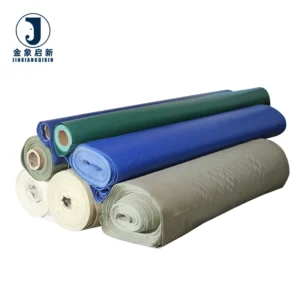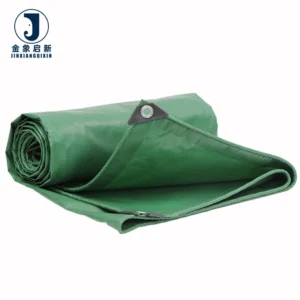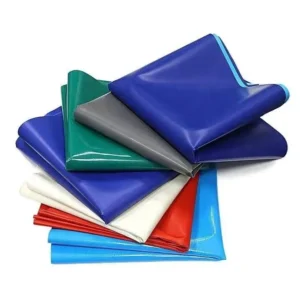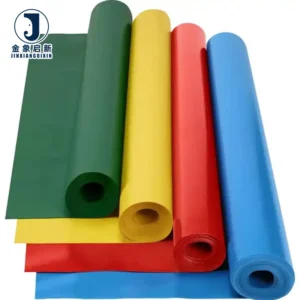
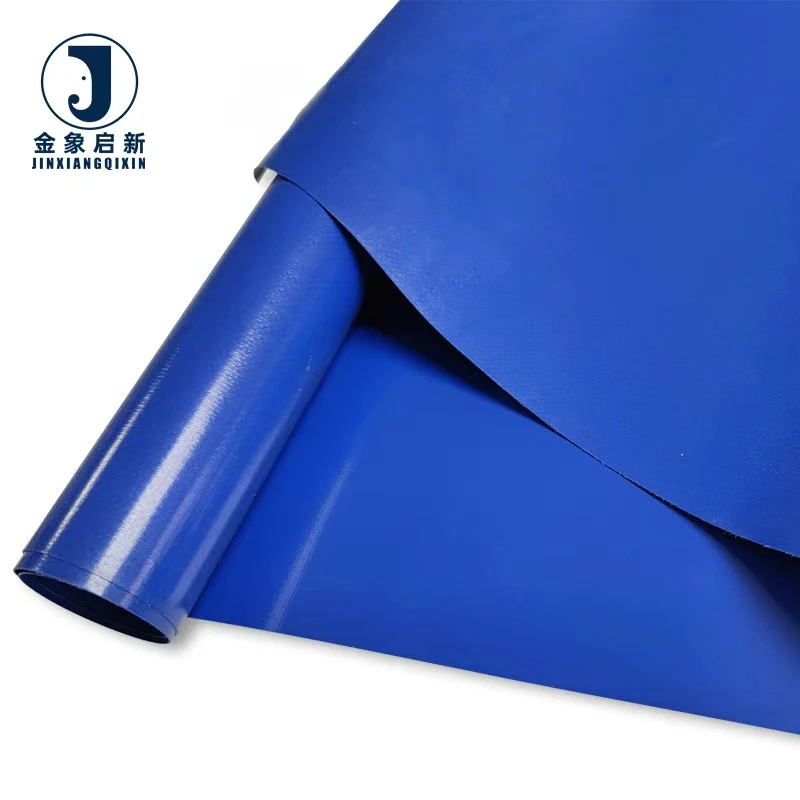
Coating consistency — PVC adhesion to polyester mesh is controlled through in-process monitoring during laminated and hot-melt coating, with every roll inspected before leaving the line.
Technical Specifications
| Parameter | Value |
|---|---|
| Product Type | PVC Laminated Weft Knitted Double Coated Organic Breathable Blackout Heavy Duty Tarpaulin Fabric |
| Coating Material | PVC |
| Base Fabric | High-strength polyester mesh fabric |
| Coating Method | Laminated Technology & Hot-melt Coating Technology |
| Weight (GSM) | 350gsm / 420gsm / 500gsm / 550gsm / 600gsm / 750gsm |
| Total Thickness | 0.32mm / 0.35mm / 0.4mm / 0.45mm / 0.5mm / 0.65mm |
| Roll Width | 2m / 2.1m |
| Roll Length | 75m (2m width) / 50m (2.1m width) |
| Color Options | Blue / Red / Yellow / Light blue / Grey (Customized) |
| Yarn Type | High tenacity polyester yarns |
| Waterproof | Yes |
| Anti-Mildew | Yes (test standard not stated) |
| Anti-Static | Yes (test standard not stated) |
| Flame Retardant | Available in special treatment grades — confirm the grade required for your market |
| Cold Crack Resistance | Yes (temperature rating not stated) |
| Custom Printing | Available |
| Custom Sizing | Available |
Application Suitability
| Application | Exposure & Requirement |
|---|---|
| Construction covers & scaffolding enclosure | Constant weathering, UV exposure, wind load, mechanical abrasion from site activity |
| Truck awning & cargo ship covers | Repeated flexing, road salt spray, tie-down tension at seams, water ingress risk |
| Tent cover & inflatable structures | Fabrication by cut-and-weld, seam integrity under inflation pressure, outdoor sun exposure |
| Fish tank & pool liners | Continuous water contact, hydrostatic pressure, puncture from substrate |
| Equipment & temporary industrial covers | Dust ingress prevention, repeated folding and unfolding, outdoor storage |
| Plant & refinery maintenance enclosures | Chemical splash, temporary weather protection, potential flame retardant requirement |
What "Flame Retardant" Means Without a Grade Behind It
A flame retardant claim is only as useful as the test standard it references.
Tarpaulin distributors regularly face site inspections where a flame retardant PVC tarpaulin roll aftermarket supplier certificate is requested — and the document does not match the local fire code. A PVC laminated tarpaulin roll can be treated to resist ignition, but without naming the classification system (DIN 4102 B1, NFPA 701, M2, or local equivalent), the material may be rejected at the point of installation. This is not a rare occurrence on construction sites and in mining ventilation applications where safety officers audit every material brought through the gate. [NEED_CITE: DIN 4102 fire classification for building materials]
Base Fabric Denier and Mesh Construction
The high-strength polyester mesh fabric beneath the PVC coating determines how the material behaves under tension and at fold points. Laminated and hot-melt coating technologies bond the PVC layer to this base, but the yarn denier and knit structure govern whether a tear initiates and propagates through the roll stock. A PVC tarpaulin roll aftermarket supplier must specify the base fabric construction because two rolls at the same GSM can behave differently under load depending on how the polyester yarns are woven and oriented.
Coating Method and Adhesion Behaviour
Laminated technology and hot-melt coating technology produce different surface characteristics and peel strength profiles on PVC coated tarpaulin fabric. Hot-melt coating typically yields stronger bonding between the PVC layer and the polyester base, which matters when fabricated covers undergo repeated flexing at weld lines and seam junctions. For tent manufacturers and inflatable structure fabricators buying PVC laminated tarpaulin roll stock, the coating method directly influences whether seams outlast the body of the fabric or fail prematurely under cyclic loading. [NEED_CITE: tensile and tear test methods for coated fabrics per ISO 1421]
Reading GSM Against Thickness and Application Demand
The available grades span from 350gsm at 0.32mm through to 750gsm at 0.65mm, and selecting the correct one depends on the end-use environment rather than choosing the heaviest option by default. A 350gsm roll may be sufficient for temporary agricultural covers where weight and cost are priorities, while truck awning fabricators and scaffolding enclosure contractors typically specify heavier grades where wind load and mechanical abrasion are constant. Thickness and GSM move together in this range, meaning a heavier grade also provides greater rigidity — which can be an advantage for flat covers but a disadvantage where the PVC tarpaulin roll must be folded frequently or rolled onto smaller diameter cores for transport.
The Cost of Underspecifying Roll Stock for Fabrication
When a tent or inflatable manufacturer orders PVC coated tarpaulin fabric without confirming the coating method or cold crack resistance rating, the material may perform adequately in the workshop but crack or delaminate once deployed in a colder climate. Similarly, sourcing roll stock for truck awnings without verifying the weld-line tear behaviour leads to seam failures at flex points — the most common failure mode in heavy-duty transport covers. Colour inconsistency between rolls from the same order forces fabricators to sort and segregate inventory, sometimes rejecting entire batches when the variation becomes visible after installation. [NEED_CITE: coating adhesion failure modes in laminated PVC fabrics]
Why Sourcing PVC Tarpaulin Roll Stock Here Differs
This facility operates three full production lines with 36 sets of professional equipment dedicated to coated fabric, meaning PVC laminated tarpaulin roll orders are not outsourced or run on shared lines with unrelated products. A 10-person R&D team handles material selection and sample development, allowing custom widths, colours, and treatment combinations to be prototyped within days rather than weeks. Dedicated QA/QC runs at every production stage, with 100% pre-shipment inspection ensuring that GSM, colour reference, and coating weight match the material specification sheet before rolls are packed. The hot-melt and laminated coating processes are monitored for adhesion consistency, and roll packing lists include batch traceability so that colour and treatment records can be matched to each shipment.
Documentation & Verification
- Material specification sheet listing exact GSM, base fabric type, coating method, and colour reference per roll
- Pre-shipment inspection record confirming weight and thickness against the quoted grade before dispatch
- Test report for flame retardant and anti-static treatments where specific grades are requested at inquiry
- Roll packing list with batch number for colour consistency traceability across multi-roll orders
- ISO and CE certificates included with shipment documentation package
Fabrication, Handling & Storage
- Hot-air welding parameters should be calibrated to the coating method — laminated and hot-melt surfaces respond differently to temperature and dwell time at seam junctions
- Roll stock stored upright on pallets prevents flat spots and creasing that can affect the PVC surface finish and subsequent print adhesion
- Cold crack resistant grades should be specified for winter fabrication environments to avoid brittleness when unrolling 75m lengths in low temperatures
- Cut-and-weld layout planning should account for the 2m or 2.1m roll width to minimise offcuts and reduce seam count on large fabricated covers
- Cleaning with mild detergent preserves the PVC coating surface — solvent-based cleaners may degrade the outer layer and compromise future weld strength
Specifying the Right Roll for Your Application
Provide your end-use application, the environmental exposure conditions at the installation site, and the target market’s fire safety or building code requirements so that the correct treatment grade can be matched. Confirm whether you need roll stock in standard widths and lengths or custom sizing, and indicate your annual volume to support batch-consistent production scheduling. Colour references, printing requirements, and sample approval timelines should be communicated at inquiry stage.
Frequently Asked Questions
Q: How is GSM verified at production and upon arrival?
A: Each roll is weighed and measured during 100% pre-shipment inspection against the material specification sheet. Buyers can request the inspection record showing GSM and thickness values per roll before dispatch, and conduct their own verification upon container arrival using a scale and micrometer.
Q: What flame retardant grades are available and to which standards?
A: Flame retardant treatment is available as a special option. Specify your target market’s fire code — such as DIN 4102, NFPA 701, or local equivalent — at the inquiry stage so the appropriate grade is formulated and a matching test report is supplied with the shipment.
Q: How is colour consistency maintained across rolls in the same order?
A: Rolls within a single production batch are manufactured from the same PVC compound mix and colour reference. Batch numbers are recorded on the roll packing list, enabling traceability and ensuring that reorders can be matched to the original shade where inventory is restocked.
Q: Which roll dimensions are available and can custom widths be produced?
A: Standard rolls are supplied at 2m width by 75m length or 2.1m width by 50m length. Custom widths and lengths can be produced by the R&D team — provide your required dimensions and annual quantity at inquiry for minimum order and lead time confirmation.
Q: What are the recommended welding parameters for laminated PVC on polyester mesh?
A: Welding temperature and dwell time vary between laminated and hot-melt coated surfaces. Request a fabrication guide with your sample roll, which includes recommended hot-air temperature range, roller pressure, and speed settings matched to the specific GSM grade you have selected.