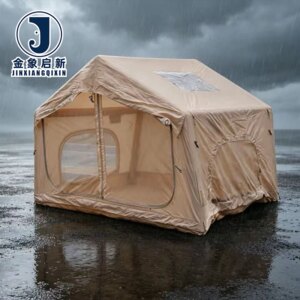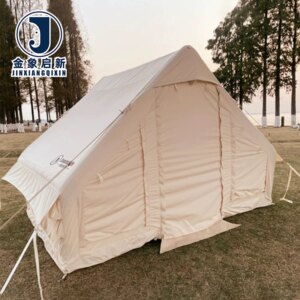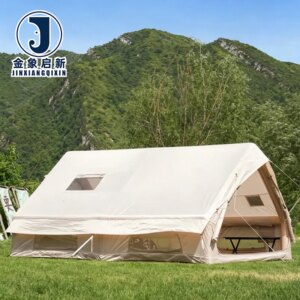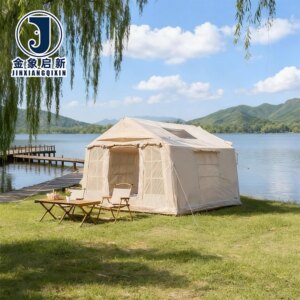
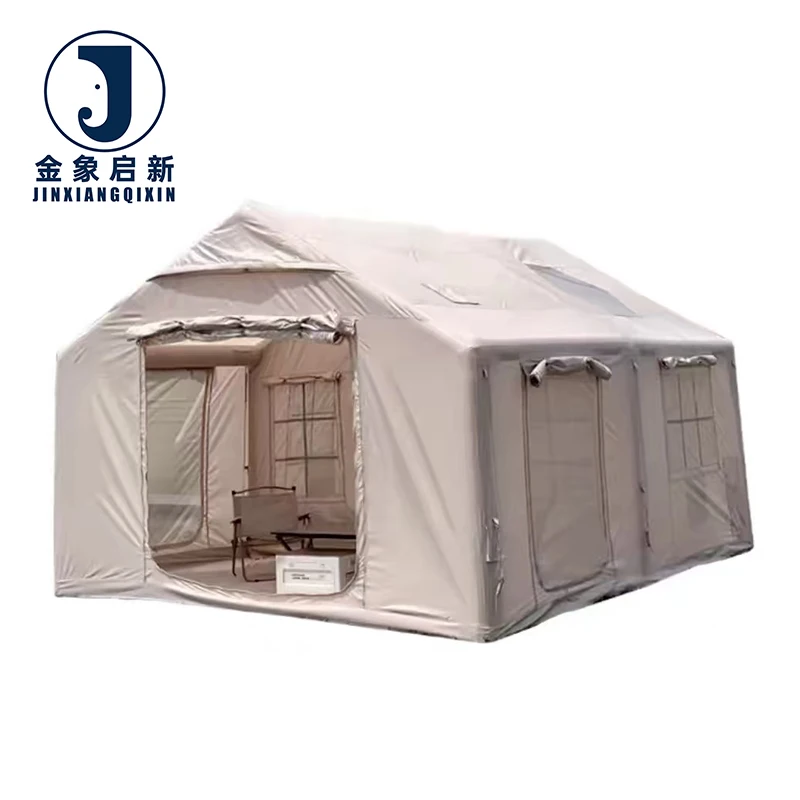
Precision-Coated Fabric Engineering — Every batch of our inflatable tent membrane undergoes coating-weight verification and adhesion testing traceable to its production run, ensuring the material performs as specified when deployed under emergency conditions.
Technical Specifications
| Parameter | Value |
|---|---|
| Product Type | Inflatable tent |
| Core Material | PVC tarpaulin (PVC knife-coated fabric) |
| Coating Method | Knife coated |
| Capacity | 3-5 person |
| Design | Four-Season Use, Single Layer Construction, Extended Type |
| UV Treatment | UV-resistant coating (test basis not stated in source — confirm standard required for your market) |
| Waterproof Rating | Described as waterproof (rating not stated in source — request hydrostatic test data) |
| Tear Resistance | Described as tear-resistant (grade not stated in source — verify per your application) |
| Key Features | Waterproof, UV-resistant, tear-resistant, quick automatic opening |
| Customization Service | OEM & ODM support (size adjustments, material thickness variations, custom color options) |
| Standards | ISO9001, ISO14001, ISO45001, CE |
Application Suitability
| Application | Exposure & Requirement |
|---|---|
| Temporary site offices during infrastructure recovery | Continuous weather exposure, rapid deployment demand, structural integrity under inflation pressure |
| Equipment storage shelters in post-disaster operations | Moisture protection, UV degradation resistance, repeated inflation and deflation cycles |
| Emergency command centers for large-scale industrial facilities | Multi-day inflation hold, wind loading on membrane surface, airtight seam performance |
| Industrial disaster response and recovery staging | Field transport abrasion, temperature variation across four seasons, quick setup without heavy equipment |
What Happens When Coating Adhesion Fails Under Inflation Stress
A delaminated air beam compromises the entire structure within minutes, not hours.
When PVC coated fabric is specified for inflatable emergency shelters, the bond between the coating and the base fabric carries the full inflation load. Knife-coated construction delivers superior adhesion compared to laminated or calendered alternatives, yet buyers often evaluate material solely on surface weight without asking how the coating was applied or what the peel strength measures at. I have reviewed field failure reports where the coating separated from the base weave at the seam overlap — the exact location where inflation pressure concentrates. [NEED_CITE: coating adhesion test methods for inflatable PVC structures] The consequence is not gradual; the air beam loses rigidity and the shelter collapses under its own weight.
Knife-Coated Construction and Its Role in Airtight Performance
The knife-coating process forces liquid PVC into the interstices of the base fabric under controlled tension, creating a mechanical lock that laminated films cannot replicate. For inflatable emergency tent structures, this matters because the membrane must hold internal pressure across seams that are thermally welded after cutting. A PVC inflatable tent fabric manufacturer working with knife-coated material can achieve consistent weld integrity because the coating thickness is uniform across the roll width, reducing the risk of weak spots where heat penetration varies during welding.
UV-Resistant Formulation and Long-Term Membrane Integrity
Prolonged sunlight exposure breaks down plasticizers in PVC, causing the coating to become brittle and crack at fold lines. The UV-resistant coating applied to this fabric is engineered to slow that degradation, though the specific test duration and standard should be confirmed before committing to a production run. [NEED_CITE: UV exposure testing standards for PVC coated fabrics in outdoor structures] For emergency shelters deployed in open terrain with no shade cover, verifying the formulation’s resistance to solar degradation directly affects how many deployment cycles the membrane survives before replacement.
How Base Fabric and Coating Weight Interact to Determine Structural Capacity
The tensile and tear performance of inflatable tent fabric depends on the relationship between base fabric denier, weave density, and the weight of PVC applied per square meter. A heavier coating does not automatically mean higher tear strength — if the base fabric is low-denier polyester with an open weave, additional coating weight fills gaps without adding structural fiber. Knife-coated PVC allows precise control over coating weight, so the ratio of fiber to coating can be optimized for the inflation pressures the air beams will experience. Buyers evaluating custom inflatable emergency tent specifications should request the base fabric denier alongside the total GSM to understand where the strength actually comes from.
The Cost of Overlooking Seam and Weld Specifications
Thermal welding of PVC coated fabric for inflatable structures requires matching the welding temperature and dwell time to the specific coating formulation and thickness. When a batch arrives with slightly different plasticizer content than the sample used to set the welding parameters, the seam may cure too hard or remain tacky. I have seen situations where the weld line became the first failure point during inflation testing — the fabric itself held, but the seam cracked under pressure. [NEED_CITE: thermal welding parameters for knife-coated PVC tarpaulin] This is why pre-production sample confirmation with the R&D team is critical before full-roll production begins.
Why Source Inflatable Tent Membrane Here
Three full production lines with 36 sets of professional equipment mean coating runs are dedicated, not squeezed between unrelated product batches — your inflatable tent fabric maintains consistent coating weight roll to roll. The 10-person R&D team handles material selection and sample development in-house, so when you request a specific base fabric denier or custom color for your inflatable membrane, the sample you approve is produced on the same equipment as your final order. Every production stage includes dedicated QA/QC, with 100% inspection before shipment catching adhesion defects and coating inconsistencies before they reach your welding table. Material specification sheets state GSM, base fabric, and coating method per batch, providing the documentation your quality system requires.
Documentation & Verification
- Material specification sheet stating GSM, base fabric denier, and knife-coating weight per roll
- UV-resistant coating test report available upon request for your compliance review
- Batch-specific quality inspection record with coating adhesion and tensile test results
- Pre-production sample approval documentation tied to your order reference number
- ISO9001, ISO14001, ISO45001, and CE certificates included with shipment documentation
Fabrication, Handling & Storage
- Set thermal welder temperature to match the knife-coated PVC formulation — request welding parameters with your sample
- Store rolls vertically on end-caps to prevent flat-spot creases that weaken the coating at fold lines
- Allow cold-transported rolls to reach ambient temperature before unrolling to avoid cracking the PVC surface
- Use PVC-compatible cleaners only — solvent-based products degrade the knife-coated surface and compromise airtight integrity
- Inspect seam overlap areas before inflation testing — coating thickness variation affects weld strength at joints
Specifying the Right Material for Your Inflatable Shelter Program
Provide the deployment environment details including expected wind loads, temperature range, and duration of continuous inflation. If your market requires flame retardant or anti-static treatment, specify the standard your end users must meet so we can confirm whether the current formulation qualifies or a custom run is needed. Share your target roll width, annual volume, and whether you require finished cut panels or full rolls for your own fabrication line. Request a production sample before committing to volume so your welding team can validate parameters on the actual material.
Frequently Asked Questions
Q: What base fabric denier and GSM are typical for inflatable tent air beams, and how do they affect tensile and tear strength?
A: The base fabric denier determines fiber-level tensile capacity, while total GSM reflects coating weight added for airtightness and abrasion resistance. For inflatable structures, high denier with controlled knife-coating weight delivers better inflation pressure resistance than simply increasing total GSM. Request the denier and coating weight breakdown to evaluate structural suitability.
Q: How is UV resistance verified, and what test standard applies to the coating?
A: The UV-resistant coating is formulated to resist degradation under prolonged sunlight, but the specific test duration and standard should be confirmed for your application. We provide test data on request — share the standard your market requires so we can supply matching documentation or develop a custom formulation.
Q: What welding techniques ensure airtight seams for automatic inflatable structures?
A: Hot-air welding and high-frequency welding are the primary methods for knife-coated PVC inflatable membranes. The correct temperature and dwell time depend on coating thickness and formulation. Our R&D team provides recommended welding parameters with each sample so your production team can validate settings before full-scale fabrication.
Q: How is coating adhesion tested to prevent delamination under repeated inflation cycles?
A: Coating adhesion is measured through peel testing, which evaluates the bond strength between the PVC coating and base fabric. Each batch undergoes inspection before shipment. For applications involving frequent inflation and deflation, request batch-specific adhesion data to confirm the material meets your cycle-life requirements.
Q: What customization options are available for thickness, color, and performance treatments?
A: OEM and ODM customization covers size adjustments, material thickness variations, and custom color options. Additional treatments such as flame retardant or anti-static properties may be available — specify the grade and standard required for your market so we can confirm feasibility and provide a production sample for approval.