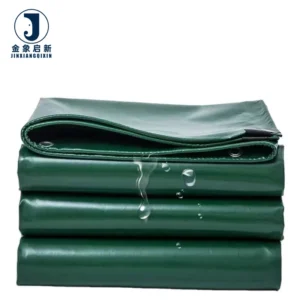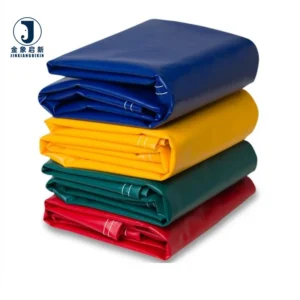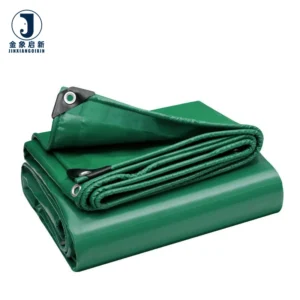
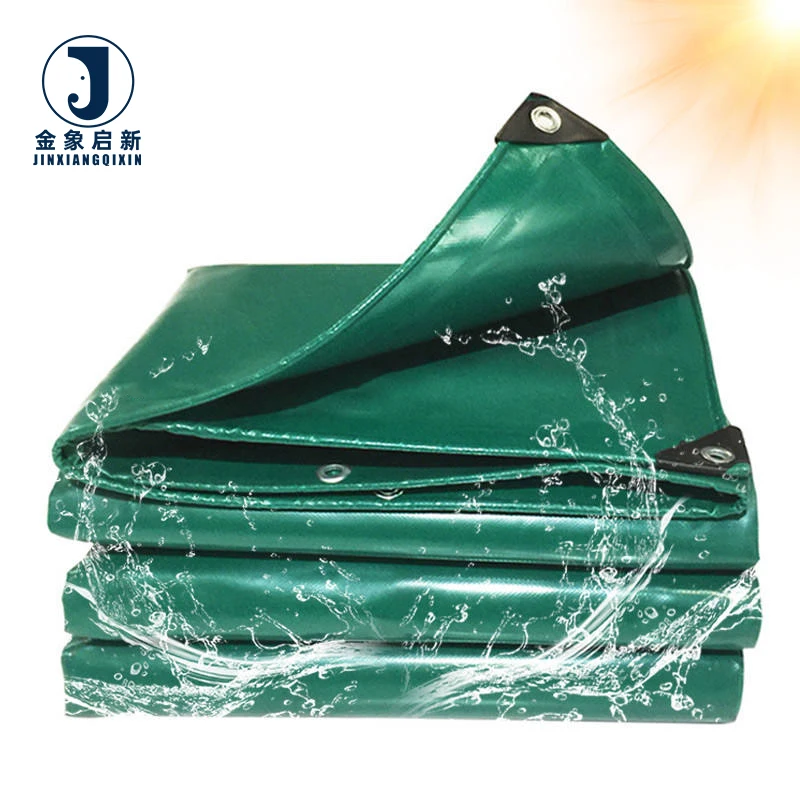
Coating Precision — Every roll of PVC Coated Tarpaulin ships with a specification sheet stating exact GSM, base fabric denier and coating weight, backed by 100% pre-shipment inspection.
Technical Specifications
| Parameter | Value |
|---|---|
| Product Type | PVC Coated Tarpaulin |
| Base Fabric | Polyester Base Fabric + Double-Sided PVC Coating |
| Weight Range | 350 gsm – 900 gsm (8 distinct grades: 350 / 400 / 420 / 500 / 600 / 650 / 750 / 900) |
| Yarn Count Options | 500D840D / 500D1000D / 1000D1000D / 1000D1300D / 1300D1300D / 1000D2000D |
| Mesh Density Options | 3019 / 2020 / 30*15 |
| Total Thickness Range | 0.29 mm – 0.65 mm |
| Tensile Strength (Warp) | 1650 N – 3900 N (test basis not stated) |
| Tensile Strength (Weft) | 1600 N – 3500 N (test basis not stated) |
| Material Density | 1.15 – 2.00 g/cm³ |
| Brittle Temperature | ≤ -50 °C to -60 °C |
| Softening Temperature | ≥ 80 °C |
| Melting Point | 212 °C |
| Coating Method | Knife Coated |
| Fabrication Options | High frequency hot melt, Hot air welding, Sewing |
| Edge Finishing | 5 mm thick rope without splicing, high temperature heat sealed seamless edge wrapping |
| Eyelet Options | 3 cm enlarged aluminum alloy buttonhole with reinforced corners |
| Flame Retardant Grade | Available in flame retardant grades — confirm the grade required for your market |
| UV Treatment | Available with anti-UV treatment — request test report for exposure hours and standard |
| Key Features | Waterproof, Fire Retardant, Anti-UV, Heavy Metal Free, Anti-Mildew, Flexible, Self-Clean, Printable |
| Standards | ISO, CE |
Application Suitability
| Application | Exposure & Requirement |
|---|---|
| Truck and Trailer Side Curtain | Constant flexing at tie-down points, road debris abrasion, UV exposure, weld seam integrity under load movement |
| Outdoor Event Tent (Block-Out) | Full-day sun exposure, wind loading on pole structures, flame retardant compliance for public assembly venues |
| Awnings and Terrace Pergola Covers | Permanent outdoor weathering, colour fastness against UV, dimensional stability across temperature swings |
| Inflatable and Membrane Structures | Consistent coating adhesion for high-frequency welding, air retention under internal pressure, puncture resistance |
| Construction Site Covers | Abrasion from aggregate and steel, water ingress prevention, flame retardant requirement on regulated sites |
| Army and Carriage Tents | Extreme temperature range from -50 °C to softening point, repeated pack-unpack cycles, mildew resistance in humid storage |
| Garden Furniture and Plant Covers | Seasonal UV exposure, moisture trapping leading to mildew risk, lightweight handling for end users |
| Pallet and Equipment Wraps | Forklift contact abrasion, stacking compression, waterproof barrier during outdoor staging |
Why the Base Fabric Construction Matters More Than GSM Alone
A PVC coated tarpaulin fabric buyer who specifies only by weight is leaving tensile performance to chance. Two fabrics can carry the same GSM but behave very differently under load because the base fabric denier and mesh count determine how force distributes through the weave.
Base denier and weave density are what actually govern how the material handles sustained tension and puncture events.
I have seen situations where a heavier-coated fabric with a low-denier base tore along the weft line under wind load, while a lighter-coated fabric with a 1000D*1000D base held firm on the same structure. The coating contributes to waterproofing, abrasion resistance and weld strength, but the skeleton of the material — the polyester yarn and how tightly it is woven — carries the mechanical load. When a PVC coated tarpaulin manufacturer quotes a grade, the conversation must cover both the coating weight and the yarn construction underneath it [NEED_CITE: tensile and tear test methods for coated fabrics per ISO 1421].
Coating Weight Versus Base Fabric: Where the Real Specification Happens
Technical buyers evaluating PVC coated tarpaulin fabric need to separate what the coating does from what the base fabric does. The PVC layer provides the waterproof barrier, chemical resistance and surface characteristics for welding or printing. The polyester base — specified by denier and mesh count — governs tensile strength, tear propagation resistance and long-term dimensional stability. A 500D840D base with 3019 mesh will flex readily and suit applications like side curtains, while a 1300D*1300D base delivers the structural capacity needed for large-span membrane roofs or heavy-equipment covers.
Weld Integrity and Fabrication Behaviour at Flex Points
Seam failure on coated fabrics almost always occurs at the junction where the coated surface meets the base fabric at the weld line. High-frequency hot melt welding fuses the PVC coating layers directly, creating a bond that can approach the parent material strength when parameters are set correctly for the specific GSM and coating thickness. Hot air welding offers field-repair flexibility but depends heavily on operator technique. Sewn seams, when used, concentrate stress at needle holes through the base fabric — a factor that matters more on lower-denier constructions where yarn displacement is easier.
Reading the Specification Sheet: Denier, Mesh and Tensile Together
The interplay between yarn denier and mesh density determines how load transfers through the weave. A 1000D1000D fabric at 2020 mesh has fewer but thicker yarns per centimetre, giving high individual yarn strength but larger gaps between yarns that rely more on coating fill. A 500D840D at 3019 mesh uses finer yarns packed more densely, distributing point loads across more intersections. Tensile strength figures reported in Newtons for warp and weft reflect this combined behaviour — thicker yarns in the warp direction typically yield higher warp strength, which matters when the fabric is tensioned along its length on a trailer or structure [NEED_CITE: relationship between base fabric construction and tensile performance in PVC coated textiles].
The Hidden Cost of Specifying Without Verifying Coating Adhesion
Coating weight and base fabric denier can both be correct on paper, yet the material fails prematurely if the bond between coating and substrate is weak. Delamination shows up first at welded seams and at fold lines where the coating is under repeated bending stress. On truck side curtains, this manifests as the PVC layer peeling away from the base along the curtain track channel. On inflatable structures, it appears as blistering near high-frequency welds. Requesting a peel-strength test value alongside the GSM quote gives a far clearer picture of field performance than weight alone [NEED_CITE: coating adhesion test methods for industrial PVC fabrics].
Why Technical Buyers Source PVC Coated Tarpaulin Fabric Here
Material specification sheets ship with every roll, stating the exact GSM, base fabric denier, mesh count and coating weight so receiving teams can verify against the purchase order without waiting for third-party lab results. Three full production lines with 36 sets of professional equipment handle both standard roll widths and custom widths with consistent coating application across the entire web. A 10-person R&D team develops samples to your target denier, weight and colour within days before you commit to a production run. Pre-shipment inspection covers 100% of rolls for weight, colour and dimensional accuracy. ISO and CE certification underpins the quality management system governing every batch.
Documentation & Verification
- Material specification sheet per roll stating GSM, base denier, mesh count and coating weight
- Independent test reports for UV stability and flame retardant grades where specified
- Pre-shipment roll inspection record confirming weight and colour within tolerance
- Certificate of origin and customs documentation for export shipments
- Roll packing list detailing batch number, roll count, individual roll weight and dimensions
Fabrication, Handling & Storage
- High-frequency welding parameters must be calibrated to the specific GSM and coating thickness of each grade
- Hot air welding on lighter grades requires lower temperature settings to avoid burning through the PVC layer
- 5 mm splice-free rope edging distributes tension evenly across the full hem width without weak splice points
- 3 cm enlarged aluminum alloy eyelets with reinforced corners prevent pull-through under sustained tie-down loads
- Rolls should be stored upright on end-caps to prevent flat-spot deformation on the coating surface
- Avoid dragging uncoated edges across abrasive surfaces during site deployment to protect base yarn integrity
What We Need to Quote Your PVC Coated Tarpaulin Fabric Order
To match the right base fabric construction and coating grade to your application, share the end-use environment including UV exposure duration, temperature range and any flame retardant or anti-static compliance requirements. Let us know the roll width and length you need, your annual volume and whether you require finished cut sizes with eyelets and hems or roll stock only. If you have a target colour or print specification, we will develop a sample for your approval before production begins.
Frequently Asked Questions
Q: How do I verify the GSM I receive matches the GSM I ordered?
A: Every roll ships with a material specification sheet stating the exact GSM, base fabric denier and coating weight. Your receiving team can cross-reference this against the purchase order immediately on arrival. We conduct 100% pre-shipment inspection and provide the inspection record with each dispatch, so any discrepancy is caught before the material leaves our facility.
Q: What test standards back the UV and flame retardant claims?
A: Anti-UV and flame retardant treatments are available across the product range, but the specific grade and test standard must be confirmed for your target market before ordering. Request the test report for the applicable standard — such as DIN 4102, NFPA 701 or M2 — and the UV exposure hours tested. We supply the documentation alongside the material specification sheet for your compliance records.
Q: Which weld method suits my PVC coated tarpaulin fabric application?
A: High-frequency hot melt welding delivers the strongest bond for factory fabrication of truck curtains, inflatable structures and tensioned membranes. Hot air welding is practical for on-site repairs and field joints. Sewing works for applications where mechanical fasteners supplement the seam. The best choice depends on your grade, coating thickness and whether the seam will sit at a flex point.
Q: How consistent is colour and weight across multiple rolls in one order?
A: Roll-to-roll colour and weight consistency is controlled through in-process QA at every production stage. Coating weight is monitored continuously across the web width, and colour is checked against the reference standard before winding. The pre-shipment inspection record documents the weight and colour verification for each individual roll in your order.
Q: Can you develop a sample to my target GSM, colour and width before I commit?
A: Yes. Our 10-person R&D team develops samples matched to your required denier, GSM, colour and width specification. Sample turnaround is typically completed within days. Once you approve the sample, production runs to the same formulation and parameters, so the bulk material matches what you evaluated.