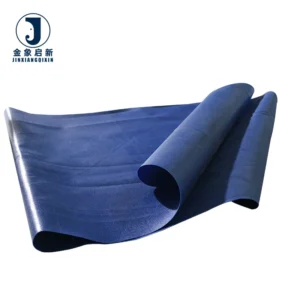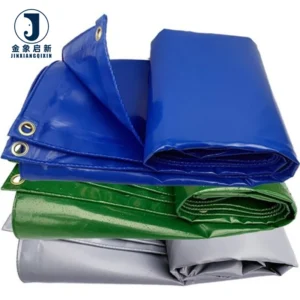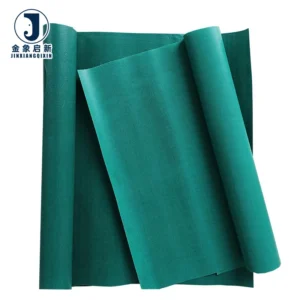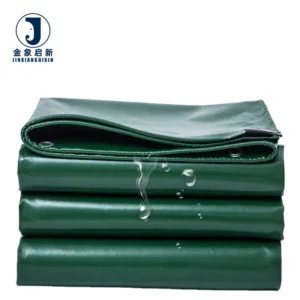
Coated Fabric Process Control — Nearly 30 years of PVC coating expertise applied to warp-knitted base fabrics, with dedicated QA at every production stage ensuring roll-to-roll consistency for agricultural cover applications.
Technical Specifications
| Parameter | Value |
|---|---|
| Product Type | PVC Coated Tarpaulin Roll |
| Coating Material | PVC |
| Base Fabric | Warp knitted polyester |
| Weave Style | Plain woven |
| Surface Treatment | Waterproof, Anti-static (test standard not stated in source) |
| Assembly State | Roll stock |
| Color | Customizable colors available |
| Certification | ISO, CE |
Application Suitability
| Application | Exposure & Requirement |
|---|---|
| Poultry and broiler farm curtain covers | Constant humidity, ammonia vapor, mechanical abrasion from equipment and personnel contact, waterproof integrity required |
| Pig and sheep shelter tarpaulin | Moisture exposure, animal contact, wind load on span structures, tear resistance at fastening points |
| Agricultural tent and temporary enclosures | Seasonal weather exposure, repeated installation and takedown, roll-to-roll color consistency across multiple panels |
Why Coating Weight Alone Does Not Define Farm Cover Durability
Coating adhesion to the base fabric and the denier of the warp-knitted yarn together determine how the PVC coated tarpaulin base fabric coating weight performs under real farm conditions.
I have reviewed too many material data sheets where the GSM figure is presented as the sole indicator of quality, while the base fabric construction and coating method are left vague. On a poultry farm, the cover flexes under wind load and is exposed to moisture and ammonia daily. A coating that is technically heavy but poorly bonded to a light base fabric will delaminate at the stress points long before the fabric itself fails [NEED_CITE: coating adhesion test methods for PVC coated fabrics]. Specifying the PVC coated tarpaulin base fabric coating weight without verifying the underlying yarn denier and weave density leaves you with a number that tells only part of the story.
Warp Knitted Base Fabric and Dimensional Stability
The warp knitted polyester base provides dimensional stability under tension, which matters when the tarpaulin is stretched across a farm enclosure frame. Unlike woven constructions that may shift at the intersections under sustained load, warp knitted structures lock the yarn in place, reducing the chance of coating cracks forming at the weave cross-points. This construction method directly supports the long-span installations common in poultry and livestock shelters where the PVC coated tarpaulin base fabric coating weight must remain uniform across the entire panel.
PVC Coating Method and Waterproof Integrity
The knife coating process applies a controlled layer of PVC onto the warp knitted base, filling the interstices between yarns and forming a continuous waterproof membrane. The thickness and formulation of this coating determine how well the fabric resists moisture penetration in high-humidity livestock environments. When coating weight is specified without a corresponding adhesion value, there is no way to confirm whether the PVC layer will remain bonded through seasonal temperature swings and repeated flexing cycles [NEED_CITE: PVC coating peel strength standards for coated technical textiles]. Consistent coating application across the full roll width is what separates a farm cover that performs through multiple seasons from one that develops pinholes within months.
Anti-Static Treatment — Claim Versus Measured Value
Anti-static treatment is listed in the specification, but the surface resistance value and the test standard used to measure it are not stated. For livestock environments where dust accumulation can affect air quality and where static discharge near feed systems is a concern, requesting a measured surface resistance figure backed by a recognized test method is the only way to verify the claim. Without this documentation, anti-static remains a product description term rather than a verifiable material property.
Custom Color Consistency Across Rolls
Pigment dispersion in the PVC coating formulation determines whether rolls from the same production batch will match when installed side by side on a farm structure. Color variation between rolls becomes immediately visible once panels are hung adjacent to each other, especially on large broiler house enclosures. Control of pigment batching at the formulation stage — not just at the mixing stage — is what maintains consistency across an entire order.
Understanding GSM, Base Fabric Density and Coating Weight Together
GSM alone does not predict how a farm cover will perform. The total weight is the sum of the base fabric mass and the coating mass, and different ratios between the two produce fabrics with very different handling and durability characteristics. A PVC coated tarpaulin base fabric coating weight that leans heavily toward coating mass with a light base fabric will feel stiff and may crack at fold lines. Conversely, a heavier base fabric with a thinner coating will offer better tear strength but may compromise waterproof integrity in prolonged wet conditions. Warp knitted polyester contributes to tear propagation resistance because the loop structure absorbs and distributes stress rather than allowing a tear to travel in a straight line. The relationship between denier, stitch density, and coating thickness is what defines the final material behavior.
The Hidden Cost of Specifying on Price Per Kilogram
When procurement focuses on unit cost without requiring documentation of base fabric denier and coating adhesion, the result is often a roll that meets the quoted GSM on the scale but underperforms in the field. Coating that is poorly bonded will peel at the welded seams — precisely where the cover flexes most under wind load — leaving the livestock exposed and forcing an unplanned replacement mid-season. Batch-to-batch color inconsistency discovered only after installation means the entire enclosure must be re-skinned to maintain a professional appearance [NEED_CITE: common failure modes in agricultural PVC tarpaulin installations]. These costs are never reflected in the original quotation but are borne entirely by the end user.
Why Source This PVC Coated Tarpaulin Here
Three full production lines and 36 sets of professional equipment support bulk roll output with consistent lead times for farm cover projects of any scale. A 10-person R&D team handles material selection, custom color matching and sample development within days, so specification can be confirmed before a full order is committed. Dedicated QA and QC inspection at every production stage — from base fabric intake through coating application to final winding — catches adhesion defects and color drift before the roll is packed. Pre-shipment inspection covers 100 percent of rolls, not a statistical sample, ensuring that what arrives on site matches the approved specification. Custom widths and colors are available without prohibitive minimums, supporting farm contractors who need specific panel dimensions rather than standard catalog sizes.
Documentation & Verification
- Material specification sheet stating exact GSM, base fabric denier, weave type and coating weight for each roll
- Anti-static test report with surface resistance value and applicable standard — request before ordering
- Pre-shipment inspection record confirming coating adhesion check and color consistency roll by roll
- ISO and CE certificates on file for the manufacturing facility
- Roll packing list and certificate of origin for customs and import documentation
Fabrication, Handling & Storage
- Heat weld at temperatures matched to the PVC coating thickness to avoid burning through or under-bonding at seams
- Reinforce fastening points with additional PVC patches where tie-downs or frame clips contact the warp knitted base
- Store rolls upright on a flat surface to prevent permanent creasing in the coated surface
- Unroll and allow the fabric to relax before cutting to minimize tension distortion in the warp knitted structure
- Use mild detergent for cleaning; avoid solvent-based agents that may soften the PVC coating layer
- Repair minor punctures with compatible PVC adhesive patches applied to both sides of the warp knitted base
What to Include in Your Enquiry
Provide the specific livestock or agricultural application, the dimensions of the enclosure or shelter structure, and the environmental conditions the cover will face including humidity levels and wind exposure. If your market requires anti-static certification, state the surface resistance range and the test standard your compliance body recognizes. Confirm whether you need roll stock in standard widths or custom-cut panels, and indicate the total meterage or roll count required for your project timeline.
Frequently Asked Questions
Q: How can I verify the GSM of the tarpaulin when the rolls arrive?
A: Cut a sample of known dimensions from the roll and weigh it on a calibrated scale. Compare the result against the GSM value stated on the material specification sheet provided with your order. Any significant deviation should be flagged before the fabric is cut or installed.
Q: What test documentation should the supplier provide for anti-static performance?
A: Request a test report that states the measured surface resistance value along with the specific test standard used. A product description that claims anti-static treatment without supporting data does not provide sufficient basis for compliance verification in regulated livestock environments.
Q: How does warp knitted construction compare to woven base fabric for farm covers?
A: Warp knitted polyester locks the yarn structure in place, offering dimensional stability under sustained tension and reducing the risk of coating cracks at weave intersections. This makes it suited to long-span farm enclosures where the fabric is stretched across a frame under constant load.
Q: How is color matching controlled across multiple rolls in a single order?
A: Pigment batches are formulated and controlled at the compounding stage to minimize variation. Pre-shipment inspection includes a visual color consistency check across all rolls in the order. For critical applications, requesting a cutting from each production batch before dispatch provides additional assurance.
Q: What is the relationship between PVC coating weight and waterproof performance in livestock environments?
A: The coating must fully fill the interstices of the base fabric and form a continuous membrane. Heavier coating generally supports better waterproof integrity, but only when adhesion to the base fabric is maintained through temperature cycles and flexing — which is why coating weight must be evaluated alongside adhesion data.