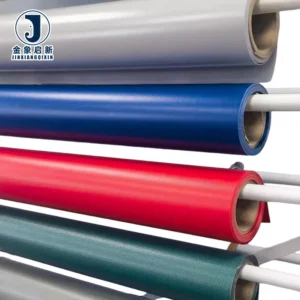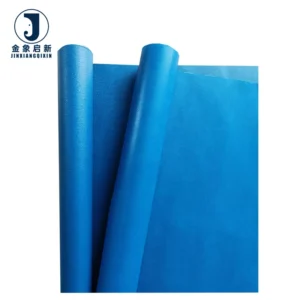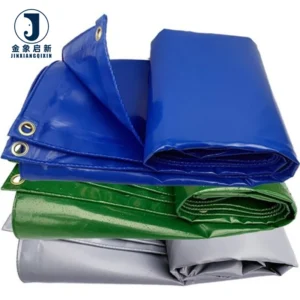
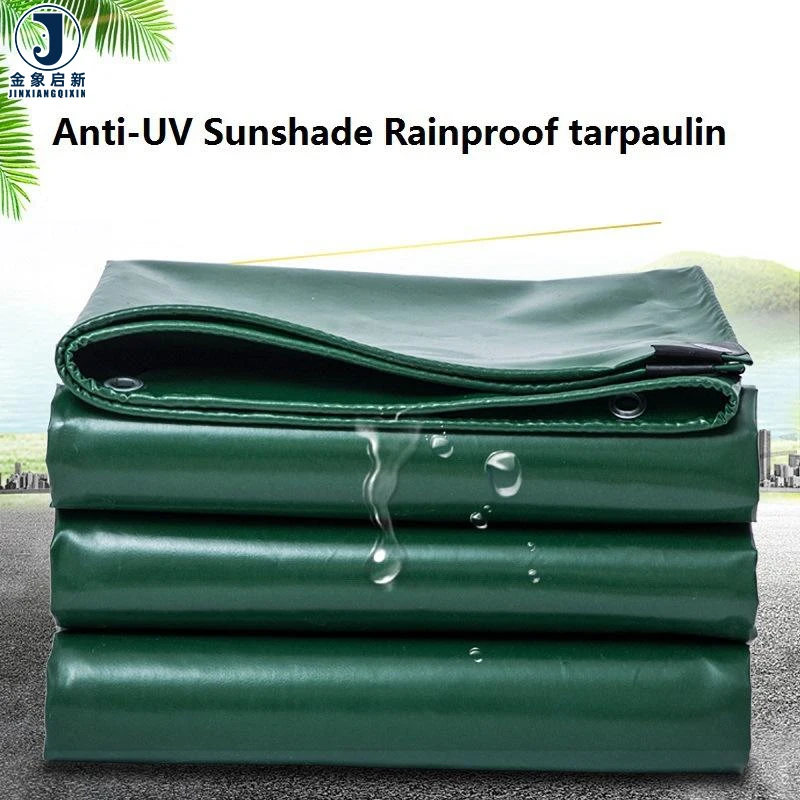
Precision GSM Control — every roll of PVC coated tarpaulin undergoes dedicated QA/QC at each production stage with 100% pre-shipment inspection to verify coating weight matches the material specification sheet.
Technical Specifications
| Parameter | Value |
|---|---|
| Product Type | PVC Coated Tarpaulin Roll |
| Material Composition | PVC coating on high-strength polyester mesh fabric |
| Coating Technology | Laminated technology / Hot-melt coating technology |
| Weight Range | 350gsm, 420gsm, 500gsm, 550gsm, 600gsm, 750gsm |
| Total Thickness | 0.32mm, 0.35mm, 0.4mm, 0.45mm, 0.5mm, 0.65mm |
| Standard Roll Size | 2m × 75m / 2.1m × 50m |
| Available Colors | Blue, Red, Yellow, Light blue, Grey (custom colors available) |
| Key Features | Waterproof, sunproof, anti-mildew, cold crack resistance, outstanding tearing strength for welding, high color fastness |
| Special Treatments | Flame retardant (confirm grade required), anti-static (confirm grade required), anti-cold, anti-mildew, 3P |
| Certifications | ISO, CE |
Application Suitability
| Application | Exposure & Requirement |
|---|---|
| Tent and awning structures | Sustained wind load, UV exposure, structural tension at seams |
| Truck awning and cargo ship covers | Dynamic flexing, road salt, marine moisture, tie-down abrasion |
| Construction scaffolding enclosure | Wind-driven rain, scaffolding tube contact, flame retardant site compliance |
| Inflatable and membrane structures | Internal air pressure, continuous UV and thermal cycling |
| Fish tank and pool liners | Permanent water immersion, chemical treatment exposure, puncture risk |
| Temporary industrial equipment covers | Dust ingress, outdoor weathering, repeated handling and folding |
Why the Quoted GSM Does Not Guarantee the Roll You Receive
The specification sheet on a PVC coated tarpaulin roll quotation states a weight, but arrival inspection frequently reveals a lighter material with a thinner coating than what was agreed. Consistent coating weight depends on process control at the coating head, not just the stated GSM figure. Technical buyers evaluating base fabric denier, coating adhesion and GSM-to-strength correlation need documentation that links every roll to a verified measurement, not a batch average. When the roll arriving at the fabrication shop floor is lighter than the quotation, the tensile and tear performance drops accordingly — welds may fail earlier under flex load, and the fabric body becomes more susceptible to puncture during installation [NEED_CITE: incoming material verification practices for coated fabrics].
Coating Technology and Base Fabric Adhesion
The bond between the PVC layer and the high-tenacity polyester mesh determines whether the coating delaminates under field stress. Laminated technology applies the PVC film to the base fabric under heat and pressure, while hot-melt coating deposits molten PVC directly onto the mesh for deeper yarn penetration. Each method influences adhesion strength, surface finish and suitability for welding. Selecting the right PVC coated tarpaulin for a specific fabrication method depends on matching the coating technology to the weld parameters your equipment uses.
Tearing Strength at Weld Points
Welded seams represent the highest-stress zone on any fabricated cover. The tearing strength at the weld line must exceed the force applied at flex points during use, or the seam will part before the fabric body fails. This product family is engineered with tearing strength at weld joints as a primary specification target, addressing the common failure mode where seams separate under load [NEED_CITE: weld integrity testing standards for coated technical textiles]. The hot-melt coating method typically supports stronger weld adhesion due to the deeper PVC penetration into the base yarn structure.
Reading GSM, Thickness and Base Fabric Together
GSM alone does not define tensile or tear performance. A 550gsm roll built on a high-denier, tightly woven polyester mesh may outperform a 600gsm roll with a lower-density base and heavier coating fill. The six weight grades from 350gsm to 750gsm correspond to thickness values between 0.32mm and 0.65mm, but the structural contribution comes from how the base yarn denier and weave density interact with the coating weight. Laminated construction tends to yield a smoother, more uniform surface suitable for printing and clean welds, while hot-melt coating produces a thicker PVC layer relative to the base fabric, influencing flexibility and cold crack resistance. Technical specifiers should request the base fabric denier and weave data alongside the GSM to make an informed material selection [NEED_CITE: relationship between base fabric construction and coated fabric tensile properties per ISO 1421].
The Hidden Cost of Specifying on GSM Alone
When a buyer selects material based only on a GSM number without verifying coating technology, base fabric construction and treatment documentation, the consequences appear after fabrication. Rolls with insufficient coating adhesion delaminate at the weld line within months of deployment. Flame retardant treatment claimed without a supporting test report causes site inspection failure, halting a construction project until compliant material arrives. Colour variation between rolls in the same order becomes visible only after panels are installed side by side on a tent or awning structure, forcing costly replacement of the affected sections [NEED_CITE: batch consistency standards for coated fabric color matching].
Sourcing with Verified Material Data
Every roll is produced on one of three full production lines with 36 sets of professional equipment, supporting batch consistency across multiple orders. A 10-person R&D team develops custom samples within days, covering material selection, colour matching and specification verification before bulk production proceeds. In-process QA at each production stage is followed by 100% pre-shipment inspection, ensuring the GSM, coating thickness and colour reference match the material specification sheet. Custom widths, colours and special treatment grades are available with corresponding test documentation — request the specific certification your market requires before confirming the order.
Documentation & Verification
- Material specification sheet stating GSM, base fabric denier, coating type and thickness per roll
- UV and flame retardant test reports supplied for treated grades — confirm required standard before ordering
- Pre-shipment inspection record verifying weight and visual quality against specification
- Roll packing list with batch identification for receiving audit and traceability
- Certificate of origin and customs documentation included with each shipment
Fabrication, Handling & Storage
- Adjust hot-air weld temperature to match the coating technology — laminated and hot-melt grades respond differently to heat input
- Store rolls upright on pallets to prevent flat-spot deformation across the 2m or 2.1m width
- Allow cold-stored rolls to reach ambient temperature before unrolling to avoid coating crack at low GSM grades
- Use compatible PVC adhesive for field repairs, matching the coating method of the original roll
- Plan panel cutting layout to minimize offcut waste from 75m and 50m standard roll lengths
Specifying the Right Grade for Your Application
Provide the end-use application, expected exposure conditions and any fire safety or anti-static compliance requirements for your target market. Specify whether you require roll stock in standard widths or custom dimensions, and confirm the colour reference system you use for batch consistency verification. If fabricated finished sizes are needed instead of roll stock, supply the cut dimensions and reinforcement requirements for a production sample before bulk confirmation.
Frequently Asked Questions
Q: How is GSM verified per roll and what documentation accompanies shipment?
A: Each roll undergoes weight verification during 100% pre-shipment inspection, measured against the stated GSM on the material specification sheet. The inspection record is included with the shipment along with a roll packing list showing batch identification, enabling incoming quality checks at your facility without independent sampling delay.
Q: What test standard supports the flame retardant claim and which certifications are available?
A: Flame retardant treatment is available in multiple grades. The applicable test standard depends on your market — specify whether your project requires M2, B1 per DIN 4102, NFPA 701 or another classification. Request the test report for the specific grade before placing the order to ensure site compliance documentation is ready upon delivery.
Q: What is the difference between laminated and hot-melt coating for weld strength?
A: Hot-melt coating penetrates deeper into the polyester mesh, typically producing stronger weld adhesion at seam joints. Laminated coating provides a smoother surface more suited to printing and clean visual finishes. The choice depends on whether your priority is structural weld integrity or surface appearance for the fabricated product.
Q: How is batch-to-batch colour consistency controlled across rolls?
A: Colour reference is established during sample approval and applied as a production standard across the full order. The 100% pre-shipment inspection includes visual comparison against the approved reference to identify shade variation before dispatch, reducing the risk of visible colour differences when panels are installed side by side.