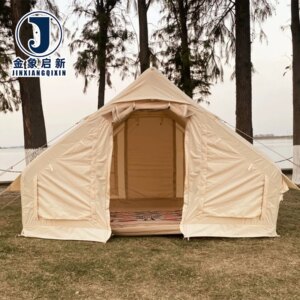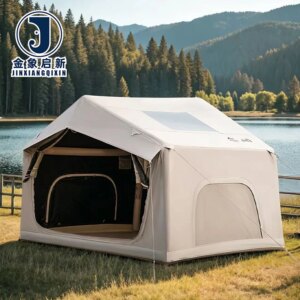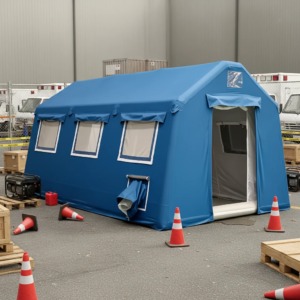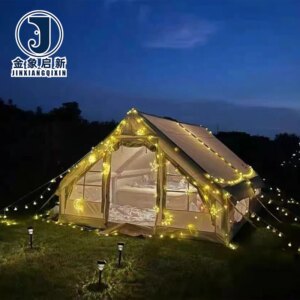
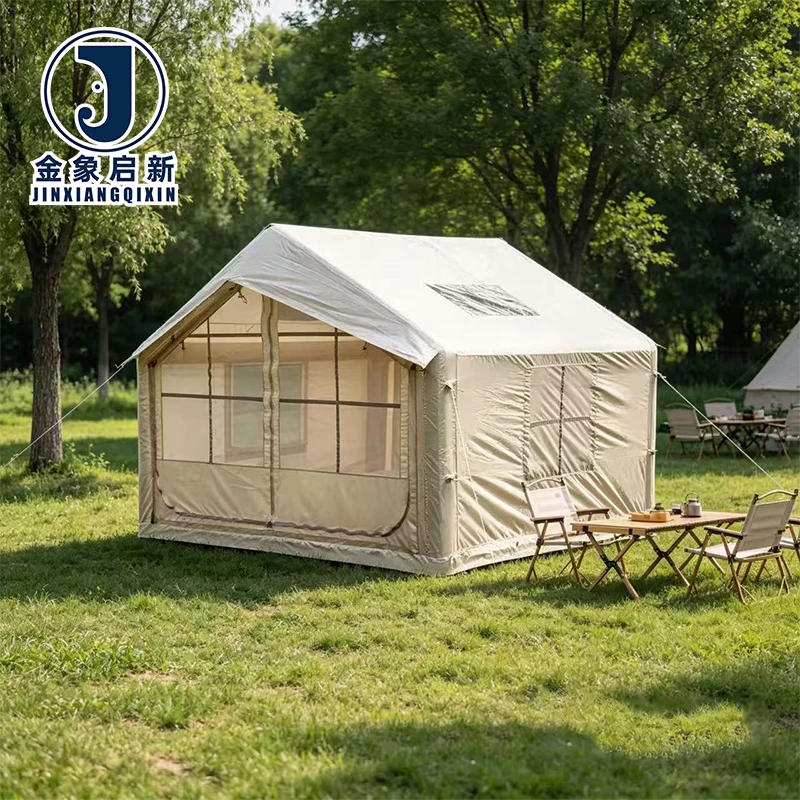
Process Control — Coating weight and adhesion managed across three production lines to ensure airtight integrity in inflatable tent fabric structures.
Technical Specifications
| Parameter | Value |
|---|---|
| Product Type | Inflatable Tent |
| Core Material | PVC tarpaulin |
| Key Performance | Waterproof, UV-resistant (test basis not stated in source), tear-resistant, fire-retardant (grade not stated in source), anti-static (standard not stated in source) |
| Construction | Single-layer |
| Capacity | 4-6 Person |
| Season Rating | Four-season |
| Opening Mechanism | Quick automatic opening |
| Customization Service | OEM & ODM (sample customization, pattern printing, custom dimensions, material thickness adjustments) |
| Production Facility Area | 9,180 square meters |
| Production Lines | 3 full production lines |
| Processing Equipment | 36 sets of professional processing equipment |
| R&D Team Scale | 10 technicians |
| Quality Control | Full-process quality inspection with dedicated QA & QC staff |
| Standards | ISO 9001, ISO 14001, ISO 45001, CE |
Application Suitability
| Application | Exposure & Requirement |
|---|---|
| Remote construction crew shelters | Continuous outdoor weathering, rapid deployment, four-season thermal protection, certified fire-retardant materials for site compliance |
| Outdoor event and commercial structures | Crowd-adjacent temporary enclosure, UV exposure across multi-day installations, fire safety certification for public venues |
| Industrial project housing and equipment tents | Long-duration field exposure, abrasion from wind-driven particulates, airtight inflation performance over extended periods |
| Beach and coastal camping deployments | Salt spray exposure, high UV index, sand abrasion at ground contact, moisture ingress prevention |
Why "Flame Retardant" on a Data Sheet Is Not Enough for Site Acceptance
A PVC inflatable tent fabric must carry the specific fire classification your local authority demands — not a generic claim.
Technical buyers sourcing PVC inflatable tent fabric for mining camps, aviation hangars, or construction sites frequently encounter a gap between the quotation and the compliance document. The data sheet states flame retardant, but the site inspector asks for a test report referenced to a recognized standard. When that report does not exist, the structure sits unapproved while deadlines slip. [NEED_CITE: fire classification standards for temporary structures vary by jurisdiction and project specification]
The same problem extends to anti-static requirements in environments housing sensitive electronic equipment or fuel-handling operations. Without a stated standard, there is no basis for verification, and the inflatable tent fails pre-commissioning inspection. We address this by making fire-retardant grades and anti-static treatments available with corresponding test documentation — confirm the grade required for your deployment before placing an order.
Coating Adhesion and Airtight Integrity in Inflatable Structures
Inflatable tent performance depends on sustained internal pressure, which places continuous demand on the bond between the PVC coating and the base fabric. A PVC inflatable tent fabric with poor coating adhesion will delaminate at stress concentration points — particularly along welded seams and at inflation valve surrounds — leading to progressive air loss that worsens under temperature cycling. Our production process controls coating application parameters at every stage across three dedicated lines to maintain consistent adhesion strength across the full roll length.
Fire-Retardant and Anti-Static Options for Regulated Environments
Inflatable structures deployed on industrial sites often fall under fire safety and electrostatic discharge regulations that generic tent materials cannot satisfy. Available fire-retardant grades are formulated into the PVC coating system rather than applied as a topical treatment, which preserves performance through handling and weathering. Anti-static formulations address environments where static accumulation poses ignition or equipment interference risks. Request the specific test reports that align with your site compliance framework before confirming material selection. [NEED_CITE: anti-static and fire-retardant test methods for coated technical textiles]
Reading the Specification Sheet Beyond the GSM Figure
GSM alone does not predict how a PVC inflatable tent fabric will behave under inflation load. The base fabric denier and weave density determine tensile and tear resistance, while the coating weight and method govern airtightness, weld performance, and surface durability. A lighter base fabric with a heavy coating may reach the target GSM yet deliver lower tear strength than a heavier base with a proportionally lighter coat. When evaluating material options, request the full specification sheet that breaks down base fabric construction, coating type, and total weight separately — this is the only way to compare materials on equal terms. Coating method also matters: knife-coated fabrics generally deliver higher peel strength at welded seams compared to laminated constructions, which directly affects the reliability of inflatable tube joints under sustained pressure. [NEED_CITE: tensile and tear test methods for coated fabrics per ISO 1421]
The Hidden Cost of Specifying on Price Per Kilogram Alone
When PVC inflatable tent fabric is selected primarily on cost per kilogram, the result often surfaces months into deployment. Coating weight may be reduced to hit the price point, leading to early UV degradation visible as chalking and embrittlement across sun-exposed panels. Welded seams on under-specified material fail preferentially at the flex points of inflatable tubes, where cyclic loading concentrates stress. Batch-to-batch colour variation becomes visible when replacement panels are fitted alongside original fabric. These failures do not reflect poor workmanship — they reflect material that was never specified for the demands of a pressurized, outdoor, multi-month structure. [NEED_CITE: common failure modes in inflatable fabric structures under continuous UV and mechanical cycling]
What This Supply Chain Delivers for Inflatable Fabric Buyers
Coating weight and base fabric adhesion are monitored in-process across three full production lines, giving consistent roll-to-roll output for inflatable tent fabric orders. The 10-person technical team develops custom material formulations and provides samples within days so that fire-retardant grade, colour, and thickness can be validated before bulk production runs begin. Every roll undergoes inspection at each production stage, with a 100% pre-shipment check against the agreed specification sheet. ISO 9001, ISO 14001, and CE certification cover the full production scope, supporting site audit and documentation requirements. Pattern printing and custom dimension cutting are available with pre-production sample approval to confirm registration accuracy and dimensional tolerance.
Documentation & Verification
- Material specification sheet stating GSM, base fabric denier, and coating weight per roll
- Fire-retardant and anti-static test reports issued per batch against stated grades
- Pre-shipment inspection record confirming coating weight and colour consistency
- ISO 9001 and CE certificates covering PVC inflatable tent fabric production scope
- Roll packing list with net weight and linear meter count for inventory reconciliation
- Certificate of origin and customs documentation for international shipment clearance
Fabrication, Handling & Storage
- Hot-air welding parameters should be adjusted to coating thickness to ensure seam peel strength matches the PVC tarpaulin body
- Store rolls upright on pallets to prevent flat-spot deformation that affects inflation tube roundness
- Cut panels with sealed edges to prevent base fabric wicking moisture into the PVC coating layers
- Clean surfaces with neutral pH detergent to preserve coating integrity and any applied fire-retardant treatment
- Allow cold-stored rolls to reach ambient temperature before unrolling to avoid coating crack at low-temperature flex points
- Repair field damage with compatible PVC adhesive patches matched to the coating formulation of the inflatable tent fabric
What to Include in Your Material Inquiry
Provide the deployment environment and expected continuous exposure duration so we can recommend the appropriate coating weight and UV treatment level. Specify the fire-retardant classification or anti-static standard required by your site authority to ensure the test documentation matches compliance expectations. Indicate whether you need rolls for in-house fabrication or finished panels with custom dimensions and pattern printing, along with target colour references and quantity per colourway.
Frequently Asked Questions
Q: What fire-retardant and anti-static certifications accompany the inflatable tent fabric?
A: Fire-retardant grades and anti-static treatments are available with test reports referenced to recognized standards. The specific classification required depends on your deployment jurisdiction and site safety framework. Request documentation matching your compliance requirement before confirming the order, and our technical team will align the formulation and testing accordingly.
Q: Can custom colours and pattern printing maintain batch consistency across multiple tent units?
A: Colour consistency across rolls in a single production run is managed through in-process QA checks at each stage. For pattern printing and multi-colour orders, pre-production samples are provided for approval so that registration and shade can be verified before full-volume output begins, reducing the risk of visible variation between installed units.
Q: What GSM and coating options suit different deployment durations?
A: Material selection balances base fabric denier, coating weight, and total GSM against the expected exposure conditions and inflation load. Heavier base fabrics with controlled coating thickness deliver higher tear resistance for multi-month industrial deployments. Request a full specification breakdown rather than relying on GSM alone to compare options for your application.
Q: How are welded seams validated for airtight performance under inflation pressure?
A: Welded seams are inspected during production to confirm peel strength and coating adhesion at the joint line. The coating formulation and application method are selected to support reliable hot-air or high-frequency welding. Fabrication parameters should be confirmed through sample testing before full production, particularly for inflatable tube geometries under sustained internal pressure.
Q: What documents ship with the order for customs and site compliance?
A: Each shipment includes a material specification sheet, roll packing list, certificate of origin, and applicable test reports for fire-retardant or anti-static performance. ISO and CE certificates covering the production scope are available for site audit purposes. Additional documentation can be prepared to support specific customs or regulatory requirements in the destination market.