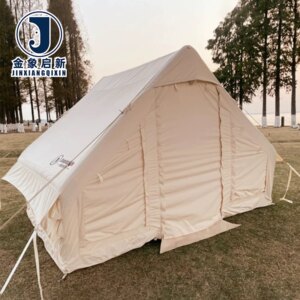
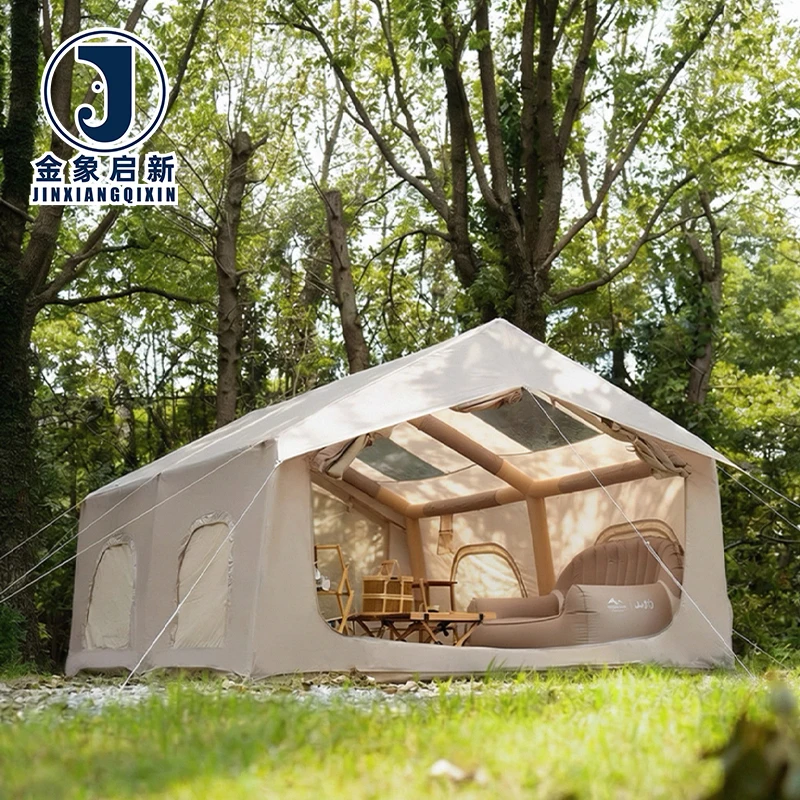
Material and Coating Consistency — three dedicated production lines and 36 sets of processing equipment maintain tight control over coating weight and adhesion across every roll of PVC inflatable tent fabric shipped.
Technical Specifications
| Parameter | Value |
|---|---|
| Product Type | Inflatable Tent Fabric |
| Core Material | PVC waterproof fabric |
| Key Performance | UV resistant (test basis not stated), waterproof, quick automatic opening |
| Product Forms | Single Layer Construction, Extended Type |
| Season Rating | Four-season |
| Customization | OEM & ODM — material selection, design modification, pattern printing |
| Certifications | ISO9001, ISO14001, ISO45001, CE |
Application Suitability
| Application | Exposure & Requirement |
|---|---|
| Temporary site offices at construction projects | Continuous sun and rain exposure, wind loading on inflated frame, daily entry and exit abrasion at door panels |
| Equipment storage during outdoor operations | Ground moisture, dust ingress, UV degradation over extended deployment periods |
| Mobile command centers for industrial events | Rapid deployment requirement, frequent inflation and deflation cycles, branding visibility |
| Emergency response shelters for infrastructure teams | All-weather deployment in remote locations, low-temperature flexibility, structural stability under wind load |
| On-site material storage in remote industrial locations | Prolonged UV exposure, puncture risk from site debris, thermal expansion and contraction of air beams |
Why Coating Weight Consistency Matters More Than the Quoted GSM for Inflatable Tent Fabric
A stated GSM that drops across rolls in the same shipment is a deployment liability, not a material specification.
When an Inflatable Tent Fabric manufacturer custom order arrives with rolls that vary in coating thickness, the thinner sections inflate unevenly and the heat-welded seams on lighter panels carry disproportionate stress. I have seen procurement teams sign off on a specification sheet, only to find on-site that some panels sag while adjacent ones hold pressure correctly. The problem is not the fabric chemistry — it is the absence of in-process coating weight verification during production. [NEED_CITE: coating weight variation and its effect on welded seam integrity in inflatable structures]
How PVC Coating Chemistry Defines Inflatable Structure Behaviour
The PVC coated waterproof fabric used for inflatable tents must balance flexibility at low temperatures with dimensional stability under internal air pressure. A coating that is too rigid cracks at the fold lines during packing and transport, while one that is too soft allows the air beams to deform under lateral wind loads. The formulation and application method of the PVC layer directly determine whether the structure holds its geometry through repeated inflation cycles.
UV Resistance Claims Require Test Documentation
UV resistant treatment is listed as a key performance attribute for this PVC inflatable tent material, though the specific test basis is not stated in the source documentation. For projects where the shelter remains deployed for extended periods under direct sunlight, buyers should request the test method and exposure duration data before confirming the material for their application. Confirm the UV test standard required for your target market and match it against the supplier’s report.
Reading Beyond the Spec Sheet: What GSM, Base Fabric, and Coating Method Actually Control
The relationship between fabric weight and structural performance in inflatable tent applications is governed by more than a single number. The base fabric denier and weave density establish the tensile and tear baseline, while the PVC coating weight adds mass, waterproofing, and UV protection but does not proportionally increase strength. A heavier coating on a low-denier base yields a stiff, heavy panel that tears easily along the warp direction, whereas a lighter coating on a high-density base may lack the abrasion resistance needed for ground-contact sections. For inflatable tent fabric, the single layer construction format demands that the material perform both as a pressure-retaining membrane and as a weather barrier simultaneously — a dual role that makes the balance between base fabric specification and coating thickness critical. [NEED_CITE: relationship between base fabric denier and tear propagation in PVC coated textiles per ISO 1421]
The Hidden Cost of Specifying on Price Rather Than Coating Verification
When procurement focuses on unit cost without verifying coating consistency, the consequences appear during fabrication and deployment. Rolls that arrive below the quoted GSM produce air beams that cannot sustain the target internal pressure, leading to partial collapse in moderate wind. Colour variation between rolls in the same order becomes visible once panels are welded side by side on the finished tent — a defect that cannot be corrected without scrapping entire sections. Heat-welded seams on inconsistently coated fabric fail at the weld line before the fabric body reaches its rated stress, because the thinner coating melts through before achieving full bond penetration. [NEED_CITE: heat welding parameters and coating thickness correlation in PVC tarpaulin fabrication]
Production Infrastructure That Directly Addresses Material Consistency
Three full production lines dedicated to coated fabric allow simultaneous processing of multiple orders without changeover contamination between different PVC formulations. The 36 sets of professional processing equipment include the coating, curing, and finishing stages needed to maintain uniform treatment application from the first metre to the last metre of each roll. A 10-technician R&D team handles material selection, design modification, and pattern printing specifications — meaning custom requirements are resolved at the formulation stage rather than patched during finishing. Dedicated QA and QC staff conduct 100 percent inspection before shipment, checking coating weight, colour consistency, and surface finish against the confirmed sample. Sample development for custom inflatable tent fabric specifications is completed within days, with customer sign-off required before mass production begins.
Documentation & Verification
- Material specification sheet stating base fabric type, PVC coating description, colour reference, and treatment claims for each roll
- Batch quality inspection reports traceable by order number with coating weight and visual inspection records
- UV resistant and waterproof performance documentation provided where test basis is established
- ISO9001, ISO14001, ISO45001, and CE certificates available for compliance verification
- Pre-shipment inspection record confirming 100 percent inspection before dispatch
Fabrication, Handling & Storage
- Heat welding parameters must be adjusted to match the PVC coating thickness of the specific roll batch being processed
- Store rolls vertically on pallets in a shaded, ventilated area to prevent flat-spot deformation of the PVC coated surface
- Allow cold-stored rolls to acclimatise before unrolling to avoid cracking the PVC layer at low temperatures
- Use compatible PVC adhesive and patch material matching the coating chemistry for on-site repair of punctures or seam separation
- Plan cutting layout to minimise off-cuts on the single layer construction panels, accounting for weld seam allowance at each joint
What to Include in Your PVC Inflatable Tent Fabric Enquiry
Provide the intended deployment environment, including typical wind conditions, temperature range, and expected duration of continuous outdoor exposure. Specify whether you require fabric in roll form for your own fabrication line, or if OEM and ODM finished product support is needed. Include your target market so that the correct UV resistant treatment documentation and certification requirements can be matched to your compliance framework.
Frequently Asked Questions
Q: How can I verify the PVC fabric GSM on arrival against the quoted specification?
A: Request a pre-shipment inspection record that documents the measured coating weight per roll. On receipt, conduct a sample cut-and-weigh test on a known area from each roll to confirm the actual GSM matches the material specification sheet. Any discrepancy beyond normal tolerance should be flagged before fabrication begins, as welding parameters depend on accurate coating thickness data.
Q: What UV test basis supports the UV resistant claim for this inflatable tent fabric?
A: The product documentation lists UV resistant treatment as a key performance attribute, but the specific test method and exposure duration are not stated in the source material. Request the test report identifying the standard used and the exposure hours achieved. Match this against the regulatory or project requirements of your deployment region before confirming the material grade.
Q: How is colour consistency maintained across multiple rolls in a single order?
A: Colour matching is controlled through the R&D team during sample development, with customer approval required before production begins. The 100 percent pre-shipment inspection process checks colour consistency roll by roll. For orders involving pattern printing, confirm the Pantone or RAL reference and request a strike-off sample for approval before the full run proceeds.
Q: What is the recommended welding approach for inflatable tent fabrication on this PVC coated fabric?
A: Hot air or high-frequency welding is standard for PVC coated waterproof fabric. Welding temperature, speed, and pressure must be calibrated to the specific coating thickness of the batch being processed. Under-heating produces weak bonds that fail under air beam pressure, while over-heating burns through the coating. Request the supplier’s recommended welding parameters for your material specification.
Q: What customisation options are available for material selection and finished product design?
A: OEM and ODM support covers PVC material selection, product design modifications including single layer and extended type configurations, and pattern printing for branding. The 10-person R&D team develops samples within days for review. Confirm your required fabric performance attributes, dimensions, and any regulatory certifications needed so the sample accurately represents the production specification.