Precision coating weight verification — Every roll of PE tarpaulin material coating technology is measured against the stated GSM on the spec sheet before it leaves the line, eliminating the gap between quotation and delivery.
Technical Specifications
| Parameter | Value |
|---|---|
| Product Type | PVC Coated Tarpaulin |
| Base Fabric | Vinyl-coated polyester mesh (100% PES dipping coating process) |
| Weave Construction | Knitting and plain weave options |
| Weight Range | 50 gr/m² to 220 gr/m² (confirm the grade for your application) |
| Total Thickness | 0.2 mm – 0.4 mm (8 mil – 16 mil) |
| Roll Width Options | 6 ft, 8 ft, 10 ft, 12 ft / 2 m, 4 m, 6 m |
| Roll Length | 100 yards, 100 meters, or custom |
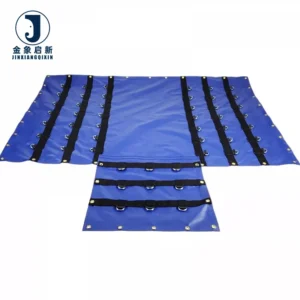
| Edge Reinforcement | PP rope hem on all four edges (finished tarps) |
| Eyelet Spacing | Galvanized eyelets every 3 ft or 1 m (finished tarps) |
| Corner Reinforcement | Plastic corner patches at stress points (finished tarps) |
| UV Treatment | Available — confirm test basis for your market |
| Mildew Resistance | Mildew proof formulation — verify grade upon inquiry |
| Color Options | Blue, Blue/Orange, Green, Grey, Black, Clear, Grey/Green, Orange, or custom |
| Printing | Custom printing and color customization accepted |
| Certifications | ISO, CE (documentation available) |
Application Suitability
| Application | Exposure & Requirement |
|---|---|
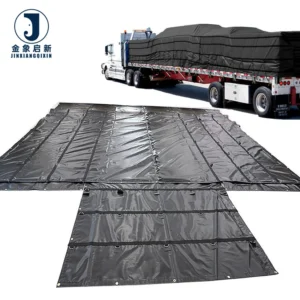
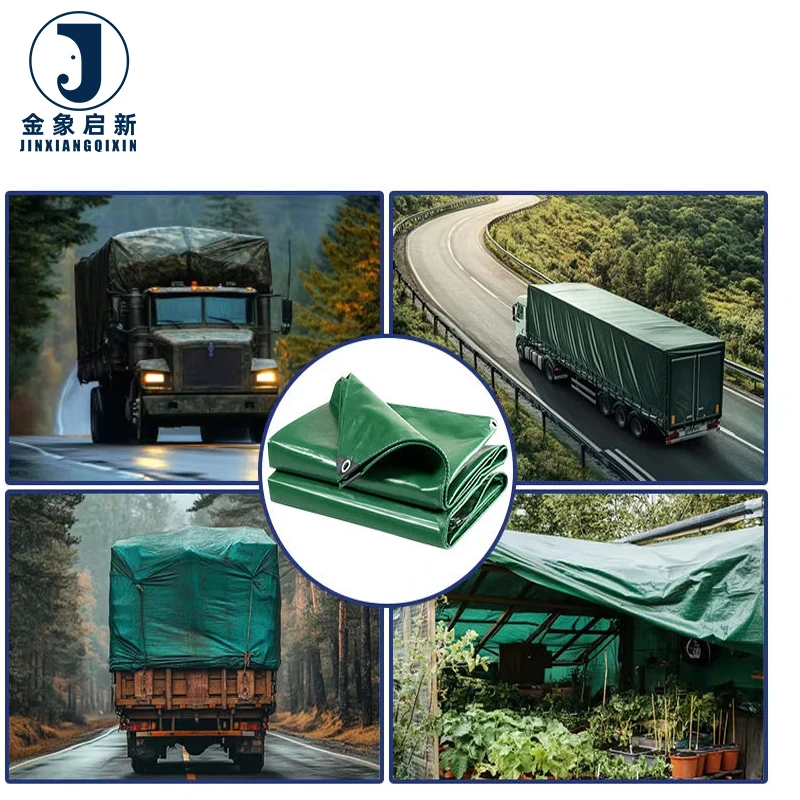
| Lumber tarps on flatbed trailers | Constant road vibration, tie-down abrasion at edge hems, prolonged UV exposure during staging |
| Steel coil and sheet protection | Sharp-edge puncture risk, heavy tie-down tension at eyelets, condensation under load |
| Snow and debris containment | Wet-weight load stress, freezing temperatures reducing fabric flexibility, repeated folding |
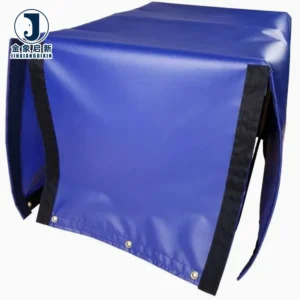
| Equipment and machinery covers on site | Ground moisture contact, forklift and crane proximity, wind-lift at unreinforced corners |
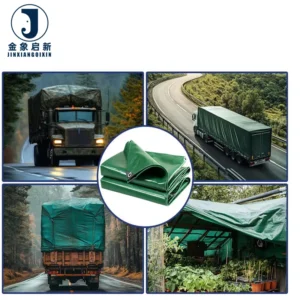
| General truck and trailer flatbed covers | Highway-speed wind flutter causing flex fatigue, rain ingress at seams, diesel particulate staining |
What "GSM on the Quotation" Actually Means When the Roll Arrives
Total coated weight and base fabric denier together define how the tarpaulin handles under load — one number alone does not tell the full story.
Buyers reviewing PE tarpaulin material coating technology often receive a quotation citing a specific GSM, only to find the delivered fabric feels noticeably lighter. The issue usually traces back to whether the stated weight refers to the base fabric alone or the fully coated laminate. A 150 gr/m² base scrim with 50 gr/m² of coating on each side yields a different tensile profile than a 200 gr/m² single-dip construction, even though both might be quoted at the same total weight. [NEED_CITE: ISO 1421 test methods for tensile properties of coated fabrics]
When coating weight is concentrated on one side, the uncoated face becomes the weak point for moisture penetration and abrasion. For truck cover applications where the load side and weather side experience different stresses, understanding the coating distribution across the laminate matters more than the headline GSM figure.
How Dipping Coating Builds the Laminate Structure
The 100% PES dipping coating process saturates the polyester mesh base rather than laying coating on top. This means the vinyl compound penetrates the yarn interstices, creating mechanical adhesion that resists delamination under repeated flex cycles. For truck cover fabricators, this coating method directly affects how the material behaves at heat-welded seams — the compound flows into the weld zone from within the weave rather than relying on surface bonding alone.
Coating Weight and Tensile Performance at Tie-Down Points
GSM in the 50 gr/m² to 220 gr/m² range covers everything from light weather wraps to heavier-duty flatbed covers. The relationship between total weight and tensile strength is not linear: a heavier base scrim with moderate coating outperforms a lighter scrim with thick surface coating when tie-down straps concentrate load at the eyelets. [NEED_CITE: tensile and tear test methods for coated fabrics per ISO 1421] Specifying PE tarpaulin material coating technology requires matching the base denier to the expected point-load, not simply selecting the heaviest available grade.
Reading the Thickness-to-Flexibility Trade-Off
Total thickness between 0.2 mm and 0.4 mm determines both puncture resistance and handling flexibility. Thinner gauges fold tighter for storage and drape more easily over irregular loads, while thicker constructions resist abrasion from chains and binders. At the hem and eyelet zone, excessive thickness can cause the PP rope reinforcement to sit proud of the fabric surface, creating a catch point during wind-flutter. The right gauge depends on whether the tarp will be folded daily or deployed for extended periods.
The Cost of Overlooking Batch Consistency
Colour variation between rolls in the same shipment becomes visible the moment two panels are installed side by side on a trailer fleet. This inconsistency often traces to pigment dispersion during the coating compound preparation stage, not the weaving process. When a distributor commits to a multi-container order, a single off-shade roll can trigger a full re-sort at the warehouse, delaying every downstream customer. [NEED_CITE: colour consistency standards for coated textile batches]
Welded seams failing before the fabric body is another recurring issue. If the heat-seal temperature is calibrated for a different coating formulation, the seam bond degrades under flex fatigue while the main panel remains intact. This failure mode appears most often at the point where the load flexes during transit — typically the mid-span between tie-downs.
Why Source This Fabric Through a Controlled Production Line
Three full production lines and 36 sets of professional equipment support bulk roll output with consistent coating weight across the run. A 10-person R&D team handles material selection and sample development, allowing custom width and colour to be validated before the production run starts. Dedicated QA/QC at every stage, with 100% pre-shipment inspection, means each roll is measured against the specification sheet before packing. Nearly 30 years of focused coated-fabric production provides the process depth to hold GSM tolerances roll-to-roll. Samples for custom requirements are developed within days, reducing the approval cycle before container loading.
Documentation & Verification
- Material specification sheet stating GSM, base fabric denier, and coating weight per side
- UV and mildew test reports with stated test basis — request before order confirmation
- Pre-shipment inspection record verifying roll-by-roll GSM and colour match
- ISO and CE certificates included in the shipment documentation package
- Roll packing list with individual roll IDs for traceability
Fabrication, Handling & Storage
- Heat-weld parameters must match the vinyl coating formulation — request the recommended temperature window for the 0.2–0.4 mm thickness range
- Galvanized eyelet insertion at 1 m intervals requires a reinforced patch zone to prevent pull-through under strap tension
- Store rolls upright on end-caps to avoid flat-spot creases that become permanent fold lines
- Unroll in temperatures above 5 °C to prevent coating micro-cracking on the 50–220 gr/m² range
- Clean with pH-neutral detergent only; solvent-based cleaners degrade the LDPE and vinyl surface layer
- Trim waste at 6 m width requires a long cutting table to maintain straight hem lines
Before You Request a Quote
Provide the specific truck or trailer model dimensions, the expected tie-down configuration, and the climate exposure profile for the route. Specify whether you need roll stock in standard widths or finished tarps with hem and eyelet work completed. If your market requires particular UV or mildew test documentation, state the standard upfront so the correct grade is quoted. Custom colour and printed branding are available — confirm Pantone references and print area dimensions with your inquiry.
Frequently Asked Questions
Q: How is GSM verified on coated tarpaulin — base fabric weight versus total coated weight?
A: The total GSM includes the PES base mesh plus the vinyl coating on both sides. Our specification sheet breaks down the base fabric weight and coating weight separately so buyers can confirm the laminate structure matches the quotation. Pre-shipment inspection measures actual roll weight against the stated grade.
Q: What test basis supports the UV treatment and anti-mildew claims?
A: UV and mildew-proof treatments are available on this vinyl-coated polyester fabric. The specific test standard and exposure duration depend on the grade selected. Request the test report with your sample to confirm it meets your market requirements before committing to a production run.
Q: How does vinyl dipping coating compare to PVC knife coating for seam welding?
A: The dipping process saturates the mesh, creating coating compound within the weave structure. This generally provides strong weld adhesion because heat activates compound from inside the fabric. Knife-coated PVC concentrates material on the surface. We recommend weld testing with sample material to confirm parameters for your fabrication setup.
Q: What eyelet spacing and hem reinforcement options are available for truck covers?
A: Finished tarps come with PP rope hem reinforcement on all four edges, galvanized eyelets at every 3 ft or 1 m interval, and reinforced plastic corners. Custom spacing and additional reinforcement patches at high-load tie-down points can be specified during the sampling stage.
Q: How is batch-to-batch colour consistency controlled across multiple rolls?
A: Pigment batches are mixed to a single formulation for the entire order, and colour is checked at the coating stage before winding. The pre-shipment inspection includes a side-by-side visual comparison of rolls to flag any shade variation before dispatch.