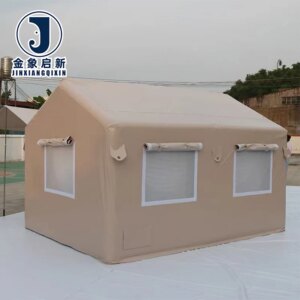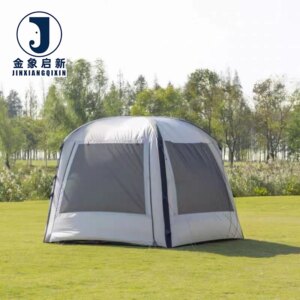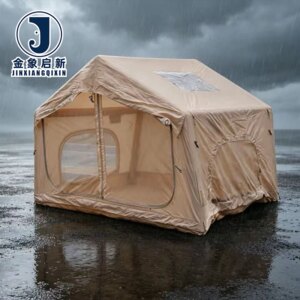
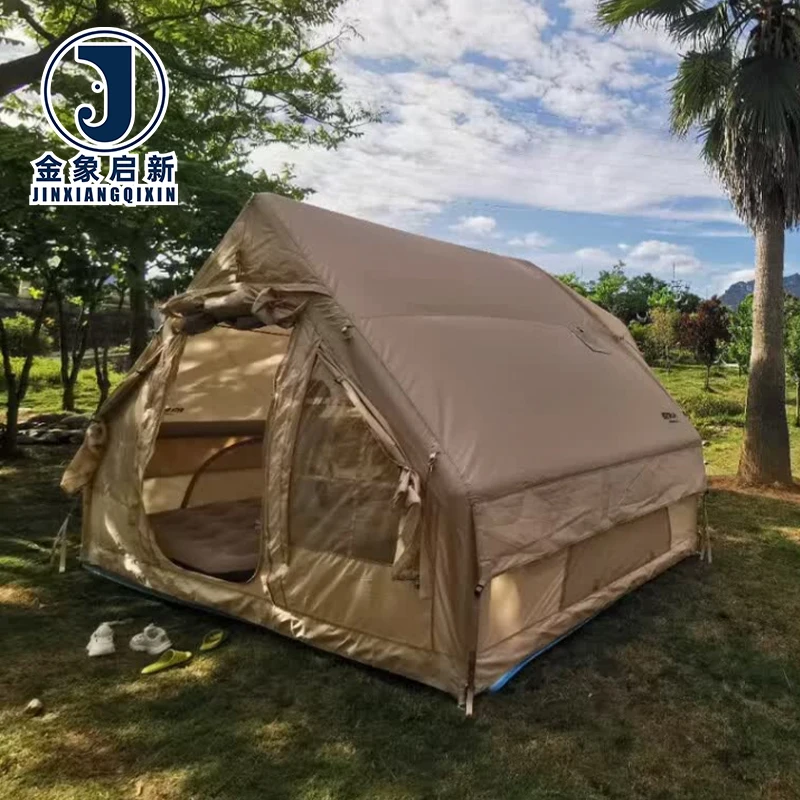
Coating Adhesion Control — deep process mastery over PVC coating weight and base fabric bonding ensures every roll of inflatable tent fabric leaves the line with uniform peel strength and waterproof integrity.
Technical Specifications
| Parameter | Value |
|---|---|
| Product Type | Inflatable Tent Fabric |
| Core Material | PVC tarpaulin |
| Construction | Single-layer PVC tarpaulin |
| Waterproof Rating | ≥2000mm water column (source value — verify against manufacturer catalog) |
| Tear Strength | ≥300N (test standard not stated in source) |
| UV Treatment | 500 hours exposure (test basis not stated in source) |
| Flame Retardant | Available in flame retardant grades — confirm the grade required for your market |
| Anti-Static | Available in anti-static grades — confirm surface resistance or standard for your application |
| Customization | OEM & ODM (sample customization, pattern printing, material selection, product design) |
| Prototype Lead Time | 7-10 business days |
| Production Lead Time | 15-20 days for standard orders |
| Standards | ISO9001, ISO14001, ISO45001, CE |
Application Suitability
| Application | Exposure & Requirement |
|---|---|
| Commercial inflatable camping tent manufacturing | Repeated inflation/deflation cycles, flex stress at seam lines, sustained UV and rain exposure |
| Family-sized inflatable shelter production | High hydrostatic pressure during storms, abrasion from ground contact, packing and transport wear |
| Professional outdoor equipment ranges | Compliance with fire safety regulations for commercial campsites, batch colour consistency across product lines |
| Outdoor gear wholesale distribution | Shelf-ready visual uniformity, verified material safety data for cross-border regulatory markets |
Why "Waterproof" on the Label Is Not Enough for Inflatable Tent Fabric
Batch-specific hydrostatic test reports are the only reliable proof that inflatable tent fabric will perform identically across an entire production run.
Outdoor gear manufacturers regularly discover that the waterproof rating stated on a supplier’s data sheet applies only to the sample roll tested in the lab. When production-scale rolls arrive, coating thickness variations across the width or from one batch to the next create weak zones where water penetrates under sustained hydrostatic pressure. [NEED_CITE: hydrostatic test methods for coated fabrics per ISO 811] For inflatable tent makers, a single leaking panel means a returned product, a warranty claim, and damaged brand credibility in a market where campers share reviews instantly. Sourcing custom inflatable tent PVC fabric with documented per-batch verification eliminates this failure mode at the material level before it reaches the cutting table.
Coating Consistency and the Waterproofing Chain
Every square metre of this PVC tarpaulin inflatable tent fabric undergoes controlled coating application to maintain a uniform film thickness across the full roll width. Variations in coating weight are the primary cause of hydrostatic weak spots in single-layer constructions. The production line monitors coating adhesion and surface continuity so that the waterproof rating holds not only on the sample swatch but throughout the commercial batch.
Structural Balance Between Weight and Portability
The single-layer PVC tarpaulin construction is engineered to balance mechanical durability with the low packed weight that inflatable camping tent designs demand. Shipping efficiency improves when finished tents fold into compact carry bags without sacrificing tear resistance. Manufacturers producing commercial-grade inflatable camping tents at scale benefit from a fabric that reduces freight costs per unit while maintaining the structural rigidity needed for inflatable beam support.
Safety Properties for Regulated Campsite Markets
Commercial camping operators in North America and Europe increasingly require shelter materials that meet specific fire safety and static dissipation thresholds. This custom inflatable tent PVC fabric is available in flame retardant grades — confirm the grade required for your market. Anti-static versions are also available for environments where static discharge poses a risk. [NEED_CITE: NFPA 701 fire test standard for textiles and films] Verifying the applicable standard early in the design phase prevents costly re-certification later.
Reading the Specification Sheet Beyond the Headline Number
Tear strength, waterproof rating, and UV stability interact in ways that a single headline figure cannot capture. A fabric rated ≥300N in tear resistance (test standard to be confirmed) may still fail prematurely if the base fabric weave allows tear propagation along a single yarn path. The PVC coating adds puncture resistance and hydrostatic performance but contributes relatively little to tear strength compared with the base fabric denier and weave density. Buyers specifying inflatable tent fabric manufacturer options should request the full test report, not just the summary value, and evaluate tear performance alongside coating adhesion data to predict real-world behaviour under inflation stress. UV stability claims of 500 hours exposure (test basis to be confirmed) should be matched against the expected seasonal service profile of the finished tent to determine whether supplemental UV additives are warranted. [NEED_CITE: accelerated UV weathering test standards for PVC-coated textiles]
The Hidden Cost of Specifying on Price Per Kilogram Alone
When procurement decisions reduce inflatable tent fabric to a cost-per-kilogram comparison, the downstream consequences surface on the production floor. Rolls that arrive below the quoted coating weight produce tents that leak under moderate rainfall, triggering batch rejections and line stoppages. Colour variation between rolls forces manufacturers to sort and match panels manually, adding labour and delaying shipment. [NEED_CITE: coating weight variance impact on hydrostatic performance in PVC tarpaulins] Fire-retardant grades lacking verifiable certification can block an entire container at customs in regulated markets. These failures do not appear on the purchase order but dominate the total cost of ownership for any outdoor gear manufacturer running serial production.
Why Material Control Matters Here
Three full production lines and 36 sets of professional processing equipment support bulk capacity with controlled on-time delivery for scheduled production runs. A 10-person R&D team handles material selection, pattern printing, and prototype development, delivering samples within days rather than weeks. Dedicated QA/QC staff inspect every production stage with full pre-shipment verification, so the custom inflatable tent PVC fabric arriving at your factory matches the approved sample in weight, colour, and coating performance. ISO and CE certifications accompany each shipment, and the coating process is calibrated to hold consistent adhesion values across long production campaigns.
Documentation & Verification
- Material specification sheet stating core material, construction type, and applicable treatment grades
- Batch-specific test reports covering waterproof performance, tear resistance, and UV stability results
- Fire retardant and anti-static certification copies matching the grade specified on the purchase order
- Pre-shipment inspection record confirming roll count, colour consistency, and dimensional tolerances
- ISO9001, ISO14001, ISO45001, and CE certificate copies for regulatory market access support
Fabrication, Handling & Storage
- Heat welding parameters should be tuned to the single-layer PVC construction to avoid scorching or incomplete bonding at seam intersections
- Store rolls upright on padded racks to prevent permanent creasing in the PVC coating that transfers to finished tent panels
- Use compatible PVC adhesive for field repairs on the single-layer construction to maintain waterproof continuity at patch edges
- Allow cold-stored rolls to acclimatise to workshop temperature before unrolling to prevent coating micro-cracking
- Plan cutting layouts around the available roll width to minimise off-cuts and maintain consistent grain direction across inflatable beam panels
- Select mild, non-solvent cleaners for finished tent surfaces to preserve the PVC coating integrity and any applied UV treatment
What We Need to Quote Accurately
To provide a specification that matches your production requirements, share the target market and applicable fire safety or anti-static standards, the annual volume and roll width preference, and whether you require finished custom printing or blank stock. If you are developing a new inflatable tent model, let us know the inflation pressure range and expected seasonal exposure so we can recommend the appropriate treatment package. Sample rolls are available for your own in-house testing before you commit to a production order.
Frequently Asked Questions
Q: How is batch-to-batch waterproof consistency verified before shipment?
A: Each production batch undergoes hydrostatic pressure testing at multiple points across the roll width. The results are recorded on a batch-specific inspection report that ships with the documentation package. This allows outdoor gear manufacturers to trace waterproof performance back to the exact production run used in their finished inflatable camping tents.
Q: What flame-retardant grade and test standard apply to this inflatable tent fabric?
A: The fabric is available in flame retardant grades suited to commercial camping applications. The specific grade and test standard depend on your target market’s regulatory requirements. Confirm the applicable standard during the inquiry stage so the correct formulation is produced and certified documentation is included with your shipment.
Q: What UV exposure test basis supports the stability claim?
A: UV stability is assessed through accelerated weathering exposure. The test basis and conditions should be confirmed against your product’s expected service environment. Request the detailed test report to evaluate whether the treatment level meets the seasonal usage profile of your commercial inflatable camping tent range.
Q: What customization options are available for printing, dimensions, and thickness?
A: OEM and ODM services cover pattern printing, custom roll widths, material thickness adjustments, and colour matching. Prototype samples are developed within 7-10 business days for design validation. Share your dimensional tolerances and print artwork so the R&D team can prepare a sample that reflects your production specification.
Q: What documentation supports compliance in North American and European markets?
A: Shipments include ISO9001, ISO14001, ISO45001, and CE certificate copies, material specification sheets, batch test reports, and certificates of origin. Additional documentation such as MSDS or specific fire safety certificates can be provided upon request to support customs clearance and regulatory submissions in your destination market.