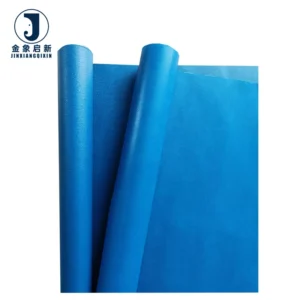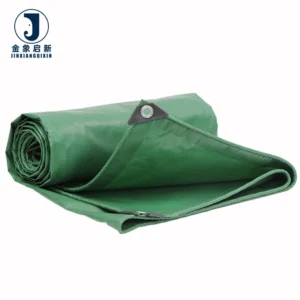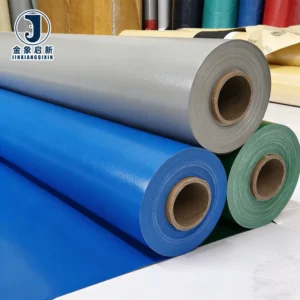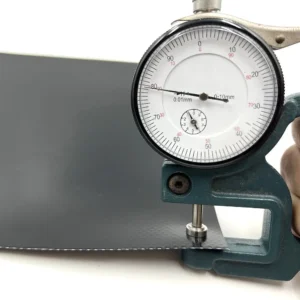
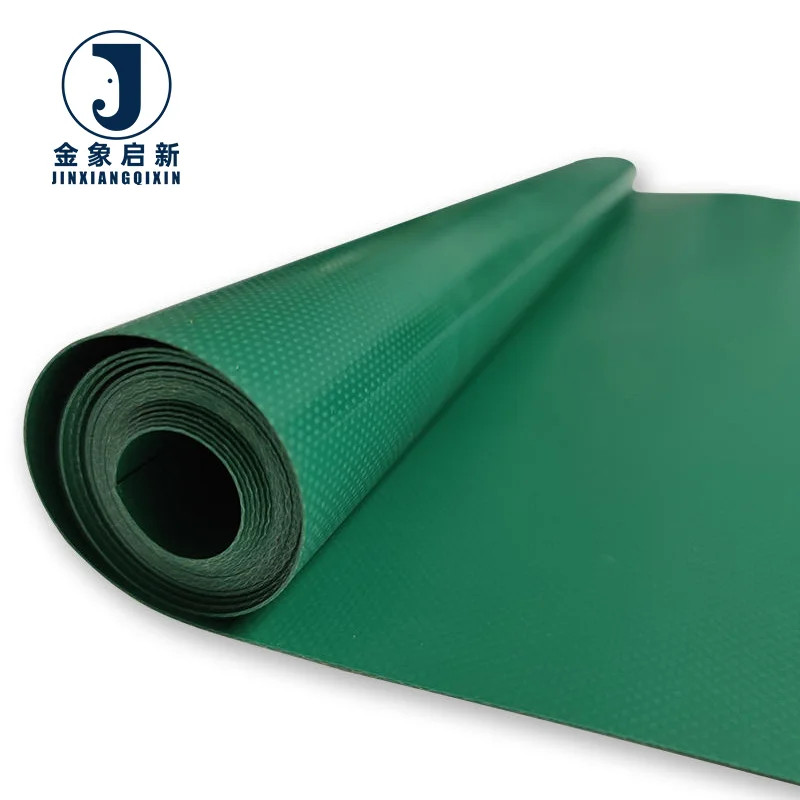
Deep Process Control Over Coating Weight — verified through in-line monitoring on every roll to ensure the stated GSM matches the base fabric denier and mesh count before the PVC coating is applied.
Technical Specifications
| Parameter | Value |
|---|---|
| Product Type | PVC Coated Tarpaulin |
| Base Fabric Construction | 500D×500D to 1000D×2000D polyester yarn |
| Mesh Count Options | 30×19, 20×20, 30×15 (varies by grade) |
| Coating Material | PVC, double-sided on polyester base fabric |
| GSM Range Available | 350, 400, 420, 500, 600, 650, 750, 900 |
| Total Thickness | 0.29mm (400 GSM) to 0.65mm (900 GSM) |
| Tensile Strength (Warp) | 1650 N (350 GSM) to 3900 N (900 GSM) |
| Tensile Strength (Weft) | 1600 N (350 GSM) to 3500 N (900 GSM) |
| Temperature Performance | Brittle ≤ -50 °C, softening ≥ 80 °C, melting 212 °C |
| Density | 1.15–2.00 g/cm³ |
| Flame Retardant | Available in flame retardant grades — confirm the grade required for your market |
| UV Treatment | Anti-UV treatment available — test basis supplied on request |
| Waterproof Rating | Fully waterproof coated construction |
| Width Options | 2m (most grades), 2.1m (750/900 GSM) |
| Finish | Available in glossy or matte finish |
| Color | Customizable |
Application Suitability
| Application | Exposure & Requirement |
|---|---|
| Truck side curtain fabric | Constant flex-fatigue at fold lines, road abrasion, sustained UV and weather exposure |
| Tent and awning structural panels | Tensile loading under wind, UV degradation, weld seam integrity at tension points |
| Industrial equipment covers | Abrasion from contact with metal edges, moisture ingress, temperature cycling |
| Inflatable and membrane structures | Air retention under coating, seam adhesion under internal pressure, flame retardant compliance |
| Outdoor storage and agricultural covers | Prolonged UV exposure, ponding water, biological growth in humid climates |
Why the PVC Coated Tarpaulin GSM Material Specification Is More Than a Weight Number
GSM alone does not determine strength — it is the combination of base fabric denier, mesh count, and coating weight that governs how the material performs under load.
Technical buyers frequently encounter tarpaulin quoted by GSM without reference to the underlying yarn construction. A 500 GSM fabric built on 500D×1000D yarn with a 30×19 mesh behaves very differently from one using lower-denier yarn with heavier coating to reach the same weight. The coating adds mass but cannot compensate for a weak base fabric when the material is pulled at the seams or flexed repeatedly at tie-down points. Without a full specification sheet, incoming inspection cannot distinguish between a properly engineered grade and one that merely hits the target weight on the scale. [NEED_CITE: relationship between base fabric denier and tensile performance per ISO 1421]
How Base Fabric Construction Drives Coated Fabric Performance
The PVC coated tarpaulin GSM material specification begins with the polyester base fabric. Yarn denier determines the individual filament thickness — 500D yarn in the warp and weft produces a lighter, more flexible fabric suited to covers and light-duty enclosures, while 1000D×2000D construction in the 900 GSM grade delivers substantially higher tensile values for heavy-duty transport and structural membrane applications. Mesh count defines how tightly those yarns are woven: a 30×19 weave in the lighter grades provides adequate density for general-purpose covers, whereas a denser 20×20 construction in the 600–750 GSM range increases the number of yarn intersections per unit area, distributing load more evenly across the fabric surface.
Coating Weight, Thickness, and the Adhesion Interface
The PVC coating applied to both faces of the base fabric adds waterproof sealing, UV screening agents, and the physical thickness that protects the yarn from abrasion. Thickness progresses from 0.29mm at 400 GSM to 0.65mm at 900 GSM — a direct consequence of increasing coating mass on heavier base fabrics. The critical interface is where PVC meets polyester: adhesion strength determines whether the coating delaminates at a flex point or holds through repeated folding. Double-sided coating ensures that neither face is left exposed to moisture or chemical contact, and the total GSM reflects the combined weight of base fabric plus both coating layers. [NEED_CITE: double-sided coating adhesion and peel strength test methods for PVC on polyester]
Reading the Specification Table for Material Selection
Three parameters interact to define how this PVC coated tarpaulin performs in service. First, tensile strength in both warp and weft directions — ranging from 1650 N at 350 GSM to 3900 N at 900 GSM in the warp direction — indicates the maximum sustained load before the fabric ruptures. Second, total thickness correlates with abrasion resistance: a thicker coating layer absorbs more surface wear before the base yarn is exposed. Third, the brittle temperature of ≤ -50 °C and softening temperature of ≥ 80 °C define the thermal boundaries within which the PVC remains flexible and structurally competent. Selecting a grade requires matching all three to the expected service conditions rather than choosing on weight alone.
What Happens When Material Properties Are Assumed Rather Than Verified
Fabricators who specify by GSM alone risk receiving a material that passes the weight check but fails at the weld line or under tensile load. A base fabric with insufficient denier produces a tear-prone substrate regardless of coating thickness. Rolls that vary in colour between batches force rework on visible installations such as awning canopies or truck curtain sets. Flame retardant grades supplied without a documented test result can lead to failed site inspections on construction or mining projects, causing delays that far exceed the material cost. These failures are preventable with a complete specification and pre-shipment verification. [NEED_CITE: common failure modes in coated fabric installations related to specification gaps]
Engineering Support Backed by Process Data
The 10-person R&D team handles material selection queries by referencing base fabric denier, mesh count, and coating weight data rather than generic product categories. Three full production lines and 36 sets of professional equipment maintain batch-to-batch consistency across the entire GSM range, so a repeat order of 650 GSM rolls matches the tensile and thickness values of the first shipment. Every roll passes through dedicated QA/QC inspection before dispatch, with GSM and thickness measured against the stated specification. ISO and CE certified production ensures that the documentation accompanying each shipment — from material specification sheets to test reports — meets international compliance requirements. Custom widths and sample development are supported within the same quality framework.
Documentation & Verification
- Material specification sheet stating GSM, base fabric denier, mesh count, and coating composition per roll
- Test reports for UV and flame retardant grades supplied with documentation where applicable
- Pre-shipment inspection record confirming GSM and thickness against the quoted specification
- ISO and CE certificates included in the compliance documentation package
- Roll packing list detailing weight, dimensions, and batch reference for traceability
Fabrication, Handling & Storage
- Heat welding parameters should be adjusted to coating thickness — the 0.65mm surface on 900 GSM requires longer dwell time than the 0.29mm on 400 GSM
- Seam strength depends on coating adhesion; test a weld sample before committing to a production run on any grade
- Store rolls vertically on end-caps to prevent flat-spot deformation on the PVC coating surface
- Allow cold-stored rolls to reach ambient temperature before unrolling to avoid brittle cracking below -50 °C
- Clean PVC surfaces with neutral detergent only; solvent-based cleaners can soften the coating at the softening threshold of 80 °C
Requesting a Material Specification for Your Application
Provide the intended application, expected mechanical loads, and environmental exposure conditions so we can recommend the appropriate base fabric denier and GSM grade. Specify your target market’s fire safety or compliance requirements so that the correct flame retardant grade and test documentation are included. Confirm required width, colour references, and whether you need roll stock or cut-to-size panels.
Frequently Asked Questions
Q: How is the actual GSM verified on each roll before shipment?
A: Every roll undergoes GSM measurement during our 100% pre-shipment inspection. The measured value is recorded against the specification sheet and compared to the quoted grade. Rolls that fall outside the stated tolerance are held for review. The inspection record accompanies the shipment so you can cross-reference on arrival.
Q: What test documentation supports the UV and flame retardant claims?
A: For grades ordered with UV treatment or flame retardant properties, we supply the applicable test report with the shipment documentation. The specific test standard depends on the grade selected. We recommend confirming the test basis required by your market before placing the order so the correct grade is produced.
Q: How does base fabric denier relate to the tensile strength values in the table?
A: Higher denier yarn provides greater individual filament strength, which translates directly to higher warp and weft tensile values. For example, the 1000D×2000D base fabric in the 900 GSM grade delivers 3900 N warp tensile strength, while the 500D×840D base in 350 GSM yields 1650 N. Mesh count also contributes by distributing load across more yarn intersections.
Q: Can custom widths be produced across the full GSM range?
A: Custom widths are available and are subject to minimum order requirements that vary by grade and specification. Our three production lines support non-standard widths alongside stock 2m and 2.1m options. Submit your required width and GSM grade so we can confirm feasibility, lead time, and minimum quantity.
Q: How do you handle colour consistency across multiple rolls in one order?
A: All rolls in a single order are produced in the same batch run with continuous colour monitoring. The QA/QC team checks colour reference at multiple points during production. A pre-shipment inspection record documents the results, and any roll showing visible deviation is removed before dispatch.