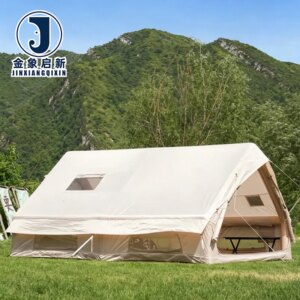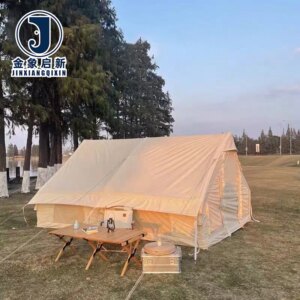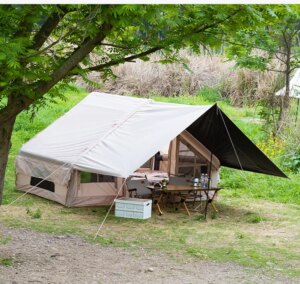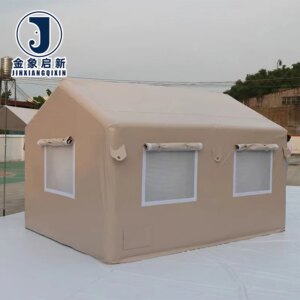
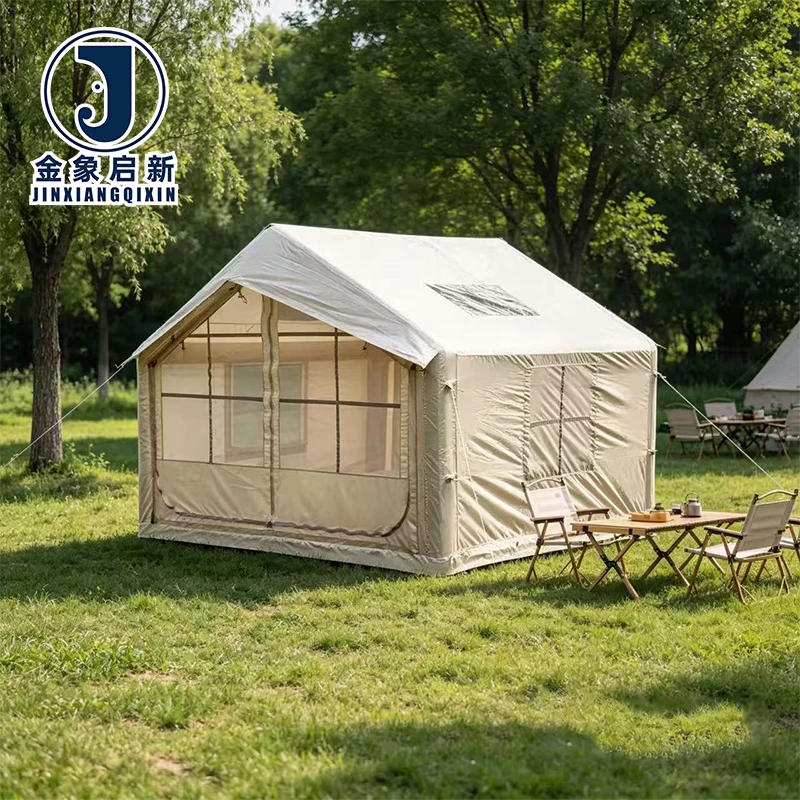
Deep Process Control — Nearly three decades of coating line operation translate into consistent PVC adhesion and verified GSM on every roll of inflatable tent fabric shipped.
Technical Specifications
| Parameter | Value |
|---|---|
| Product Type | Inflatable Tent Fabric |
| Core Material | PVC tarpaulin |
| Construction | Single-layer |
| Coating Method | Knife coated |
| Key Performance | Waterproof, UV-resistant (test basis not stated), tear-resistant, fire-retardant (grade not stated), anti-static (standard not stated) |
| Capacity Reference | 4–6 person inflatable structures |
| Opening Mechanism | Quick automatic opening compatible |
| Season Rating | Four-season deployment |
| Customization | OEM & ODM, sample customization, pattern printing, custom dimensions, material thickness adjustments |
| Certifications | ISO9001, ISO14001, ISO45001, CE |
Application Suitability
| Application | Exposure & Requirement |
|---|---|
| Temporary site shelters | Prolonged sun exposure, wind loading, abrasion from ground contact, rapid deployment cycles |
| Remote construction crew accommodations | Continuous occupancy load, thermal fluctuation, moisture ingress prevention |
| Outdoor event management structures | High foot traffic around anchor points, UV degradation risk, repeated inflation-deflation stress |
| Beach and coastal camping installations | Salt-laden air, sand abrasion, intense solar radiation, wind-driven moisture |
| Industrial project housing | Fire safety compliance at project level, anti-static requirements in specific zones |
What "Fire Retardant" Means Without a Verified Grade Behind It
Inflatable tent fabric must carry a flame-retardant rating matched to the jurisdiction where the structure will be erected — anything less leaves the buyer exposed at inspection.
Technical buyers sourcing PVC coated fabric for inflatable structures regularly encounter quotations that claim fire retardancy without specifying whether the material meets M2, B1, NFPA 701 or another recognised classification. The consequence is not merely administrative. A membrane structure deployed on a mining site or at a public event may fail the fire marshal’s review, forcing removal and replacement at significant project cost. [NEED_CITE: fire classification standards applicable to temporary membrane structures]
This inflatable tent fabric is available in flame-retardant grades — confirm the grade required for your market and request the corresponding batch test report before committing to volume.
Base Fabric and Coating Adhesion in Inflatable Tent Fabric
The structural integrity of any inflatable membrane depends on how effectively the PVC coating bonds to the base polyester fabric. Knife coating applies a controlled layer of PVC compound directly onto the woven substrate, producing a uniform film thickness that supports consistent heat welding behaviour across the roll. When adhesion is weak, delamination begins at the weld line under repeated inflation cycles — the exact point where air pressure concentrates stress. This PVC inflatable tent fabric is produced on dedicated coating lines where coating weight and base fabric tension are monitored throughout the run.
Weld and Seam Behaviour Under Inflation Pressure
Inflatable tents place demands on seams that static structures do not. Every inflation cycle pressurises the welded joints, and any inconsistency in coating thickness or formulation creates a weak point that fails before the field fabric does. Knife coated PVC tarpaulin supports both hot air welding and high frequency welding, giving fabricators flexibility in their production setup. The single-layer construction of this Inflatable Tent Fabric simplifies the welding process because the operator works with a consistent material profile rather than managing multiple bonded layers. [NEED_CITE: tensile and tear test methods for coated fabrics per ISO 1421]
How GSM, Base Denier and Coating Weight Interact
Buyers often specify inflatable tent fabric by GSM alone, but this single number masks the relationship between base fabric density and coating mass. A 650 GSM material built on a low-denier base with heavy coating will tear more easily than a 650 GSM material built on a high-denier base with lighter coating. The base fabric denier and weave density govern tear propagation resistance, while the coating weight determines waterproofing integrity and surface durability. When evaluating Inflatable Tent Fabric for commercial deployment, request a breakdown showing base fabric weight and coating weight separately rather than accepting a combined GSM figure.
The Hidden Cost of Specifying on Price Per Kilogram Alone
Purchasing PVC coated fabric by weight without verifying construction leads to predictable failures. Rolls that arrive lighter than the quoted GSM produce inflatable structures with insufficient rigidity — the membrane sags under its own weight, stress concentrates at anchor points, and the structure requires higher blower pressure to maintain form. Batch-to-batch colour variation across rolls ordered at different times creates visible mismatches when panels are sewn side by side on a large inflatable tent. [NEED_CITE: common failure modes in PVC coated fabric used for inflatable membrane structures]
Weld seam failure represents another consequence of inconsistent coating formulation. When the PVC compound varies between production runs, the welding temperature that produced strong joints on the first batch may produce brittle or incomplete bonds on the next.
Why Source This Inflatable Tent Fabric Here
Three full production lines and 36 sets of professional equipment support bulk roll output with consistent coating parameters maintained across the entire production run.
A 10-person R&D team handles material selection, custom thickness adjustments, pattern printing and sample development — enabling fabricators to validate weld behaviour and colour match before committing to full order quantities.
Dedicated QA and QC inspection at every production stage means coating weight, colour consistency and surface finish are checked continuously, not only at final roll winding.
Samples for custom dimensions and material specifications are developed within days, reducing the lead time between inquiry and fabrication trial.
ISO9001, ISO14001, ISO45001 and CE certifications underpin the quality management system, with documentation packages provided for each shipment.
Documentation & Verification
- Material specification sheet stating GSM, base fabric denier, coating method and coating weight for this inflatable tent fabric
- Batch-specific test reports for UV resistance and flame-retardant grades where applicable to the order
- Pre-shipment inspection record with full QA verification of every roll before dispatch
- ISO9001, ISO14001, ISO45001 and CE certificates included in the shipment documentation package
- Certificate of origin and customs support documentation for international roll shipments
Fabrication, Handling & Storage
- Hot air welding temperature should be calibrated to the knife coated PVC surface before production runs begin
- High frequency welding is compatible with this single-layer PVC tarpaulin for airtight inflatable tube seams
- Store rolls upright on pallets to prevent flat spots and permanent creasing in the coated surface
- Avoid dragging cut panels across abrasive ground surfaces during on-site tent assembly
- Clean with mild detergent only — solvent-based cleaners may degrade the PVC coating formulation
- Allow cold-stored rolls to reach ambient temperature before unrolling to prevent coating crack at low temperature
Requesting a Technical Quotation
Provide the intended deployment environment and any fire safety classification required by the project specification so we can match the correct treatment grade. Specify the roll width, colour reference and annual volume to receive accurate lead time and minimum order information. If your fabrication process requires sample rolls for weld parameter testing, indicate this at inquiry stage so samples are prepared alongside the quotation.
Frequently Asked Questions
Q: How is the GSM of this inflatable tent fabric verified before shipment?
A: Every roll undergoes weight verification against the stated GSM during pre-shipment inspection. The inspection record documents actual measured values per roll and is included in the dispatch documentation package, giving buyers traceable confirmation that the material received matches the specification quoted.
Q: What flame-retardant grades are available and which test standards apply?
A: This PVC inflatable tent fabric is available in flame-retardant grades suited to various market requirements. The specific grade and corresponding test standard — such as M2, B1 or NFPA 701 — must be confirmed at inquiry stage based on the deployment jurisdiction. Batch-specific test reports are provided with each shipment.
Q: How is batch-to-batch colour consistency managed across multiple roll orders?
A: Colour consistency is controlled through in-process QA checks during coating production. When ordering across multiple batches, request the colour reference and any Lab values recorded during the previous production run so the coating line can match within acceptable tolerance for side-by-side panel installation.
Q: What welding methods are compatible with this knife coated PVC fabric?
A: Both hot air welding and high frequency welding are compatible with this single-layer knife coated PVC tarpaulin. Fabricators should run test welds on sample material to establish optimal temperature and speed settings before full production, ensuring seam strength meets the inflation pressure requirements of the finished structure.
Q: What is the minimum order and lead time for custom thickness or colour?
A: Custom dimensions, material thickness adjustments and colour specifications are handled through the OEM and ODM programme. Sample development is completed within days of specification confirmation. Minimum order quantities and lead times depend on the specific customisation requested and are provided with the formal quotation.