
Coating Weight Control — Every roll of PVC inflatable tent fabric we ship is verified against the stated GSM before dispatch, so the waterproof integrity and tear resistance you specify is exactly what arrives on your production floor.
Technical Specifications
| Parameter | Value |
|---|---|
| Product Type | Inflatable Tent |
| Core Material | PVC Tarpaulin |
| Capacity | 2-8 Person |
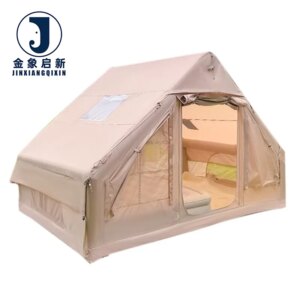
| Design | Four-Season, Quick Automatic Opening, Single Layer Construction |
| Key Features | Waterproof, Windproof, UV-resistant (test basis not stated), Tear-resistant |
| Customization | OEM & ODM — Material Selection, Product Design |
| Quality System | Full-process Inspection with Dedicated QA & QC Staff |
| Standards | ISO 9001, ISO 14001, ISO 45001, CE |
Application Suitability
| Application | Exposure & Requirement |
|---|---|
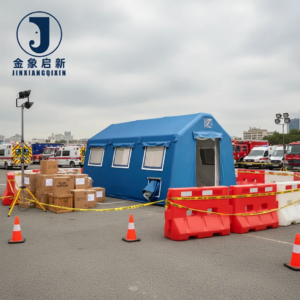
| Emergency relief shelters | Rapid deployment, continuous weather exposure, repeated inflation cycles |
| Temporary storage at construction sites | Abrasive ground contact, dust ingress, wind loading on membrane surfaces |
| Mobile command centers | Interior climate separation, multi-day occupancy, door and window weld points |
| Disaster response operations | Transport vibration, field handling abrasion, wet and muddy terrain contact |
| Industrial logistics shelters | Forklift proximity, UV exposure on static sites, frequent relocation |
Why Tent Fabric Weight Verification Matters More Than the Quotation Says
A quoted GSM only protects you if someone actually checks the roll when it leaves the factory.
Sourcing PVC inflatable tent fabric at volume means managing the gap between what the quotation states and what the cutting table receives. I have seen coated rolls arrive noticeably lighter than the agreed specification, and for inflatable tent structures that rely on air-beam pressure to hold shape, even a marginal coating weight shortfall reduces seam integrity during repeated inflation. The PVC inflatable tent fabric manufacturer you work with should be able to show you the weight check, not just the quote line. [NEED_CITE:]
Coating Adhesion and Inflatable Air-Beam Performance
Inflatable tent structures depend on the bond between the PVC coating and the base fabric to maintain air pressure across welded seams. When adhesion is inconsistent, the coating separates from the weave at flex points — particularly around beam junctions and valve openings where the fabric cycles through repeated stress. Our PVC tarpaulin base is produced with controlled coating weight and verified adhesion so that the material behaves as a single composite layer under inflation pressure, rather than delaminating after a season of field use.
Balancing Durability with Deployment Weight
Emergency relief and disaster response procurement teams face a constant tension between material toughness and transport logistics. A heavier PVC inflatable tent fabric provides more tear resistance on rocky or debris-covered terrain, but adds weight that affects container loading and manual handling in the field. The single layer construction specified here addresses that trade-off by maintaining a coated, waterproof barrier without the dead weight of a secondary lining, suited to rapid deployment scenarios where every kilogram of freight matters. [NEED_CITE:]
How Base Fabric Density and Coating Weight Interact in Tent Membranes
Tear resistance in a PVC tarpaulin inflatable tent is not determined by coating weight alone. The denier of the base yarns and the density of the warp-and-weft weave establish the structural skeleton that resists puncture propagation, while the PVC coating contributes waterproof integrity, UV protection, and the surface characteristics needed for reliable heat-welding. A fabric with high GSM but low thread count may feel heavy yet tear easily along a single yarn line, whereas a tightly woven base with moderate coating weight often outperforms it in real deployment. This is why a material specification sheet must state both the base fabric construction and the total coated weight — one number without the other leaves procurement guessing.
The Real Cost of Batch-to-Batch Inconsistency in Tent Production
When a tent manufacturer cuts and welds multiple units from rolls that vary in colour or coating thickness, the result is visible on the production floor before the products ever reach the field. Panels cut from different rolls show colour shifts when installed side by side, and heat-weld parameters that worked on one roll may produce weak seams on another. For emergency relief contracts where dozens of identical shelters are specified, this kind of inconsistency forces rework and delays. [NEED_CITE:]
Sourcing PVC Inflatable Tent Fabric with Verified Process Control
Our three full production lines and 36 sets of professional equipment support consistent output across bulk orders of PVC inflatable tent fabric, reducing the variability that comes from subcontracted coating runs. The 10-person R&D team handles material selection and sample development so that custom requirements — specific GSM targets, colour matching, or surface finish — are locked in at the sample stage before full production begins. Dedicated QA and QC staff inspect every production stage, with 100% pre-shipment inspection documented before your order leaves the facility. ISO 9001, ISO 14001, ISO 45001, and CE documentation ships with each consignment for your compliance records.
Documentation & Verification
- Material specification sheet stating base fabric, coating type, and GSM for your inflatable tent order
- Batch-level test reports for UV-resistant treatment where applicable, tied to your roll numbers
- ISO 9001, ISO 14001, ISO 45001, and CE certificates included in shipment documentation
- Pre-shipment inspection record confirming weight and visual quality against your purchase order
- Roll packing list with gross and net weights for customs and warehouse receiving
Fabrication, Handling & Storage
- Set heat-weld temperature and dwell time based on the actual PVC coating weight of your received rolls
- Store rolls upright on pallets to prevent flat-spot creases that affect tent panel cutting accuracy
- Avoid dragging single-layer PVC tarpaulin rolls across abrasive surfaces during warehouse handling
- Allow cold-stored rolls to reach ambient temperature before unrolling to prevent coating surface cracking
- Use PVC-compatible adhesive for field repair patches on inflatable air-beam sections
What to Specify When Requesting a Quotation
To match the right PVC tarpaulin grade to your inflatable tent program, share the deployment environment and expected inflation cycle frequency, along with any fire-safety or UV treatment standards your end market requires. Confirm whether you need rolls in a specific width for your cutting layout, or finished OEM panels with custom sizing and branding. Sample approval before production ensures the coating weight, colour, and weld behaviour meet your line requirements.
Frequently Asked Questions
Q: How is GSM verified on arrival and what documentation supports the quoted weight?
A: Every roll undergoes weight verification against the stated GSM during our 100% pre-shipment inspection. A pre-shipment inspection record documenting the actual measured weight ships with your order, allowing your receiving team to cross-check the material specification sheet against the physical rolls before cutting begins.
Q: What test basis supports the UV-resistant claim, and how is outdoor service life estimated?
A: UV-resistant treatment is available as a specified option for this PVC inflatable tent fabric. Where treatment is applied, batch-level test reports are provided upon request. We recommend confirming the UV standard required for your target market and requesting the corresponding documentation with your sample approval.
Q: What OEM and ODM customization options are available for inflatable tent production?
A: Customization covers material selection, product design, sizing, and branding. Our R&D team develops samples based on your specifications — including target GSM, colour references, and surface finish — for your approval before full production. This ensures the PVC tarpaulin supplied matches your cutting and welding requirements.
Q: How do you ensure colour and coating consistency across rolls in a single bulk order?
A: Colour references and coating parameters are locked during sample development and carried through production under in-process QA checks. Rolls within a single order are produced in coordinated batches to minimise variation, and the pre-shipment inspection record documents visual consistency findings across your complete order.
Q: What certifications and compliance documents are included with each shipment?
A: Each shipment includes ISO 9001, ISO 14001, ISO 45001, and CE certificates, a material specification sheet, a pre-shipment inspection record, a roll packing list, and a certificate of origin. Additional documentation such as test reports for specific treatment grades can be included based on your project requirements.