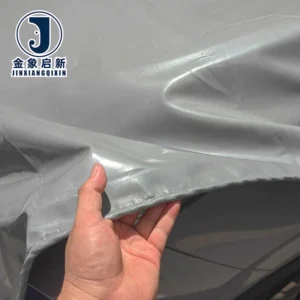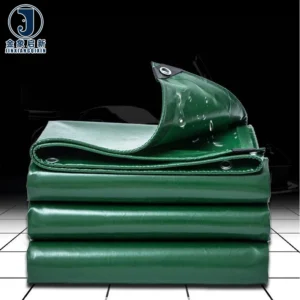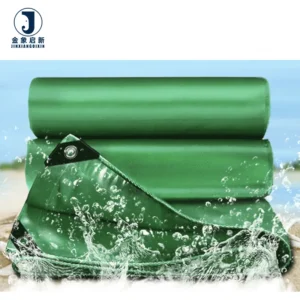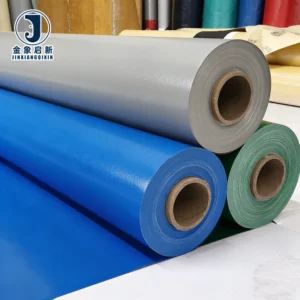
Precision Coating Control — Three dedicated production lines maintain consistent PVC coating weight across every roll, verified by stage-by-stage QA before the material leaves the facility.
Technical Specifications
| Parameter | Value |
|---|---|
| Product Type | PVC Coated Tarpaulin |
| Base Fabric Construction | Warp knitted, woven plain style |
| Coating Material | PVC coated |
| Waterproof Rating | Fully waterproof coated construction |
| Anti-Static | Available in anti-static grades — confirm the standard required for your market |
| Tear Resistance | Tear resistant construction (test standard available on request) |
| Color Options | Customizable colors available |
| Application Grade | Industrial strength / heavy-duty |
| Certifications | ISO, CE |
Application Suitability
| Application | Exposure & Requirement |
|---|---|
| Poultry and broiler farm covers | Continuous moisture, ammonia vapour, wind load on large-span structures |
| Pig and sheep enclosure shelters | Abrasion from livestock contact, rain ingress, static-prone dry environments |
| Agricultural tent and temporary shelter | Field-deployed structures requiring waterproof integrity and dimensional stability |
| Livestock windbreak and perimeter screen | Sustained outdoor UV and weather exposure, mechanical stress from wind flex |
Why the GSM on the Quotation Does Not Match What Arrives
The quoted PVC coated tarpaulin roll weight means little unless the base fabric denier, weave density and coating method are all specified and verified roll by roll.
Buyers comparing quotations often focus on a single GSM number, yet two rolls with the same stated weight can behave very differently in the field. One may carry a heavier base fabric with a thinner coat; another may rely on a thick coating layer over a lighter knit. The difference only becomes visible after the material has been cut, welded and installed — usually when the lighter construction starts to show stress at seam lines or when wind load exceeds what the thinner base fabric can handle [NEED_CITE: relationship between base fabric density and real-world tensile performance in coated fabrics]. A PVC coated tarpaulin base fabric denier coating weight GSM breakdown is the only reliable way to compare two supplier quotations on equal terms.
How Warp Knitted Base Fabric Governs Tear Behaviour
The warp knitted woven plain construction used in this PVC Coated Tarpaulin creates interlocking loop structures that resist tear propagation across both warp and weft directions. When a puncture or cut occurs in the field — common around fastener points and frame contact zones — the knitted loops distribute load to adjacent yarns rather than allowing a straight-line tear. For farm covers spanning several metres between support points, this dimensional stability under tension is the difference between a localised repair and a full panel replacement.
Coating Adhesion and Weld Integrity in Farm Structures
PVC coating applied over a warp knitted substrate must bond fully into the knit structure to deliver reliable heat-weld performance. When fabricators join panels for poultry house curtains or agricultural tent walls, the weld zone is only as strong as the coating-to-fabric adhesion beneath it. Poor adhesion causes the weld to peel under the cyclic loading created by wind gusts on large farm structures [NEED_CITE: coating adhesion strength test methods for PVC coated textiles]. Consistent coating weight across the roll width ensures that weld parameters set on the first panel remain valid through the last.
Reading the Specification Sheet Beyond the GSM Number
GSM alone describes total mass per square metre but reveals nothing about how that mass is distributed between base fabric and coating. A heavier base fabric with higher denier yarns delivers greater tensile strength and puncture resistance, while a greater proportion of PVC coating contributes to waterproof continuity and surface durability. The plain weave style of the warp knitted base provides a balanced yarn interlace that supports uniform coating penetration. For technical buyers evaluating PVC Coated Tarpaulin for agricultural applications, requesting the base fabric denier and coating weight as separate line items on the specification sheet enables an accurate comparison between competing materials. Colour consistency across rolls within a single production run is maintained through controlled pigment dosing and in-line monitoring, which matters when multiple rolls are installed side by side on a single farm structure.
What Happens When Specification Drift Goes Unnoticed
A roll that arrives lighter than the quoted GSM may pass a quick visual check but fails when subjected to the sustained wind loads typical of exposed farm sites. Coating weight shortfalls reduce waterproof reliability at overlap seams where water tracks along the weld line. Batch-to-batch colour variation becomes visible only after installation, when adjacent panels show noticeable shade differences across a large poultry house facade [NEED_CITE: colour consistency standards for coated fabric batches]. Anti-static claims without supporting test data leave buyers uncertain whether the material meets the welfare requirements of livestock environments where dust and static discharge are a documented concern.
Why Technical Buyers Source This Material Here
Nearly 30 years of focused coated fabric production means the coating weight and adhesion process is controlled from yarn selection through to final winding. Three full production lines with 36 sets of professional equipment provide the capacity to fill container-volume roll orders without splitting production across external workshops. A 10-person R&D team handles material specification matching, custom colour development and sample fabrication so that buyers can confirm performance before committing to a production run. Dedicated QA and QC at every stage, with 100 percent inspection before dispatch, ensures that the PVC Coated Tarpaulin rolls shipped match the specification sheet agreed at the quotation stage.
Documentation & Verification
- Material specification sheet stating base fabric denier, coating method and confirmed GSM for each roll
- Pre-shipment inspection record with roll-by-roll GSM spot-check against the quoted value
- Anti-static test report with surface resistance data where the grade is specified
- ISO and CE certificates covering the production facility and coating process
- Colour reference confirmation and batch consistency record for multi-roll orders
Fabrication, Handling & Storage
- Heat-weld temperature and dwell time should be set to suit the PVC coating thickness of this specific roll grade
- Store rolls horizontally on a flat surface to prevent permanent creasing through the warp knitted base fabric
- Allow cold-stored rolls to reach ambient temperature before unrolling to avoid coating crack on the PVC surface
- Use compatible PVC-based adhesive for field repairs on cuts or punctures in the coated fabric
- Plan panel cutting layout to minimise offcut waste given the selected roll width and custom colour batch
What to Include in Your Enquiry
Provide the intended application, structure span and local wind-load conditions so the correct base fabric denier and coating weight can be recommended. Specify any anti-static or fire-retardant requirements along with the test standard your market demands. Confirm the required roll width, colour reference and whether you need full rolls or pre-cut panels with finished edges.
Frequently Asked Questions
Q: How is the final GSM of a PVC coated tarpaulin roll verified before shipment?
A: The total GSM results from the combined mass of the warp knitted base fabric and the PVC coating layers. Every roll undergoes a spot-check weigh against the quoted specification during pre-shipment inspection, and the recorded value is included in the dispatch documentation so buyers can confirm alignment with the agreed material specification sheet.
Q: Does warp knitted base fabric offer better tear resistance than woven alternatives for farm covers?
A: Warp knitted construction creates interlocking loops that redirect tear forces into surrounding yarns, limiting propagation from puncture points. For large-span poultry and livestock covers subject to wind flex, this structure delivers more predictable tear behaviour compared to standard woven base fabrics where tears tend to follow a straight yarn line.
Q: How does PVC coating adhesion affect welded seam durability in agricultural tent panels?
A: Heat-welded seams rely on the PVC coating fusing across the joint. If coating adhesion to the base fabric is weak, the weld peels away under cyclic wind loading rather than the fabric itself failing. Consistent coating weight and full penetration into the warp knitted structure are essential for reliable seam performance.
Q: What test basis confirms the anti-static claim for livestock environment covers?
A: Anti-static performance is confirmed through surface resistance measurement against the relevant standard for the target market. Buyers should specify the required grade at enquiry stage so the appropriate test report can be generated and included with the shipment documentation.
Q: How is colour consistency maintained across multiple rolls in a single order?
A: Pigment dosing is controlled at the coating stage with in-line monitoring to detect shade drift. Rolls from the same production batch are grouped for dispatch, and a colour reference record is maintained so that future reorders can be matched to the original shade within the defined tolerance band.