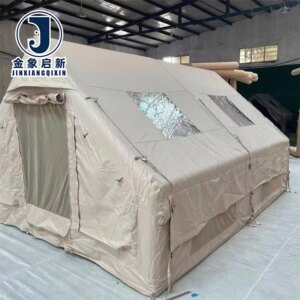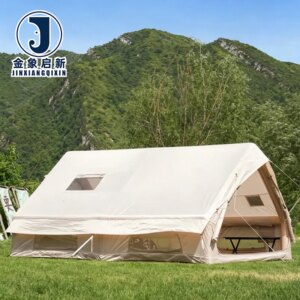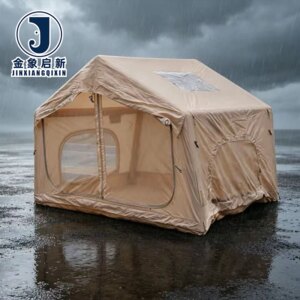
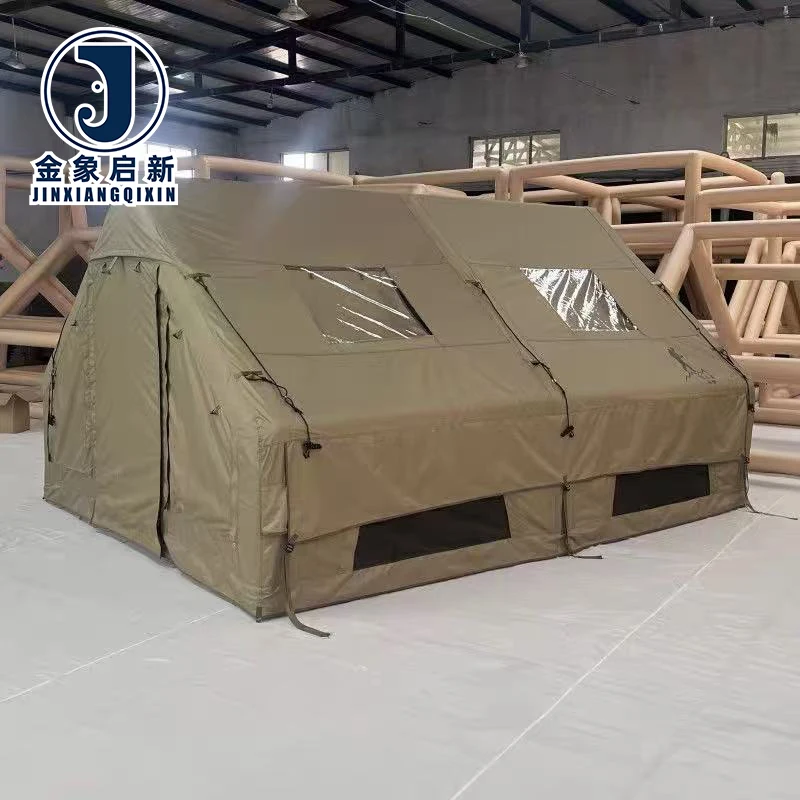
Coating Weight Precision — every roll of inflatable tent fabric is verified against the stated GSM on our coating line before dispatch, eliminating the batch-to-batch thickness variance that causes seam failures in the field.
Technical Specifications
| Parameter | Value |
|---|---|
| Product Type | Inflatable Tent |
| Core Material | PVC Tarpaulin |
| Construction | Single layer inflatable structure |
| Key Performance | Waterproof, tear-resistant, quick automatic opening |
| UV Treatment | Available — test basis not stated, confirm grade required for your market |
| Customization | OEM & ODM, sample customization, pattern printing |
| Certifications | ISO 9001, ISO 14001, ISO 45001, CE |
| Quality Control | Full-process inspection with dedicated QA/QC staff |
Application Suitability
| Application | Exposure & Requirement |
|---|---|
| Temporary site offices at remote construction projects | Wind loading, dust ingress, repeated inflation cycles, UV exposure |
| Equipment storage in disaster recovery zones | Rapid deployment under wet conditions, ground abrasion, puncture risk |
| Mobile command centers for infrastructure maintenance | Frequent relocation, temperature fluctuation, airtight seam integrity |
| Temporary warehousing during logistics operations | Extended inflation periods, solar heat gain, forklift proximity damage |
Why Coating Adhesion Matters More Than Fabric Weight for Inflatable Structures
An inflatable tent holds air only as long as the coating stays bonded to the base fabric under internal pressure.
Technical fabric buyers evaluating inflatable tent fabric coated material often focus on GSM as the primary indicator of durability. Yet in single-layer inflatable structures, the failure point is rarely the base fabric tearing — it is the coating delaminating at the weld line or along high-stress curves where the material stretches under inflation pressure. [NEED_CITE: peel strength test methods for PVC coated fabrics per ISO 2411] A roll that reads the correct weight on the scale can still fail in the field if the coating was applied at insufficient temperature or without proper plasticizer migration control. The result is an inflatable structure that loses pressure within hours, forcing crews to re-inflate or abandon the shelter entirely.
How PVC Coating Formulation Affects Airtight Weld Performance
When manufacturers specify inflatable tent fabric coated material for membrane structures, the coating chemistry determines whether high-frequency welding produces a continuous airtight seal or a porous joint that leaks under pressure. The plasticizer content, the molecular weight of the PVC resin, and the adhesion promoter package all influence how the coating melts and fuses at the weld zone. A formulation optimized for flat tarpaulin applications may not deliver the same weld integrity when the fabric is formed into curved inflatable tubes.
Base Fabric Denier and Its Role in Inflation Cycle Fatigue
Every inflation and deflation cycle flexes the base fabric at the seam junctions and along structural curves. The denier of the yarns and the weave density determine how well the fabric resists this repeated flexing without developing micro-cracks in the coating layer. [NEED_CITE: flex fatigue testing protocols for coated technical textiles] A heavier denier base fabric distributes the inflation load across more yarns, reducing the stress concentration on individual fibers and extending the service interval between replacements.
Understanding GSM in Context with Tensile and Tear Performance
The stated GSM of an inflatable tent fabric coated material reflects the combined weight of the base fabric and the PVC coating, but it does not reveal how that weight is distributed. Two rolls at the same GSM can have entirely different tensile characteristics depending on whether the weight comes from a dense base fabric with a thin coating or a light base fabric with a heavy coating layer. For inflatable structures, the tensile strength in both warp and weft directions must be sufficient to contain the internal inflation pressure without stretching the fabric beyond its elastic recovery limit, and the tear resistance must prevent a small puncture from propagating into a catastrophic failure.
The Hidden Cost of Batch Inconsistency in Coated Fabric Orders
A color shift between rolls is visible; a coating weight shift between rolls is invisible until the structure fails to hold pressure.
Buyers who source inflatable tent fabric coated material from suppliers without in-line coating weight verification often receive rolls within the same order that vary in thickness and coating adhesion. When these rolls are fabricated into inflatable structures, the thinner sections become the weak points — they stretch more under inflation pressure, the welds on those sections require different high-frequency settings, and the finished product shows inconsistent performance across its surface. [NEED_CITE: batch-to-batch coating thickness variation impact on inflatable structure performance] This forces the fabricator to either sort rolls by measured thickness before cutting, adding labor and waste, or accept the risk of field failures that damage their reputation with end users.
Why Fabricators Source Inflatable Tent Fabric Coated Material Here
Our 10-person R&D team develops material samples within days for custom inflatable structure requirements, allowing fabricators to test weld parameters and inflation performance before committing to bulk orders. Three full production lines and 36 sets of professional processing equipment support the volume consistency that inflatable tent manufacturers need when they run continuous fabrication schedules. Dedicated QA and QC staff inspect every roll at each production stage, from base fabric tension through coating weight to final winding, with 100% pre-shipment inspection before dispatch. ISO 9001, ISO 14001, ISO 45001, and CE certifications document our management systems, and we provide the test documentation that technical fabric buyers require for their own compliance submissions. The coating weight and adhesion values are verified per roll, not averaged across a production run, so fabricators receive material that performs consistently from the first roll to the last.
Documentation & Verification
- Material specification sheet stating base fabric denier, coating method, and GSM for each roll
- Test reports for UV treatment with documented testing basis applicable to the target market
- Batch-specific quality inspection reports with dimensional and thickness verification data
- Pre-production samples evaluated for weld compatibility and inflation performance
- ISO 9001, ISO 14001, ISO 45001, and CE certificates for compliance documentation
- Pre-shipment inspection record confirming coating adhesion and weight per roll
Fabrication, Handling & Storage
- Set high-frequency welder power and dwell time based on the specific PVC coating formulation received
- Verify inflation pressure rating against the tensile values on the material specification sheet
- Store rolls upright on pallets to prevent flat spots that affect weld consistency
- Allow cold-stored rolls to reach ambient temperature before unrolling to avoid coating cracking
- Clean PVC surface with mild detergent only — solvent-based cleaners attack the plasticizer in the coating
- Repair minor punctures with PVC-compatible adhesive patches matching the coating chemistry
Before You Request a Quote
Provide the inflation pressure range and cycle frequency your structures will experience in service, along with the target market so we can confirm which UV and fire classifications apply. Specify whether you need rolls at standard widths or custom widths optimized for your cutting pattern to minimize offcuts. Let us know if you require pre-production samples for weld parameter development and inflation testing before the bulk order enters production.
Frequently Asked Questions
Q: How do I verify PVC coating weight and adhesion strength on the rolls I receive?
A: We supply a batch-specific inspection report with measured GSM and peel strength values for each roll. You can independently verify coating weight by cutting a measured sample, weighing it, dissolving the PVC coating in a specified solvent, and re-weighing the base fabric. Adhesion strength is confirmed through a standardized peel test per the method stated on the test report.
Q: What UV treatment test basis applies to this inflatable tent fabric coated material?
A: UV treatment formulations are available, but the specific test basis and exposure rating should be confirmed against the regulatory requirements of your target market. Request the UV test report with documented testing methodology before specifying the treatment grade for your application.
Q: Which base fabric denier should I specify for inflatable structure tensile requirements?
A: The denier selection depends on the inflation pressure, structure size, and wind loading conditions your inflatable tents will face. Our R&D team reviews your engineering requirements and recommends a base fabric denier and weave density that delivers the necessary tensile and tear performance. Samples are provided for inflation cycle testing before bulk commitment.
Q: What high-frequency welding parameters produce airtight seams on this material?
A: Optimal weld power, pressure, and dwell time depend on the specific coating formulation and thickness of the material batch. We provide weld parameter guidelines with each shipment and recommend running test welds on sample pieces before fabricating production structures. Adjustments may be needed when ambient temperature or humidity changes significantly.
Q: How is batch consistency controlled for coating thickness and material properties?
A: Each production run is monitored with in-line thickness measurement and periodic peel strength testing throughout the coating process. Rolls that fall outside the specified tolerance are rejected before winding. The inspection report supplied with your order documents the measured values for every roll in the shipment.