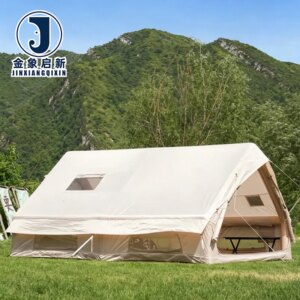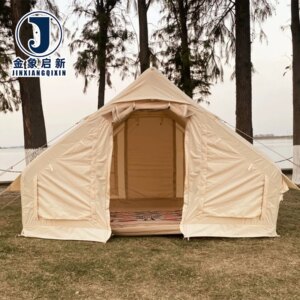
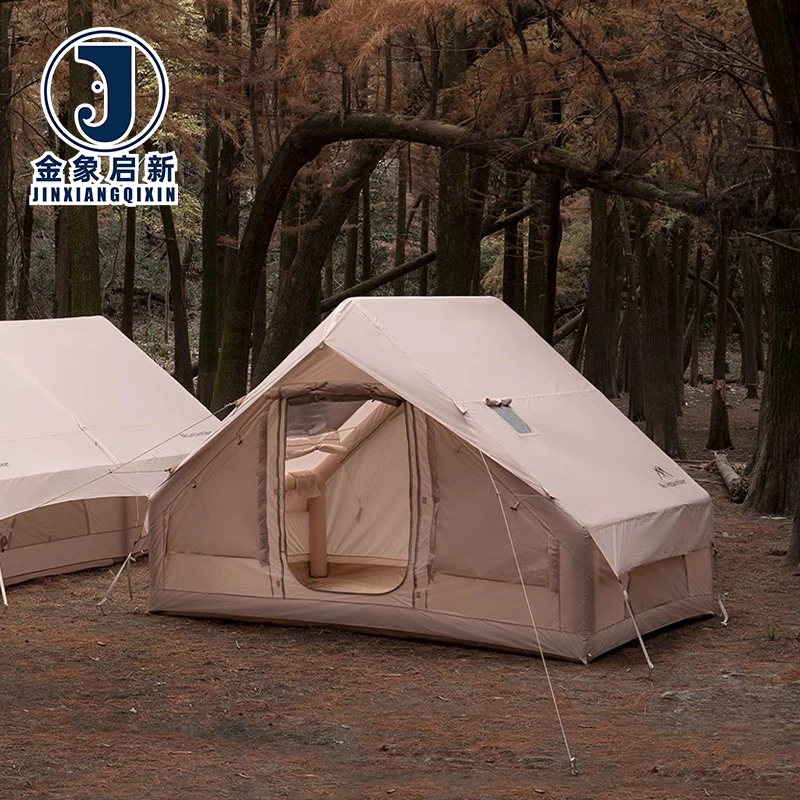
Proven Coating Control — Deep process mastery over PVC coating weight and adhesion ensures every roll of inflatable tent fabric maintains consistent airtight integrity across production batches.
Technical Specifications
| Parameter | Value |
|---|---|
| Product Type | Inflatable Tent |
| Core Material | PVC tarpaulin |
| Water Resistance | Fully waterproof coated construction |
| UV Resistance | UV-resistant formulation (test basis not stated in source) |
| Fire Performance | Fire-retardant treatment available (grade not stated in source) |
| Static Dissipation | Anti-static treatment available (standard not stated in source) |
| Tear Performance | Tear-resistant base fabric construction |
| Capacity Range | 1-12 Person configurations |
| Season Rating | Four-Season deployment |
| Inflation Mechanism | Quick Automatic Opening (Inflatable air-beam compatible) |
| Customization Scope | OEM & ODM (sample customization, pattern printing, material selection, product design) |
| Quality System | ISO9001, ISO14001, ISO45001, CE |
Application Suitability
| Application | Exposure & Requirement |
|---|---|
| Outdoor event facilities | Continuous UV exposure, frequent inflation/deflation cycles, crowd contact abrasion |
| Mobile field stations | Remote deployment, wind loading on inflated structures, temperature fluctuation |
| Temporary workforce accommodations | Extended occupancy, repeated setup cycles, fire safety compliance on industrial sites |
| Emergency response shelters | Rapid deployment under pressure, harsh weather exposure, minimal ground preparation |
What Happens When Inflatable Tent Fabric Lacks Verified Fire Performance
Specifying flame retardancy without a documented grade leaves your structure vulnerable to site rejection at the inspection stage.
Commercial operators deploying inflatable shelters on mining sites, construction zones, or public event venues face strict fire safety audits. When the fabric arrives without a test report matching the local regulatory framework, the entire structure can be barred from use regardless of its other qualities. I have reviewed project delays where the inflatable tent fabric supplier claimed fire-retardant treatment verbally but could not produce a certificate aligned with the site’s required classification [NEED_CITE: fire classification standards for temporary structures in industrial zones]. The cost of replacement material, freight, and lost operational time far exceeds the effort of confirming the grade before production begins. This Inflatable Tent Fabric manufacturer supplies test-backed documentation with every batch, but the specific grade must be confirmed against your destination market’s fire code before quoting.
Coating Adhesion and Air-Holding Reliability
The primary failure mode in inflatable tent structures is not the fabric tearing but the coating delaminating from the base scrim under repeated pressurization cycles. When the PVC layer separates, micro-leaks form along the beam channels, and the structure loses rigidity within hours. This Inflatable Tent Fabric manufacturer controls the coating process across 3 full production lines, maintaining adhesion strength that keeps the air-beam envelope sealed through continuous inflation and deflation. Consistent coating application also ensures that heat-welded seams bond coating-to-coating without trapping air pockets that weaken under load.
Batch Consistency Across Multi-Unit Orders
Event operators and rental fleets purchasing multiple inflatable tents expect uniform colour, gloss level, and stiffness from one unit to the next. Variations between rolls become immediately visible when tents are erected side by side at a festival or trade show. Our production protocol ties each order to a single coating batch wherever volume allows, and every roll undergoes inspection before dispatch to catch shade drift or surface defects [NEED_CITE: colour consistency measurement methods for PVC coated fabrics]. This discipline in roll-to-roll matching is what separates commercial-grade inflatable tent material from generic stock.
Reading the Specifications Beyond Weight Alone
GSM tells you how much material is present per square metre, but it does not reveal how that weight is distributed between the base fabric and the PVC coating. A heavier coating on a lighter scrim may resist abrasion yet tear easily under the lateral stress of an inflated beam bending in wind. Conversely, a dense base scrim with a thin coating offers tensile strength but may develop pinhole leaks at the flex points after a single season. For inflatable tent applications, the balance between scrim denier, weave density, and coating thickness determines whether the air beam holds shape or gradually sags. Available fire-retardant grades also influence coating formulation — confirm the grade required for your market — as certain flame-retardant additives affect surface tackiness and heat-weld parameters. UV-resistant formulation further interacts with the topcoat chemistry, and requesting a test basis ensures the stabiliser package matches your deployment climate. The interplay of these variables is why a material specification sheet listing each component separately is more useful than a single headline number.
The Cost of Overlooking Seam Integrity Data
Welded seams on inflatable tent beams endure concentrated stress every time the structure is pressurized. When the welding temperature or dwell time is not calibrated to the specific coating formulation, the seam becomes the weakest point in the entire air-beam envelope. Operators have reported beam failure at the joint while the field fabric remains intact, forcing a full panel replacement rather than a simple patch [NEED_CITE: tensile testing of welded seams on coated technical textiles]. Requesting pre-shipment inspection records that include weld peel-strength checks prevents this failure class before the rolls leave the factory.
Why Source Inflatable Tent Material Through This Facility
Process control over coating weight and adhesion is maintained through dedicated QA/QC personnel stationed at each stage of the three production lines, not outsourced to a third-party auditor at the end.
The 10-person R&D team develops sample swatches within days, allowing you to verify heat-weld behaviour, colour match, and inflation-cycle endurance before committing to a production run.
Full OEM and ODM capability covers pattern printing, custom roll widths, and material selection, so the inflatable tent fabric arrives ready for your cutting table without secondary conversion.
Pre-shipment inspection covers 100% of rolls with documented checks on coating adhesion, waterproof integrity, and dimensional accuracy against the purchase order.
ISO9001, ISO14001, ISO45001, and CE certification are held at the facility level, providing the compliance framework that institutional buyers and government tenders require.
Documentation & Verification
- Material specification sheet listing PVC coating weight, base fabric denier, and weave count per roll
- Fire-retardant test report citing the specific grade achieved, matched to the batch number shipped
- UV-resistance test documentation stating exposure duration and retained tensile percentage
- Pre-shipment inspection record covering coating adhesion, waterproof verification, and dimensional tolerance
- ISO and CE certificates cross-referenced to the production facility, valid at time of dispatch
- Certificate of origin and customs documentation package prepared for the destination country
Fabrication, Handling & Storage
- Calibrate hot-air welder temperature to the PVC coating formulation before sealing air-beam channels
- Store rolls horizontally on racking to prevent permanent creasing of the coated surface
- Avoid dragging cut panels across abrasive floors to protect the waterproof PVC coating layer
- Allow cold-stored rolls to acclimate to workshop temperature before unrolling to prevent coating crack
- Use mild detergent and soft cloth for cleaning; solvent-based agents may degrade the UV-resistant topcoat
- Plan cutting layout to minimize transverse seams on inflated beam sections where stress concentrates
Request a Specification Recommendation
To accelerate your inquiry, share the deployment environment including typical wind loading, temperature range, and expected inflation duration per cycle. Specify the fire-retardant classification your destination market requires so we can match the coating formulation accordingly. Indicate whether you need rolls at standard widths or custom slit dimensions, along with your annual volume estimate, so the quotation reflects accurate lead times and production scheduling.
Frequently Asked Questions
Q: What fire-retardant grades can be supplied for inflatable tent fabric?
A: Fire-retardant treatment is available, and the specific grade depends on the coating formulation selected for your order. We provide a test report citing the achieved classification with every batch. Confirm the fire code applicable in your destination market — such as B1, M2, or NFPA 701 — so we can align the formulation and documentation before production begins.
Q: How is UV resistance verified for long-term outdoor deployment?
A: UV-resistant formulation is incorporated into the PVC coating to support extended outdoor exposure. The test basis and exposure duration are documented upon request, showing retained tensile strength after accelerated weathering. Share your typical deployment climate and season length so we can recommend the appropriate stabiliser package and supply the matching test data.
Q: Can custom roll widths and pattern printing be accommodated?
A: OEM and ODM services cover custom roll widths, pattern printing, and material selection tailored to your cutting layout. The R&D team prepares sample swatches for your approval before full production runs. Provide your target width, print artwork, and quantity so we can confirm feasibility, sample lead time, and minimum order requirements.
Q: How is colour consistency controlled across multiple rolls?
A: Each production batch is mixed as a single coating run wherever order volume allows, and every roll is inspected before dispatch for shade variation. We supply a pre-shipment inspection record noting the colour reference. For large fleet orders spanning multiple batches, request a retained sample from the first run to serve as the visual benchmark for subsequent deliveries.
Q: What is the typical lead time for custom inflatable tent fabric orders?
A: Lead time depends on the customization scope, including colour matching, width, and any pattern printing required. Sample development typically completes within days once specifications are confirmed. After sample approval, production scheduling follows based on current line loading. Submit your full specification and volume so we can provide a confirmed dispatch date.