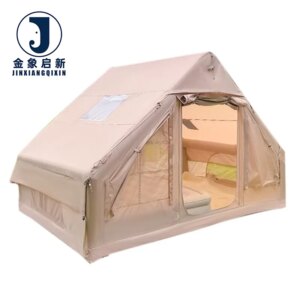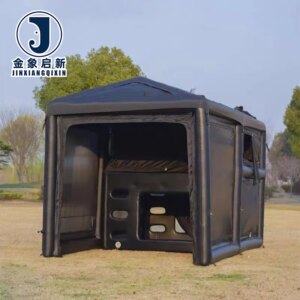
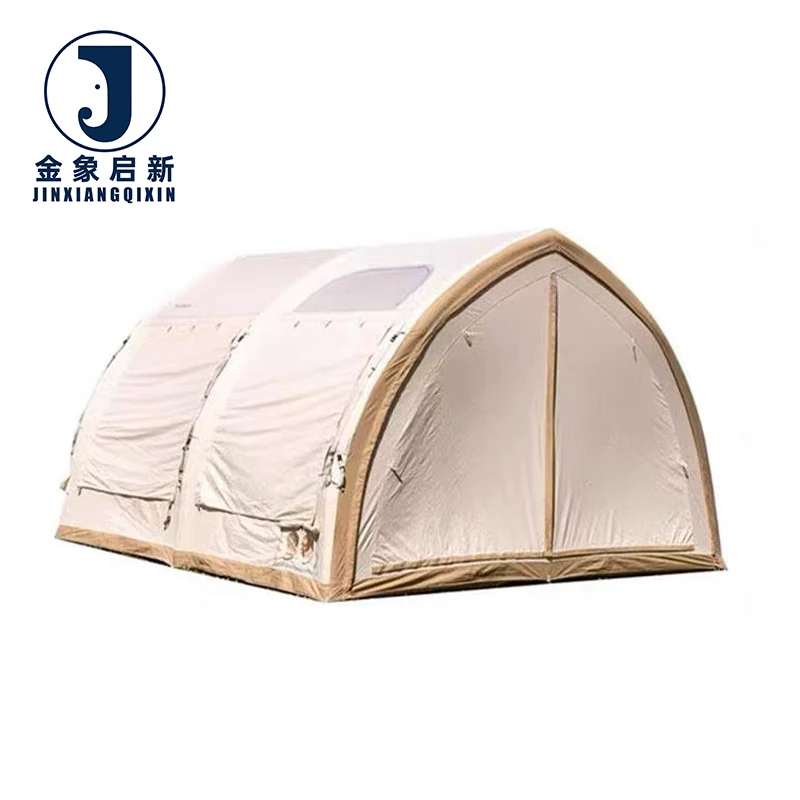
Coated Fabric Process Control — PVC coating adhesion and weight consistency verified at every production stage, ensuring inflatable tent structures hold inflation pressure without seam delamination.
Technical Specifications
| Parameter | Value |
|---|---|
| Product Type | Inflatable Tent |
| Core Material | PVC Tarpaulin |
| Waterproof | Yes, fully coated construction |
| UV Treatment | Available — test basis to be confirmed per grade |
| Tear Resistance | Yes — grade available on request |
| Flame Retardant Grade | Available in flame retardant grades — confirm the grade required for your market |
| Anti-Static | Available — surface resistance standard to be confirmed |
| Product Forms | Single Layer Construction, Extended Type |
| Customization | OEM & ODM, sample customization, pattern printing |
| Quality System | ISO 9001, ISO 14001, ISO 45001, CE |
Application Suitability
| Application | Exposure & Requirement |
|---|---|
| Temporary site shelters for construction | Wind load inflation cycles, abrasion from site debris, UV exposure over extended deployment |
| Mobile storage for logistics operations | Repeated inflation and deflation, forklift contact risk, weather exposure during loading |
| Emergency response stations for disaster recovery | Rapid deployment requirement, all-weather waterproofing, potential fire safety compliance on site |
| Temporary workspace covers for outdoor events | Public safety fire codes, branded surface printing, high foot-traffic abrasion at entry points |
What "Flame Retardant" Means Without a Test Report to Back It Up
A flame retardant claim without a referenced standard is a compliance gap that only surfaces when the site inspector asks for documentation.
PVC Inflatable Tent Fabric is frequently specified with fire-retardant treatment for disaster-relief shelters and mining site deployments, yet the grade behind the claim often remains undefined until the compliance audit. Technical buyers who assume a blanket "flame retardant" label covers their local fire code end up facing rejection at the installation stage, forcing costly replacements under time pressure. [NEED_CITE: fire classification standards for temporary structures vary by jurisdiction] The consequence is not a material failure but a paperwork failure — the fabric may perform adequately, but without a test report matched to the required standard, it cannot be legally deployed on regulated sites.
How Coating Adhesion Governs Weld Integrity Under Inflation Stress
Inflatable tent structures place continuous stress on welded seams every time the air beams pressurize and flex. PVC Inflatable Tent Fabric must maintain coating-to-base-fabric adhesion through thousands of inflation cycles without delamination at the weld line. The coating method and weight directly determine whether a heat-welded joint fails cohesively within the coating layer or adhesively at the coating-to-yarn interface — the latter being the failure mode that compromises structural inflation.
Base Fabric Denier and Weave as the Structural Backbone
The tensile and tear performance of an inflatable shelter depends on the base fabric denier and weave density beneath the PVC coating. A higher denier yarn resists puncture from site debris and equipment contact, while the weave density controls how far a tear propagates once initiated. For single layer construction tents deployed in emergency scenarios, the base fabric carries the entire structural load — the coating provides weather protection, but the yarn system carries the inflation pressure and wind load forces. [NEED_CITE: tensile and tear test methods for coated fabrics per ISO 1421]
Surface Finish and Its Effect on Print Adhesion and Cleaning
Glossy and matte surface finishes on PVC tarpaulin affect both fabrication and field performance differently. A glossy surface supports sharper pattern printing and branding reproduction for event shelters, while also allowing faster wipe-down cleaning in disaster-relief and medical staging environments. A matte finish reduces glare under direct sun and can improve grip during handling and installation. The choice of finish should align with whether the priority is visual branding, ease of sanitation, or installation handling in wet conditions.
Reading the Specification Sheet Beyond GSM
GSM alone tells you the total coated weight per square metre, but it does not distinguish between a heavy coating on a light base fabric and a lighter coating on a dense yarn system. Two PVC Inflatable Tent Fabric rolls at the same GSM can show very different tear resistance depending on how that weight is distributed between yarn and coating. The base fabric denier, the weave count per centimetre, and the coating method — whether knife coated or calendered — together define the mechanical behaviour. Knife coating typically produces higher adhesion strength, which matters for welded seams in inflatable beams, while calendered coating can yield a smoother surface finish at a lower production cost. [NEED_CITE: coating adhesion test methods for PVC tarpaulin] The specification sheet should list all three parameters so that technical buyers can compare materials on engineering merit rather than weight alone.
The Hidden Cost of Specifying on Weight Alone
When PVC Inflatable Tent Fabric is selected purely on GSM without verifying coating adhesion or base fabric density, the consequences emerge at the flex points. Welded seams on inflatable beams peel apart under repeated pressurization because the coating lacked sufficient bond strength to the base yarn, even though the overall weight met the quotation. Colour inconsistency between rolls in the same order becomes visible once panels are welded side by side on a large shelter, forcing selective panel replacement or complete rejection. [NEED_CITE: batch colour consistency standards for coated fabrics] Fire-retardant treatment claimed without a matching test report leads to failed site inspection and project delay, not because the fabric burns, but because compliance documentation was never requested during procurement.
Why Technical Buyers Source This Fabric Here
Deep process control over PVC coating weight and adhesion comes from nearly 30 years focused exclusively on coated fabric, with formulation adjustments made at the production line level rather than outsourced to a compounder. Three full production lines and 36 sets of professional equipment allow bulk roll output to be maintained without sacrificing the coating consistency that inflatable structures demand. The 10-person R&D team develops custom samples within days, enabling fabricators to verify weld parameters and print adhesion before committing to a full order. Every roll undergoes dedicated QA/QC inspection at each production stage with 100% pre-shipment verification, so the material arriving at the fabrication floor matches the approved sample. Batch-specific test documentation ships with every dispatch, closing the compliance gap that causes site rejections.
Documentation & Verification
- Material specification sheet confirming GSM, base fabric denier, weave density and coating weight for each roll
- Flame retardant and anti-static test reports matched to the specific batch and referenced standard
- ISO and CE certificates accompanying shipment documentation for compliance auditing
- Pre-shipment inspection record verifying weight and visual consistency before dispatch
- Roll packing list with individual roll identification for traceability through fabrication
Fabrication, Handling & Storage
- Heat-weld parameters should be calibrated to the specific PVC coating weight and surface finish before production runs begin
- Store rolls upright on pallets to prevent flat-spot creasing that weakens the coating at repeated bend points
- Use compatible PVC adhesive for field repairs on single layer construction panels to maintain coating chemistry match
- Allow cold-stored rolls to reach ambient temperature before unrolling to avoid cracking the PVC coating surface
- Plan panel cutting layout to minimize transverse welds across inflatable beam flex zones where stress concentrates
Requesting a Technical Quotation
To specify PVC Inflatable Tent Fabric accurately, share your target market’s fire safety standard, the intended deployment environment and expected inflation pressure range. Indicate whether you require rolls at standard width or custom slit widths, and whether pattern printing or specific colour matching is part of the project scope. Confirming these parameters upfront allows the sample development stage to address weld compatibility and regulatory compliance before bulk production.
Frequently Asked Questions
Q: How is GSM verified on PVC inflatable tent fabric before shipment?
A: Each roll is weighed and measured against the stated GSM during pre-shipment inspection. The verification record is included in the dispatch documentation, and buyers can recheck by cutting a measured sample from the roll edge on arrival and weighing it on a calibrated scale.
Q: What flame retardant grade applies to this inflatable tent fabric?
A: Flame retardant grades are available, and the specific grade must be confirmed against the fire code required at the deployment site. Request the test report referencing the applicable standard before finalizing the order to ensure compliance documentation is ready for site inspection.
Q: How does coating method affect weld seam behaviour in inflatable structures?
A: Knife coated PVC typically achieves higher adhesion to the base fabric, which helps welded seams resist peeling under inflation pressure cycles. Calendered coating may offer a smoother surface but can show lower peel strength at the weld line, making method selection critical for inflatable beam integrity.
Q: What documentation ships with each batch for compliance auditing?
A: Each batch ships with a material specification sheet, relevant test reports for specified treatments, ISO and CE certificates, a pre-shipment inspection record and a roll packing list. These documents support both procurement auditing and on-site regulatory verification.