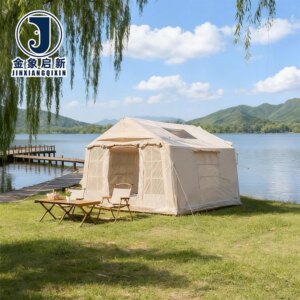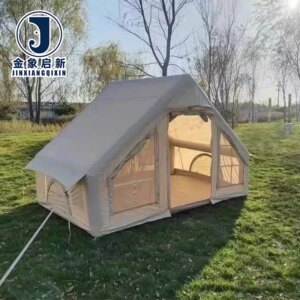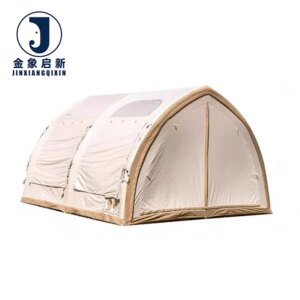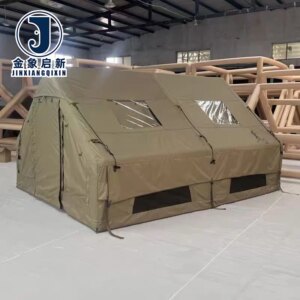
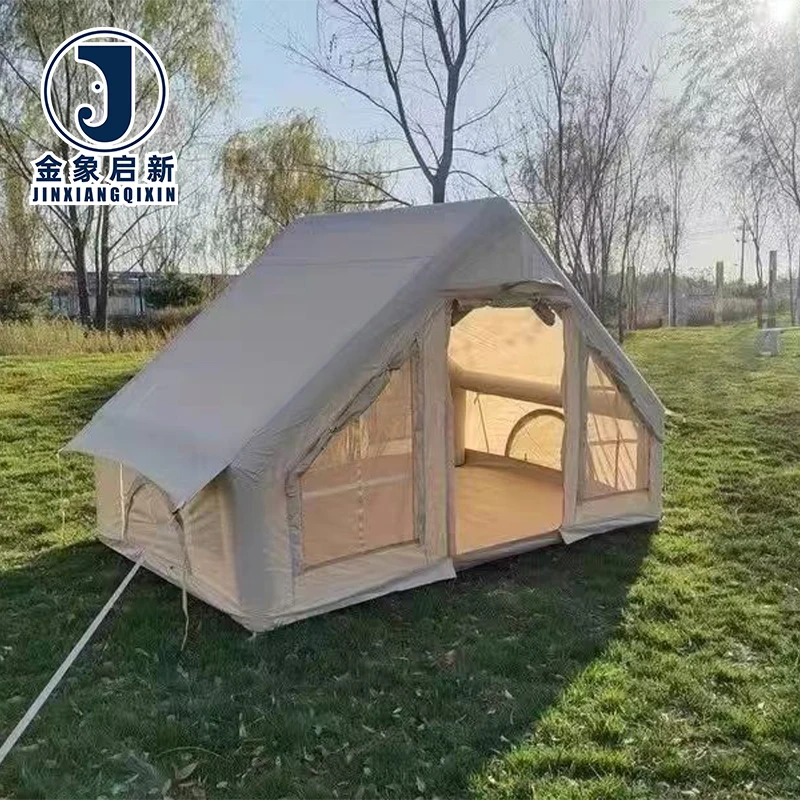
Precision-Coated Inflatable Tent Fabric — nearly three decades of coating adhesion control applied to air-beam and membrane panels, with in-house tensile and weld validation before every roll ships.
Technical Specifications
| Parameter | Value |
|---|---|
| Product Type | Inflatable Tent |
| Core Material | PVC Tarpaulin |
| Waterproof Rating | Waterproof (grade not stated in source) |
| UV Treatment | UV-resistant (test basis not stated in source) |
| Flame Retardant Grade | Fire-retardant (grade not stated in source) |
| Anti-Static | Anti-static (surface resistance or standard not stated in source) |
| Tear Resistance | Tear-resistant (test standard not stated in source) |
| Product Form | Inflatable structure with quick automatic opening mechanism |
| Customization | OEM & ODM: sample customization, pattern printing, material selection, product design, material thickness adjustment, size modification, structural design adaptations |
| Production Facility | 9,180 m² with 3 full production lines and 36 sets of processing equipment |
| R&D Team | 10 technicians |
| Quality Control | Full-process inspection with dedicated QA & QC staff |
| Pre-Production Sample | Available for approval before mass production |
| Standards | ISO9001, ISO14001, ISO45001, CE |
Application Suitability
| Application | Exposure & Requirement |
|---|---|
| Emergency disaster relief inflatable shelters | Rapid automatic deployment, all-season weather resistance, repeated inflation/deflation cycles, UV exposure during extended outdoor staging |
| Industrial site command centers | Remote construction and mining zone deployment, dust and moisture ingress protection, wind load on membrane panels, compliance-driven fire safety environments |
| Mobile workshop facilities | Equipment protection from precipitation, UV degradation of stored materials, structural stability under temperature fluctuation |
| Inflatable membrane structures | Prolonged sun exposure on tensioned surfaces, wind-induced flex fatigue at welded seams, thermal expansion and contraction across membrane panels |
Why "Fire-Retardant" Means Nothing Without a Grade Behind It
Every technical buyer sourcing Inflatable Tent Fabric manufacturer custom PVC coated material eventually faces the same question from the site safety officer: which standard does it pass? A generic fire-retardant claim satisfies no one when the project specification cites a particular classification.
The gap between a material described as fire-retardant and one that passes a documented test at a recognised laboratory is where project delays originate. Inflatable tent fabric operates in environments where welding sparks, generator exhaust, and heating equipment are routine, making verified flame performance a compliance requirement rather than a marketing point. Available in fire-retardant grades — confirm the grade required for your market and request the corresponding test report before committing to volume. [NEED_CITE: fire classification standards for temporary structures and inflatable membranes]
Coating Adhesion Under Repeated Inflation Cycles
Inflatable structures impose a unique mechanical demand on coated fabric: the material flexes with every inflation and deflation cycle, and the coating must maintain adhesion to the base fabric through thousands of these movements. The Inflatable Tent Fabric manufacturer custom PVC coated material supplied here is engineered with coating formulation and weight balanced against base fabric denier to resist delamination at stress concentrations — particularly at the junctions where air-beams meet membrane panels and where welded seams carry structural load.
Heat-Weld Integrity at Structural Junctions
The most common field failure in inflatable tent structures is not the fabric tearing but the welded seam parting under internal air pressure, especially at flex points where the geometry transitions from beam to panel. Seam strength depends on coating composition, welding temperature, dwell time, and the compatibility of the coating with the heat-seal process. Our R&D team of 10 technicians develops weld parameters matched to the specific material thickness and coating formulation ordered, and pre-production samples are welded and tested before mass production is authorised. [NEED_CITE: heat-seal strength testing methods for PVC coated fabrics]
Reading the Specification Sheet Beyond GSM
GSM alone does not determine how inflatable tent fabric will perform in the field. Base fabric denier and weave density govern tensile and tear strength; a lighter base fabric with high denier yarns and tight weave can outperform a heavier fabric with low denier and open construction. Coating weight and method — whether knife-coated, laminated, or calendered — determine peel strength and weld compatibility. For inflatable structures, the coating must bond firmly enough to resist separation under internal pressure yet remain receptive to heat welding at seam lines. UV-resistant and fire-retardant treatments are integrated into the coating formulation, and their effectiveness depends on uniform dispersion and concentration rather than total GSM. Anti-static treatment is similarly a surface property that requires verification against the relevant resistance standard for the deployment environment. Buyers specifying inflatable tent material should request the base fabric construction details alongside the coating weight to understand the full performance profile. [NEED_CITE: tensile and tear test methods for coated fabrics per ISO 1421]
The Hidden Cost of Underspecified Inflatable Fabric
Selecting material based on price per kilogram without verifying coating adhesion and weld compatibility leads to failures that appear only after deployment — seams that part under sustained air pressure, coatings that crack at fold lines during repeated inflation cycles, and membrane panels that become brittle after prolonged sun exposure. For emergency relief and industrial command applications, a shelter failure in the field is not a warranty claim but an operational crisis. Fire-retardant grades claimed without supporting test documentation create compliance exposure when site inspectors request certification. Batch-to-batch inconsistency in coating weight or colour forces fabricators to reject partial rolls mid-production. These costs are invisible at the quotation stage and disproportionate at the project delivery stage. [NEED_CITE: field failure analysis of inflatable membrane structures]
Why Procure Inflatable Tent Fabric Through This Facility
Three full production lines and 36 sets of processing equipment provide the capacity to fulfil roll-stock orders for large inflatable structure projects without splitting production across outsourced facilities. The 10-technician R&D team handles material thickness adjustment, structural design adaptation, and pattern printing within the same workflow — eliminating the coordination gap between fabric supplier and structure designer. Full-process inspection with dedicated QA and QC staff at every stage means coating weight, adhesion, and weld behaviour are verified continuously rather than sampled at the end. Pre-production samples are developed and shipped for buyer approval before mass production begins, ensuring the material matches the specification on arrival. ISO9001, ISO14001, ISO45001, and CE certification accompanies every order, providing the documentation trail required for customs clearance and project compliance. [NEED_CITE: ISO 9001 quality management in coated textile manufacturing]
Documentation & Verification
- Material specification sheet stating base fabric denier, coating weight, and treatment type for each roll
- Test reports for UV-resistant and fire-retardant grades issued against recognised standards on request
- ISO9001, ISO14001, ISO45001, and CE certificates included with dispatch documentation
- Pre-production sample approval record confirming thickness, colour, and weld compatibility before production
- 100% pre-shipment inspection record covering coating weight, seam integrity, and surface condition per roll
- Certificate of origin and customs support documentation for international shipment
Fabrication, Handling & Storage
- Heat-weld parameters matched to the specific PVC coating formulation and thickness ordered for this inflatable tent fabric
- Weld dwell time and temperature adjusted per material batch to prevent coating burn-through or incomplete fusion at air-beam seams
- Rolls stored horizontally on padded racks to prevent permanent creasing that compromises coating adhesion at fold lines
- Cold-weather deployment requires gradual unrolling to avoid low-temperature coating stiffness and crack initiation at weld points
- Clean membrane surfaces with pH-neutral detergent only; solvent-based cleaners degrade the PVC coating plasticiser and UV treatment layer
- Field repairs to minor punctures performed with compatible PVC patch material heat-welded at manufacturer-specified temperature
Specify Your Inflatable Tent Fabric Requirement
To receive an accurate quotation, provide the deployment environment — emergency relief, construction site, or membrane structure — along with expected exposure conditions including wind load, temperature range, and duration of outdoor service. Confirm the fire-retardant and anti-static grades required by your local regulations or project specification. State the required material thickness, membrane panel dimensions, and whether you need roll stock or pre-cut panels with pattern printing. Indicate your annual volume and whether pre-production sample approval is required before committing to full order quantities.
Frequently Asked Questions
Q: How are fire-retardant and anti-static grades verified for inflatable tent fabric?
A: Fire-retardant and anti-static grades are available with test reports issued against recognised standards. Specify the classification required by your market — such as the relevant national or project-specific fire code — and we supply the corresponding test documentation. Anti-static performance is verified by surface resistance measurement. Request sample test reports during the inquiry stage to confirm compliance before ordering.
Q: What base fabric and coating options suit inflatable air-beams versus membrane panels?
A: Air-beam panels require higher tensile strength and coating adhesion to withstand internal air pressure, while membrane panels prioritise flexibility and UV stability. Base fabric denier, weave density, and coating weight are selected accordingly. Our R&D team recommends construction based on your structural design and inflation pressure specification, with pre-production samples provided for validation.
Q: How does PVC coating adhesion perform under repeated inflation and deflation cycles?
A: Coating adhesion is formulated and tested against the flex demands specific to inflatable structures. The coating must resist delamination at weld lines and fold points through repeated pressurisation cycles. Peel strength is verified during production, and heat-weld parameters are calibrated to the coating formulation to ensure seam integrity matches the fabric strength.
Q: What customization is available for inflatable tent fabric specifications?
A: OEM and ODM services cover material thickness adjustment, structural design adaptation, pattern printing, colour matching, and size modification. The 10-technician R&D team develops custom specifications from your structural drawings, and pre-production samples are produced for your approval before mass manufacturing begins. Batch consistency is controlled across all rolls in a single order.
Q: How is colour and coating consistency controlled across rolls for one inflatable structure?
A: Coating weight and colour are monitored at every production stage by dedicated QA and QC staff. Rolls destined for the same inflatable structure are produced within a single batch to ensure uniform colour and coating properties. A 100% pre-shipment inspection verifies consistency, and the inspection record accompanies the dispatch documentation for your verification on receipt.