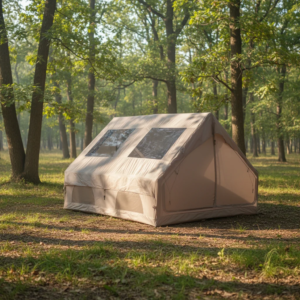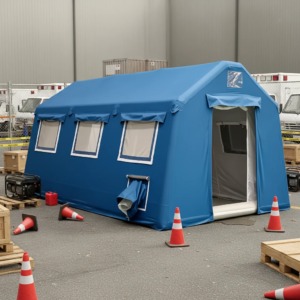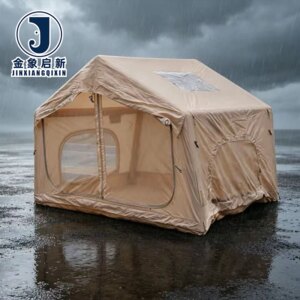

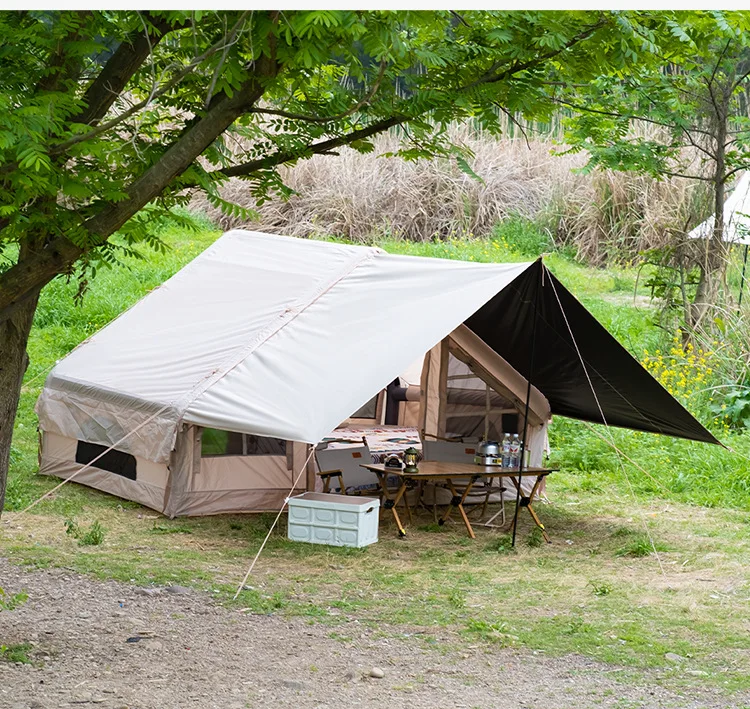
Proven Process Control — Coating weight and adhesion are verified at every production stage with 100% pre-shipment inspection, ensuring each roll of PVC inflatable tent fabric meets the stated specification before dispatch.
Technical Specifications
| Parameter | Value |
|---|---|
| Product Type | Inflatable Tent |
| Core Material | PVC waterproof fabric |
| Key Features | Waterproof, tear-resistant |
| Treatment Options | Flame retardant (grade available upon request), UV-resistant (test basis to be confirmed), anti-static (standard to be confirmed) |
| Customization | OEM & ODM supported; sample customization and pattern printing available |
| Quality System | Full-process QA/QC with dedicated inspection staff |
| Standards | ISO9001, ISO14001, ISO45001, CE |
Application Suitability
| Application | Exposure & Requirement |
|---|---|
| Outdoor gear manufacturing | Repeated inflation cycles, abrasion at ground contact, UV exposure during extended outdoor display and use |
| Construction site temporary shelters | Wind loading on inflated structure, dust and chemical exposure, requirement for fire-retardant compliance on regulated sites |
| Emergency response supply chains | Rapid deployment under adverse weather, need for reliable waterproof barrier and structural integrity during repeated relocation |
| Commercial product line integration | Batch-to-batch colour consistency for branded product ranges, pattern printing adhesion, uniform weld behaviour during fabrication |
What "Flame Retardant" Really Means Without a Certified Grade Behind It
A flame-retardant claim only protects your project if it matches the fire classification your local authority requires.
Buyers sourcing Inflatable Tent Fabric manufacturer options often receive a certificate that references a standard their market does not recognise, or worse, a test result from a different product line entirely. When a mining contractor specifies inflatable shelters for underground ventilation zones, the site safety officer needs documentation showing compliance with the specific regulation enforced at that location — not a generic statement. Fabric that passes one classification may fail another because test methods differ in sample orientation, ignition source and pass criteria [NEED_CITE: fire classification test methods for coated fabrics used in temporary structures]. The consequence is rejected shipment, project delay and potential liability. Confirming the required grade before production begins eliminates this risk.
Coating Adhesion and Its Role in Inflatable Structure Reliability
Inflatable tents place continuous stress on the bond between the PVC coating and the base fabric. Every inflation cycle creates internal pressure that pushes the coating outward, and any weakness in adhesion becomes a delamination point. The coating process must achieve sufficient penetration into the base fabric weave to create a mechanical lock, not merely a surface film.
Our 10-person R&D team develops material specifications matched to the inflation pressure and flex frequency of the end application. When a buyer requires PVC Inflatable Camping Tent custom dimensions, we adjust the coating formulation and application parameters to maintain adhesion integrity across the specified pressure range. This process-level control is what separates fabric that holds through years of inflation cycles from material that begins peeling at the seams during the first season.
Weld Integrity at Structural Stress Points
The seams of an inflatable tent carry the entire structural load. When internal air pressure pushes against a curved surface, the welded joints experience peel forces concentrated along the bond line. Heat-welding parameters — temperature, dwell time and pressure — must be matched precisely to the PVC coating chemistry and thickness [NEED_CITE: heat welding parameters for PVC coated fabric seams].
Fabric that welds cleanly on one production line may scorch or under-bond on another if the coating formulation differs. We supply material specification sheets detailing the recommended weld temperature range and dwell time for each product variant, so fabricators can set their equipment with confidence rather than relying on trial and error that risks structural failure in the field.
Reading Beyond the GSM Number on the Quotation
GSM tells you the weight per square metre, but it does not tell you how that weight is distributed between base fabric and coating. Two rolls with identical GSM can perform very differently if one achieves its weight through heavy coating over a light base fabric, while the other uses a denser base with a thinner coating layer. The base fabric denier and weave density determine tensile and tear strength, while the coating provides waterproofing, UV protection and surface characteristics.
For inflatable tent applications, tear resistance matters because any puncture or cut propagates under internal pressure. A fabric with high GSM but low base-fabric density may resist abrasion well but tear catastrophically once the surface is breached. Specifying both GSM and base fabric construction together gives a complete picture of how the material will behave under the cyclic loading of an inflated structure.
The Cost of Overlooking Batch Consistency in Colour and Weight
When rolls within the same order vary in colour or coating weight, the defect may not be visible until panels from different rolls are installed side by side on the finished product. For manufacturers producing branded inflatable tents, a visible shade difference between panels damages the product’s market perception and triggers customer returns.
Weight variation between rolls means weld parameters that work perfectly on one roll may under-bond or scorch on the next, introducing structural defects that are difficult to detect without destructive testing. Dedicated QA/QC inspection at every production stage, with weight verification per roll against the stated GSM, prevents these inconsistencies from reaching the fabricator’s cutting table [NEED_CITE: batch consistency requirements for coated fabrics in commercial manufacturing].
Why Buyers Source This Material From Our Facility
Three full production lines and 36 sets of professional processing equipment support volume orders without sacrificing the process control that inflatable tent fabric demands.
Our dedicated QA/QC staff conducts 100% pre-shipment inspection, verifying coating weight, colour consistency and surface finish on every roll before it leaves the facility. Samples are developed within days for custom requirements, allowing buyers to validate material performance before committing to bulk production. The R&D team handles material selection, pattern printing development and sample fabrication in-house, keeping the entire specification process under one roof. Nearly 30 years of coated fabric production has built the process knowledge needed to maintain coating adhesion and weld compatibility across large production runs.
Documentation & Verification
- Material specification sheet confirming PVC coating type, base fabric construction and treatment options per roll
- Test reports for flame-retardant, UV-resistant and anti-static properties supplied where applicable to your market requirements
- Weight verification record per roll measured against the stated GSM before dispatch
- Pre-shipment inspection report covering colour consistency, surface finish and coating adhesion checks
- Certificate of origin and customs documentation supporting international shipment clearance
Fabrication, Handling & Storage
- Set heat-weld temperature and dwell time to match the PVC coating formulation specified on the material data sheet
- Store rolls vertically in a climate-controlled environment to prevent permanent creasing of the PVC coating surface
- Allow fabric to acclimatise to workshop temperature before unrolling to avoid thermal shock and surface cracking
- Use compatible PVC adhesive for field repairs on coated surfaces to maintain waterproof continuity at patch edges
- Plan cutting layout to minimise off-cuts, accounting for the usable width after trimming selvedge edges
Preparing Your Specification for Inquiry
Provide your intended application, inflation pressure range and the environmental conditions the finished structure will face. If your market requires a specific fire classification, state the standard and grade needed so we can confirm compliance before sampling. Specify whether you require roll stock for your own fabrication line or finished panels, along with colour references, pattern printing artwork and estimated annual volume.
Frequently Asked Questions
Q: Can you provide a flame-retardant test report that matches my regional fire safety standard?
A: We offer flame-retardant treatment options and can supply test reports aligned to specific standards. Share the fire classification required by your local authority or project specification, and we will confirm which grade applies and provide the corresponding documentation with your shipment.
Q: How do you ensure colour consistency across multiple rolls in a single order?
A: Every production run is monitored with dedicated QA/QC staff comparing each roll against the approved colour reference. We conduct pre-shipment inspection across the entire batch, and rolls that fall outside the accepted tolerance are held back rather than shipped.
Q: What is the sample and approval process before I commit to bulk production?
A: We develop samples within days based on your specification, including material grade, colour and any pattern printing requirements. Once you approve the sample, bulk production follows the same parameters, with in-process QA checks and full pre-shipment inspection before dispatch.
Q: Which GSM and base fabric options suit inflatable tent manufacturing?
A: The appropriate combination depends on your tent’s inflation pressure, panel size and expected service conditions. Our R&D team reviews your application details and recommends a specification that balances weight, tear strength and weld compatibility for your fabrication process.
Q: What documentation ships with each order for compliance audits and customs clearance?
A: Each shipment includes a material specification sheet, batch inspection record, applicable test reports, packing list, certificate of origin and customs support documents. Additional certification can be arranged to meet specific import requirements in your destination market.